
Document Intelligence: From Hidden Enterprise Knowledge to Measurable Business Value
Share this Article on


 TL;DR
- Much of the knowledge behind critical business decisions sits in unstructured documents such as contracts, invoices, claims, loan files and compliance reports, not in ERP or CRM systems.
- Document intelligence goes beyond OCR: it combines machine learning, computer vision, NLP and generative AI to classify, extract, validate and contextualize document content.
- Build the business case on outcomes, not extraction volume: productivity, faster decisions, risk and compliance, and enterprise AI enablement.
- Template-agnostic processing is valuable but not a guarantee of accuracy; pair it with business rules, confidence thresholds, traceability and human review.
- Value comes from architecture: connect document understanding to enterprise data platforms, business systems and governed agentic AI workflows.
- Adopt in five phases, from baseline to reusable capability; scale should follow demonstrated value, not precede it.
Executive Perspective
Enterprises have invested billions in ERP, CRM, data platforms, analytics, and automation. Yet a substantial portion of the knowledge required to make critical business decisions remains buried in contracts, invoices, insurance policies, claims, loan applications, medical records, compliance reports, and email attachments.
These documents are not merely operational records. They contain commercial obligations, customer insights, financial exposure, regulatory evidence, and decision-critical information.
The challenge is no longer simply digitizing documents. It is converting their contents into trusted, governed, and actionable intelligence.
Document Intelligence is emerging as a strategic enterprise capability that connects unstructured information with business processes, enterprise data platforms, and AI-powered decision-making. Its value extends beyond reducing manual effort: it can accelerate revenue-generating decisions, improve operational throughput, strengthen risk controls, and establish the information foundation required for enterprise-scale AI.
For business leaders, the opportunity is clear: treat Document Intelligence not as an isolated automation project, but as a measurable business transformation initiative.
1. The Enterprise Knowledge Gap
Despite advances in enterprise technology, many organizations still depend on employees to locate, read, interpret, validate, and manually transfer information from documents into business systems.
Consider a few everyday examples:
- An insurer must interpret policy wording and supporting evidence before assessing a claim.
- A bank must reconcile information across loan applications, identity documents, financial statements, and credit records.
- A procurement team must compare supplier contracts, purchase orders, invoices, and delivery documentation.
- A compliance function must identify relevant obligations and evidence across large volumes of policies, reports, and correspondence.
These activities consume time, introduce operational variability, and create bottlenecks between information availability and business action.
The underlying problem is structural. Traditional enterprise applications are designed primarily to manage transactions and structured records. Documents, however, contain a mixture of text, tables, images, contextual relationships, exceptions, and business-specific terminology.
Without a reliable way to interpret this information, enterprises face three constraints:
Operational friction: Manual reviews and rework constrain throughput.
Information fragmentation: Important business context remains disconnected from enterprise data.
Decision latency: Employees and systems cannot act until the relevant information has been identified, interpreted, and validated.
Document Intelligence addresses this gap by transforming document content into structured, contextual, and traceable information that business applications and AI systems can use.
2. Beyond OCR: From Reading Documents to Understanding Business Context
Optical Character Recognition (OCR) made document text machine-readable. However, recognizing text is not the same as understanding its meaning, relationships, or business implications.
Modern Document Intelligence combines OCR, machine learning, computer vision, natural language processing, and generative AI to interpret documents across varying layouts and formats.
Depending on the use case, it can classify documents, extract entities, interpret tables, reconcile fields, identify inconsistencies, summarize content, and produce structured outputs for downstream systems.
The distinction is strategic:
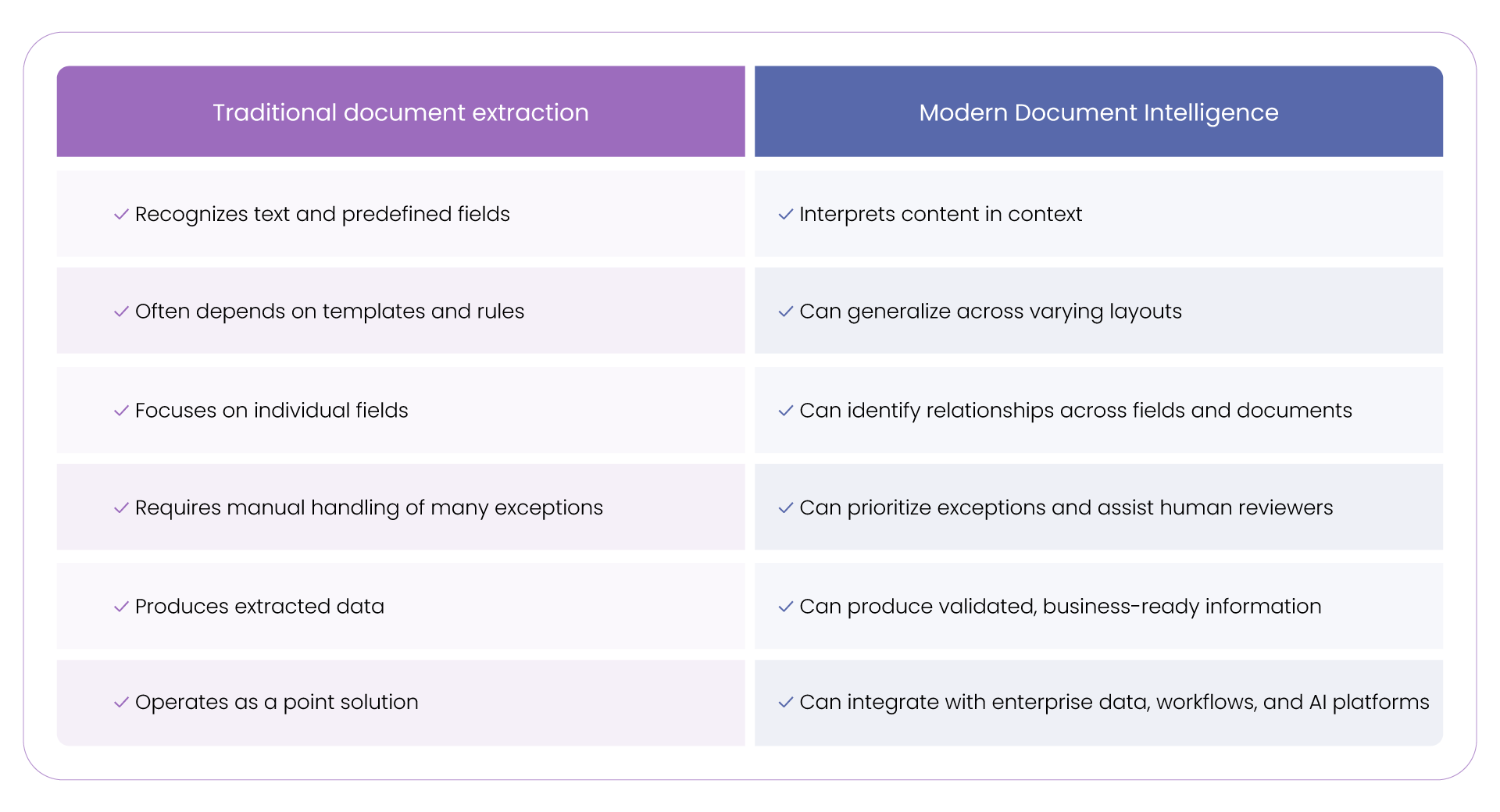
This evolution does not eliminate the need for deterministic rules, validation, or human oversight. Instead, it combines probabilistic AI capabilities with business controls to make document-driven processes more adaptable and scalable.
The result is a shift from document digitization to document-driven intelligence.
3. The Business Case: Measure Outcomes, Not Extraction Volume
The executive business case for Document Intelligence should be built around operational and financial outcomes rather than the number of documents processed or the sophistication of the underlying models.
Four value levers deserve particular attention.
Operational productivity
Automating document classification, extraction, validation, and routing can reduce repetitive manual work and improve processing capacity.
Faster business decisions
Document-intensive processes often delay lending decisions, claims settlements, supplier onboarding, contract approvals, and customer servicing.
Reducing the time between document receipt and an actionable decision can improve service levels and operational responsiveness.
Relevant measures include end-to-end cycle time, time to decision, backlog age, and service-level attainment.
Risk and compliance
Document Intelligence can help identify missing information, inconsistent values, relevant contractual clauses, and potential exceptions.
When combined with traceable evidence and appropriate approval controls, it can improve the consistency and auditability of document-driven decisions.
Relevant measures include exception detection, material error rates, audit findings, policy adherence, and the cost of remediation.
Enterprise AI enablement
Documents can provide the business context that structured databases alone may not capture.
Transforming this information into governed, searchable knowledge can support enterprise copilots, semantic search, knowledge graphs, decision intelligence, and agentic workflows.
Relevant measures include retrieval quality, grounded-answer accuracy, adoption, reduction in information-search time, and business outcomes attributable to AI-enabled workflows.
An illustrative ROI model
Executives should establish a baseline before committing to an investment. The following model illustrates how a business case can be quantified without assuming unverified performance improvements.
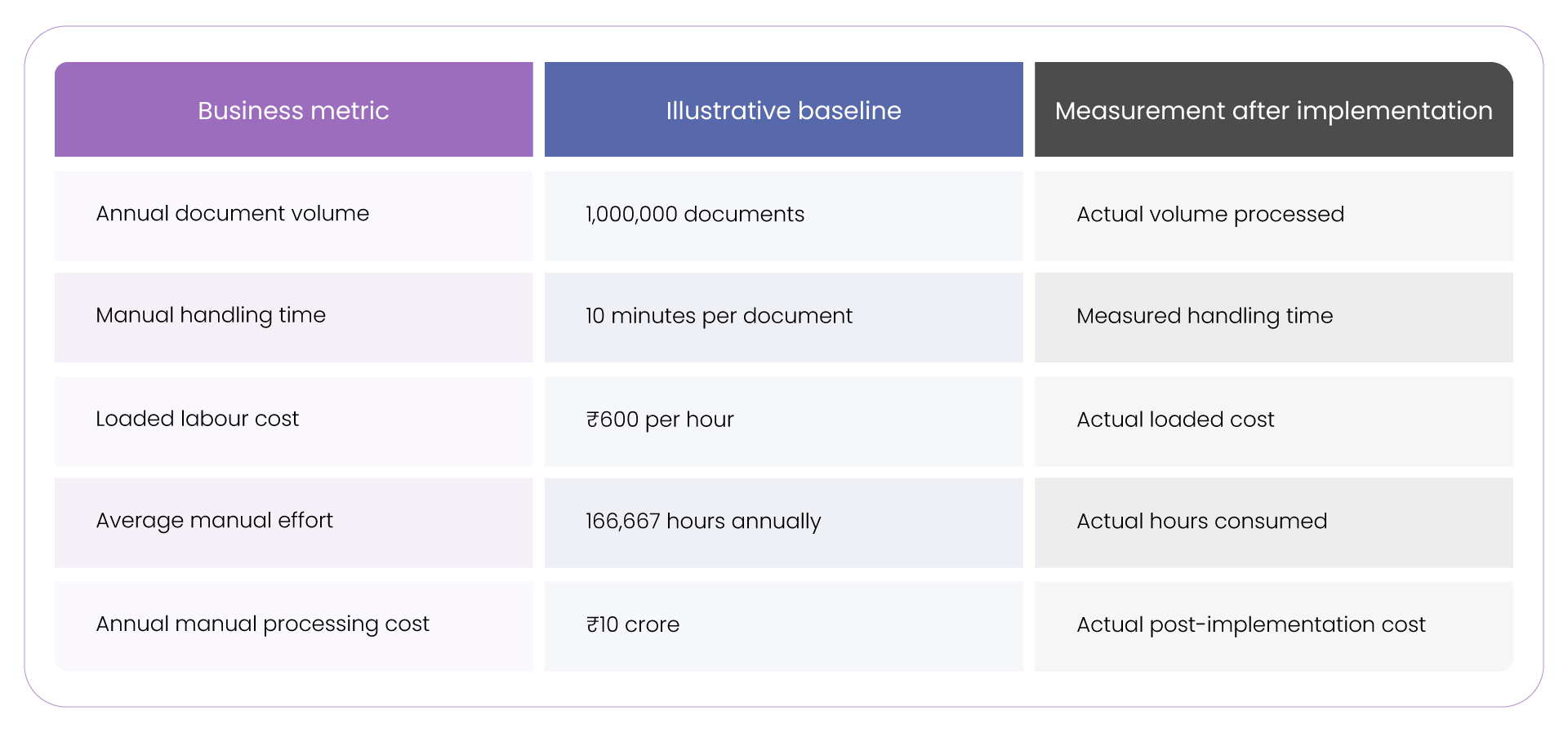
For this example, one million documents at ten minutes of manual effort per document represent approximately 166,667 labor hours. At ₹600 per hour, the theoretical annual labor cost is ₹10 crore.
If an implementation reduces manual effort, the gross labor-capacity benefit can be estimated as:
Annual gross capacity value = Baseline processing cost × Reduction in manual effort
The business case must then account for actual adoption, retained human review, exception handling, technology consumption, implementation costs, ongoing operations, and whether released capacity translates into cash savings, additional throughput, or redeployed employee time.
Net benefit and payback should be calculated from measured results rather than gross theoretical savings alone.
4. Template-Agnostic Processing: An Important Capability, Not a Guarantee
One of the persistent limitations of traditional document-processing solutions is their dependence on predefined templates, field positions, and rules.
When layouts change or previously unseen document types appear, extraction pipelines may require additional configuration and testing.
Generative AI and multimodal models can make processing more adaptable by interpreting document structure and context across a broader range of formats. This can reduce dependence on template-specific logic for suitable use cases.
However, template agnosticism should not be confused with universal accuracy.
Performance can vary with scan quality, handwriting, language, table complexity, domain terminology, document length, and the consequences of an incorrect extraction. Financial amounts, contractual obligations, and regulated decisions may require deterministic validation and human approval.
An enterprise-grade solution should therefore combine:
- OCR and layout analysis where required.
- AI-driven classification and contextual extraction.
- Business rules and cross-document reconciliation.
- Confidence thresholds and exception routing.
- Evidence traceability to the original document.
- Continuous evaluation against representative test data.
The objective is not to eliminate every template or human checkpoint. It is to minimize unnecessary configuration and manual intervention while maintaining measurable quality and control.
5. Industry Opportunities: Start Where Documents Constrain Business Performance
Document Intelligence is a horizontal capability, but its business value is realized through specific industry workflows.
Banking and financial services: Loan origination, KYC, credit assessment, mortgage processing, and regulatory documentation. The business objective is to reduce processing friction while maintaining evidence-based decisions and compliance.
Insurance: Claims intake, policy interpretation, underwriting support, and risk assessment. The opportunity is to accelerate case handling and improve consistency across diverse policy and supporting-document formats.
Healthcare: Clinical-document summarization, prior authorization, medical-record processing, and administrative claims. The focus is faster information access and reduced administrative burden, subject to privacy and clinical safety controls.
Manufacturing and supply chain: Invoice matching, purchase-order processing, supplier onboarding, shipping documentation, and quality certifications. The objective is to improve throughput and reduce delays caused by incomplete or inconsistent documentation.
Legal and compliance: Contract review, clause identification, obligation tracking, and regulatory reporting. The opportunity is to make large document collections more searchable and reviewable while preserving source evidence and professional accountability.
Organizations should prioritize use cases according to document volume, current processing cost, business criticality, error consequences, process stability, and the feasibility of integrating outputs into operational systems.
A high-volume, repetitive workflow with measurable costs is often a better starting point than a broad enterprise-wide document transformation with an unclear business owner.
6. The Architecture: Connect Documents to Enterprise Data and AI
Document Intelligence delivers its greatest value when it becomes part of the enterprise information architecture rather than remaining an isolated extraction service.
A scalable architecture typically includes six capabilities:
- Document ingestion: Securely capture documents from business applications, repositories, email, scanners, and external sources.
- Document understanding: Apply OCR, classification, multimodal AI, extraction, and contextual interpretation.
- Validation and governance: Enforce business rules, confidence thresholds, human review, access controls, and evidence traceability.
- Enterprise knowledge integration: Publish validated outputs into data platforms, searchable indexes, semantic layers, or knowledge graphs as appropriate.
- Business integration: Connect outputs to ERP, CRM, claims systems, lending platforms, workflow engines, and analytics applications.
- Continuous monitoring: Measure quality, processing cost, exceptions, latency, adoption, and realized business value.
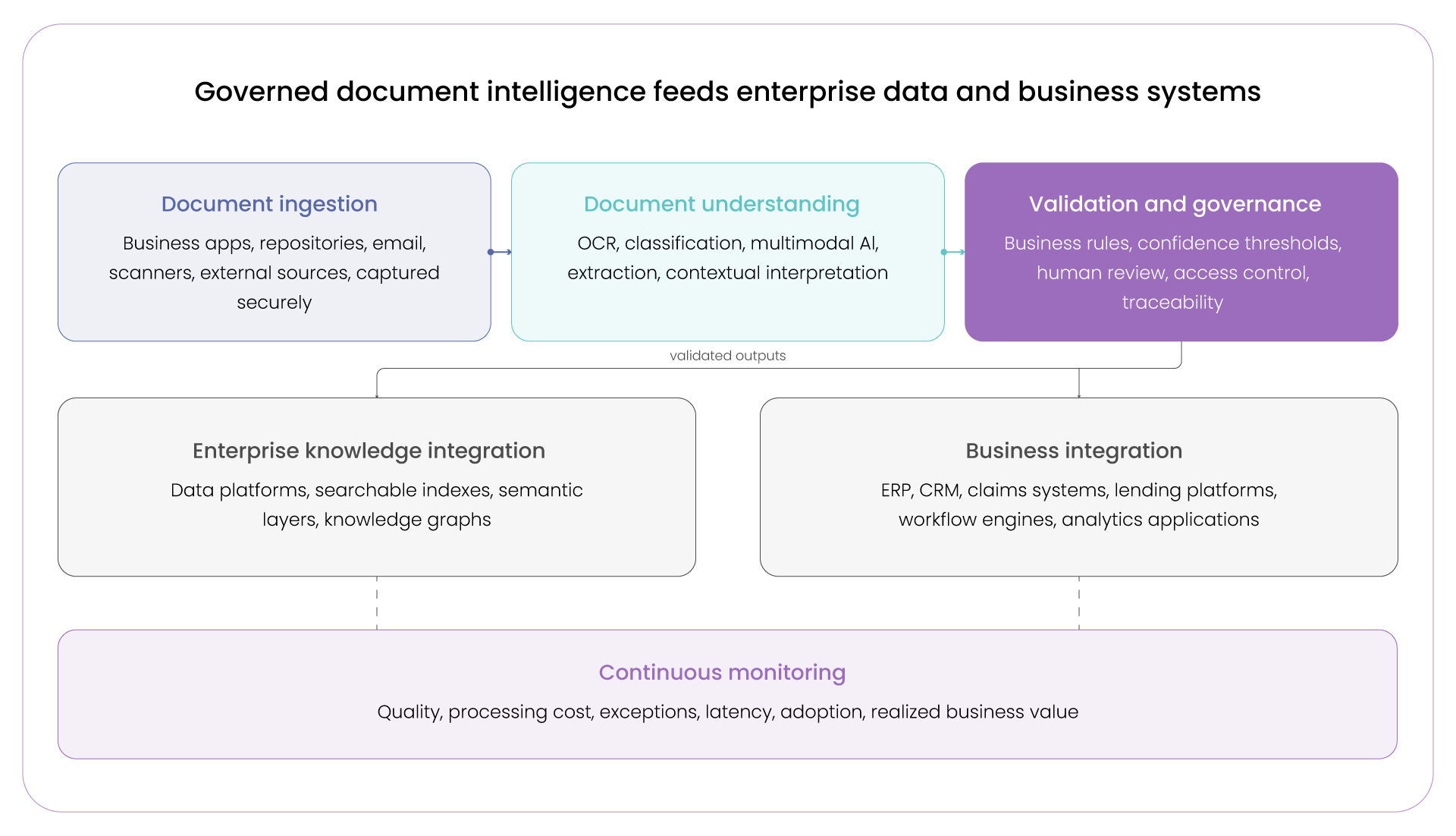
This architecture also creates an important distinction between extraction and intelligence.
Extracting a contract's renewal date is a document-processing task. Determining which contracts require action, evaluating the implications of renewal terms, and recommending an appropriate response require additional business context, rules, and decision logic.
That distinction helps enterprises avoid treating every document use case as merely an OCR or LLM implementation.
7. The Next Frontier: Document Intelligence and Agentic AI
The next stage is the integration of Document Intelligence with AI agents and governed business workflows.
An agentic workflow may receive a document, identify its type, extract relevant information, retrieve supporting enterprise records, validate the information against business rules, and recommend the next step.
For example, an invoice workflow could compare extracted invoice details against a purchase order and goods-receipt record, identify discrepancies, assemble supporting evidence, and route exceptions to the appropriate approver.
The important point is that intelligence and execution are separate capabilities.
Document Intelligence provides the information foundation. Enterprise data and business rules provide context and constraints. Agents coordinate reasoning and workflow steps. Existing systems and authorized controls govern consequential actions.
For high-impact decisions, human approval, audit trails, access controls, and explicit authorization remain essential.
This creates a progression from document extraction to document understanding, decision support, and ultimately controlled document-driven automation.
8. An Executive Roadmap: From Pilot to Enterprise Capability
A disciplined adoption strategy can reduce implementation risk and make value measurable.
Phase 1 — Establish the baseline: Select one or two document-intensive workflows. Quantify volumes, labor costs, turnaround times, error rates, exception rates, and business impact.
Phase 2 — Validate the solution: Test representative documents, including unusual layouts and poor-quality scans. Evaluate field-level accuracy, critical-error rates, processing costs, and human-review requirements.
Phase 3 — Integrate into the business process: Connect validated outputs to the systems where work is performed. Introduce exception handling, access controls, evidence traceability, and monitoring.
Phase 4 — Prove realized value: Compare results with the baseline. Verify changes in total cost, cycle time, throughput, quality, and customer or business outcomes.
Phase 5 — Scale through reusable capabilities: Establish shared ingestion, extraction, evaluation, governance, and integration components that can support additional workflows and business units.
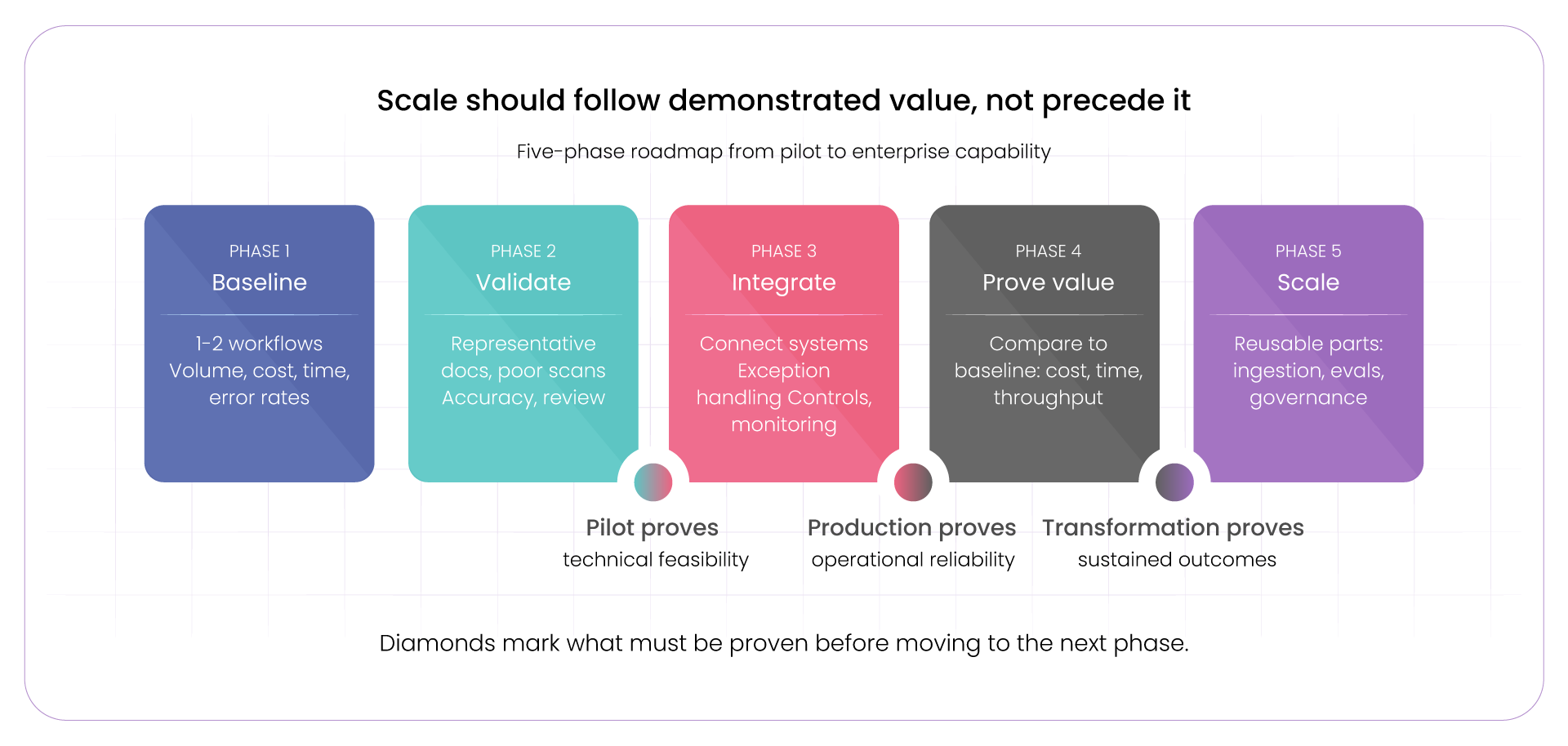
Scale should follow demonstrated value, not precede it. A successful pilot proves technical feasibility; a successful production deployment proves operational reliability; a successful business transformation demonstrates sustained, measurable outcomes.
Conclusion: Turn Document Intelligence into a Business Advantage
Documents contain information that enterprises already own but cannot always use effectively. The strategic opportunity is to make that information accessible, reliable, governed, and actionable across business operations.
Document Intelligence can improve productivity, accelerate decisions, strengthen controls, and provide a critical knowledge foundation for enterprise AI. Its value, however, depends on more than model capability. It requires workflow integration, data governance, measurable business ownership, and a clear link between technical performance and financial outcomes.
The executive question is therefore not simply, How accurately can we extract information from documents?
It is: How much business value can we unlock by turning document-bound knowledge into trusted enterprise intelligence?
Organizations that answer this question with a disciplined, measurable approach will be better positioned to connect their information assets with analytics, automation, and the next generation of AI-powered business operations.
In the age of enterprise AI, documents should no longer be treated merely as records to process. They should be treated as strategic assets from which business value can be created.
Frequently Asked Questions
What is document intelligence?
Document intelligence is an enterprise capability that turns unstructured documents such as contracts, invoices, claims and loan files into structured, contextual and traceable information. It combines OCR, machine learning, computer vision, natural language processing and generative AI so business applications and AI systems can use document content.
How is document intelligence different from OCR?
OCR makes document text machine-readable, but it does not understand meaning, relationships or business implications. Document intelligence interprets content in context, generalizes across varying layouts, links fields across documents, prioritizes exceptions and produces validated, business-ready information that integrates with enterprise workflows.
How do you measure the ROI of document intelligence?
Measure business outcomes, not extraction volume. Establish a baseline of document volume, handling time and loaded labour cost, then estimate gross capacity value as baseline processing cost multiplied by the reduction in manual effort. Net benefit and payback should come from measured results after accounting for human review, exceptions, technology and operating costs.
Can template-agnostic document processing replace human review?
No. Generative AI and multimodal models reduce dependence on templates, but accuracy still varies with scan quality, handwriting, language and table complexity. Financial amounts, contractual obligations and regulated decisions may still need deterministic validation, confidence thresholds, evidence traceability and human approval.
How does document intelligence support agentic AI?
Document intelligence provides the information foundation that AI agents act on. An agentic workflow can classify a document, extract data, retrieve related enterprise records, validate it against business rules and recommend the next step, such as matching an invoice to a purchase order. Human approval, audit trails and access controls still govern high-impact actions.
In This Article
- The Enterprise Knowledge Gap
- Beyond OCR
- The Business Case
- Template-Agnostic Processing
- Industry Opportunities
- The Architecture
- The Next Frontier
- An Executive Roadmap
- Conclusion