
Customer Data Is Everywhere. Is It Helping Your Bank Make Better Customer Decisions?
Share this POV on


 TL;DR
Retail banks already collect vast amounts of customer data across core banking, lending, cards, CRM, and digital channels. The challenge is not acquiring more data, but connecting it to create a unified customer view that supports better decisions. A Customer 360 approach helps banks move from broad segmentation to individualized, next-best-action recommendations by combining customer behavior, engagement, risk, preferences, and life-stage insights. The result is more relevant customer interactions, improved cross-sell and retention outcomes, and measurable business value from existing customer data
A practical view of how connected customer context can support more relevant decisions across retail-banking channels.
Retail banks have no shortage of customer data.
Core banking systems capture accounts and transactions. Cards and lending platforms provide product and credit information. Mobile banking reveals digital behavior. CRM, contact centers, IVR, branches, and campaign platforms add further interactions.
The challenge is that these signals often remain distributed across systems.
As a result, a bank may know a great deal about a customer collectively while an individual channel still sees only part of the customer when deciding what to do next. This fragmented view can contribute to delayed insight, generic outreach, and additional complexity when consent, residency, and model-risk requirements need to be considered.
The opportunity is therefore not simply to collect more data.
From a customer record to customer context
A useful Customer 360 needs to go beyond basic identity and account information.
The opportunity
Connect customer context well enough to make a better decision at the right moment.
The Customer 360 blueprint brings together eight areas of context:
- opportunity
- Identity and household
- Holdings
- Behavior
- Engagement
- Risk and eligibility
- Life stage
- Consent and preferences
- Derived scores
Together, these provide a more complete view of the relationship.
For example, knowing that a customer holds a particular product is useful. But the decision becomes more informed when the bank can also consider recent behavior, engagement history, eligibility, risk, preferences, consent, and propensity.
Customer 360 becomes valuable when the profile improves the next decision.
A complete profile is not the end objective. The objective is more relevant, eligible, and measurable customer action.
Move from segments to individual customer decisions
Traditional segmentation continues to have a role in understanding groups of customers. But customers within the same segment can have different products, behaviors, circumstances, risks, and needs.
- Segment-of-many → Segment-of-one
- Monthly campaign → In-session decision
- Product push → Predicted need
- Copied data → Governed profile
This changes the question from “Which campaign should this customer receive?” to “Given what we know about this customer now, what is the most appropriate action the bank can take next?”
What does that look like in practice?
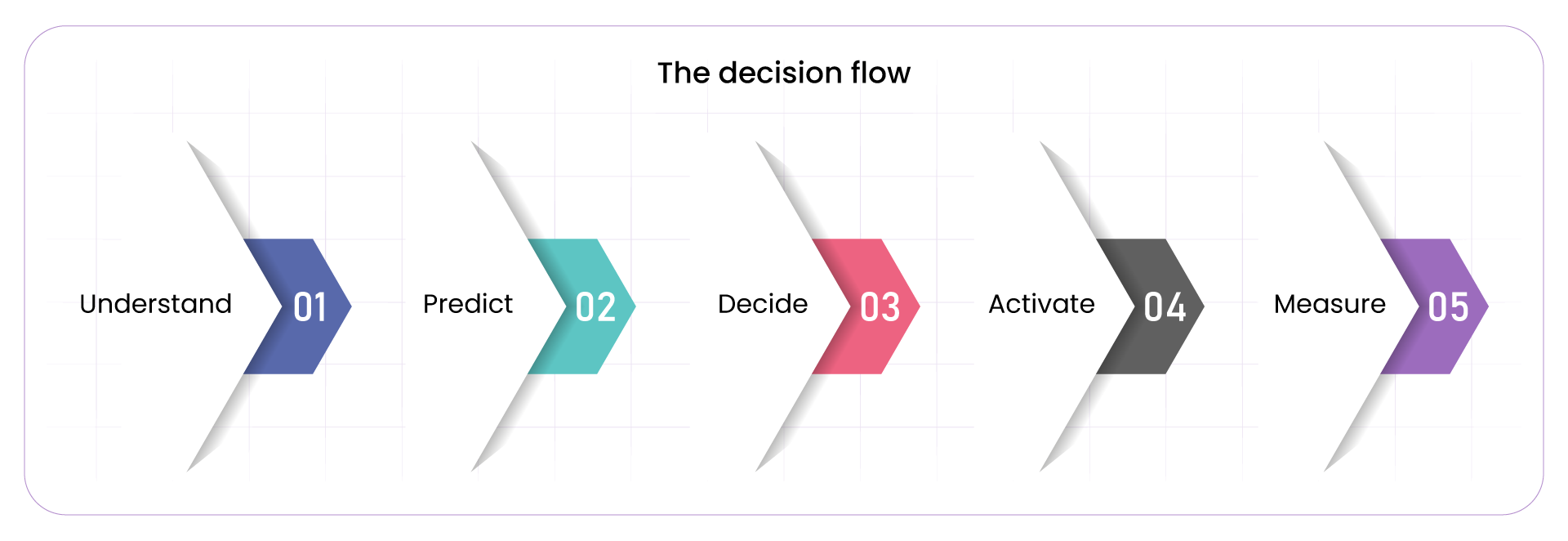
1. Create one profile
Resolve accounts, products, interactions, and consent signals to the appropriate customer and household.
2. Understand and predict the need
Continuously evaluate signals related to churn, delinquency, life-cycle movement, and product propensity.
3. Determine the next-best-action
Rank an action based on the customer context while considering eligibility and compliance requirements.
4. Activate through the appropriate channel
Deliver the action through mobile, web, IVR, contact center, relationship-manager workbench, or branch.
5. Measure what happened
Connect the action to outcomes such as acquisition, cross-sell, retention, and cost to serve.
One customer foundation can support multiple banking priorities
Once the customer context is connected and governed, the same foundation can support different decisions instead of creating a separate data path for every campaign or use case.
Customer insights and profiling
Build continuously refreshed customer profiles across demographics, holdings, channels, and behavior.
RFM segmentation
Identify loyal, high-value, dormant, and at-risk customer segments that marketing teams can act on.
Churn prediction
Use transaction, engagement, and service signals to estimate attrition likelihood before the customer leaves.
Delinquency risk
Estimate the probability of a customer falling behind on a loan or credit obligation.
Life-cycle transition
Identify the likelihood of a customer moving to another relationship or product tier.
Recommendation engine
Support cross-sell and up-sell decisions through collaborative and content-based recommendation methods.
Gap identification
Identify customer groups for which there is no targeted product and understand the white space.
Campaign personalization
Adapt the message, offer, channel, and timing based on the individual customer profile.
The important point is not to implement all eight at once. It is to identify which customer decisions matter most to the bank and which measurable outcomes those decisions need to influence.
What happens when recommendations become more relevant?
The blueprint includes an example from a leading Indian private-sector bank that moved beyond generic recommendations.
Customer, transaction, and channel data were consolidated. Behavioral and financial features were engineered, propensity and next-best-product models were developed, and personalized offers were served to customer channels.
- 25–30% increase in customer engagement
- 20–25% improvement in cross-sell/up-sell conversion
- 15–20% overall revenue boost from targeted recommendations
- Approximately 30% enhancement in customer satisfaction and retention
*These are reported outcomes from that implementation, not performance forecasts for every bank.
What the example demonstrates is the connection between customer context, decisioning, and activation. A recommendation becomes more useful when it reflects the customer rather than simply the product the bank wants to promote.
Start with the decision, not the entire transformation
Customer 360 does not have to begin by attempting to transform every customer journey. A more focused approach is to start with a small number of high-value decisions.
Weeks 1–2: Select and baseline
Choose two priority use cases, assess the required data sources, agree on controls, and establish the current performance baseline.
Weeks 3–6: Build the required Customer 360
Ingest priority data, resolve identity, build reusable features, and establish governance.
Weeks 7–10: Model and decide
Develop and validate models and apply eligibility, consent, and suppression rules.
Weeks 11–12: Activate and prove
Take the next-best-action into a live channel, compare it with the current approach, and measure the agreed KPI.
A practical starting question
Which two customer decisions would the bank improve first with better customer context?
Turn customer understanding into action
The joint approach combines the governed data and AI capabilities of Databricks with Aspire Systems’ retail-banking data models, source integration, feature engineering, model development, MLOps, channel activation, support, and knowledge transfer.
But the technology is ultimately the enabler. The business objective remains straightforward: bring customer context together, understand what matters, make a more relevant decision, activate it, and measure the outcome.
Ready to identify your first two use cases?
Explore the Customer 360 and Hyper-Personalization Blueprint.
In This Article
- From a Customer Record to Customer Context
- What Does That Look Like in Practice?
- One Customer Foundation, Multiple Priorities
- Smarter Recommendations, Better Results
- Start with the Decision, Not the Entire Transformation
- Turn Customer Understanding into Action