
Ungoverned Data Is the Most Expensive Line Item That Isn't on Your Balance Sheet
Share this Article on


 TL;DR
- Ungoverned data is a real but invisible cost. It is spread across payroll, IT, operations, risk and the boardroom, so no executive sees the total.
- AI has made the cost visible. Models and agents act on bad data at machine speed. Projects stall, and breaches tied to shadow AI and weak access controls are rising.
- Databricks, Snowflake and Microsoft Fabric now make governance the control plane for AI. But ownership, master data and cross-platform consistency are still left to you.
- Four moves put ungoverned data on the balance sheet: measure it, start where there is a deadline, build governance into the platform, and report value like any other investment.
- The bottom line: data governance is the cheapest AI investment an enterprise can make, because it recovers money already being lost.
Every enterprise pays for bad data. Almost none of them can say how much. In the age of AI, that blind spot has become a strategic risk.
Ask a CFO for the cost of the company’s data centers and you will have a number by lunch. Ask for the cost of its ungoverned data — the duplicate customer records, the three versions of revenue, the pipelines no one owns — and you will get a shrug.
That shrug is expensive. In Forrester’s 2023 data culture survey, more than a quarter of data and analytics professionals who say poor data quality holds their organization back put the annual loss above US$5 million; 7% put it at US$25 million or more [1]. Yet only 12% of data leaders say their data is ready for AI [2].
The money is real. It is simply spread so thinly across the P&L that no one owns it. My argument is that this can no longer stand. AI has turned a slow, hidden cost into a fast, visible one. The leading data platforms have made governance cheaper than ever. The leaders who put ungoverned data on the balance sheet now will fund their AI ambitions from the savings. Those who don’t will keep paying for both.
A cost hidden in plain sight
Ungoverned data does not show up as one big invoice. It shows up as a thousand small ones, each booked somewhere else:
- In payroll, as analysts who spend their mornings reconciling spreadsheets instead of analyzing them.
- In the IT budget, as duplicate platforms, storage and licenses holding the same customer in five places.
- In operations, as late or broken pipelines that nobody owns and nobody monitors.
- In the boardroom, as decisions taken on whichever revenue figure arrived first.
- In risk and legal, as audit findings, fines and breaches traced back to data no one could locate, classify or lock down.
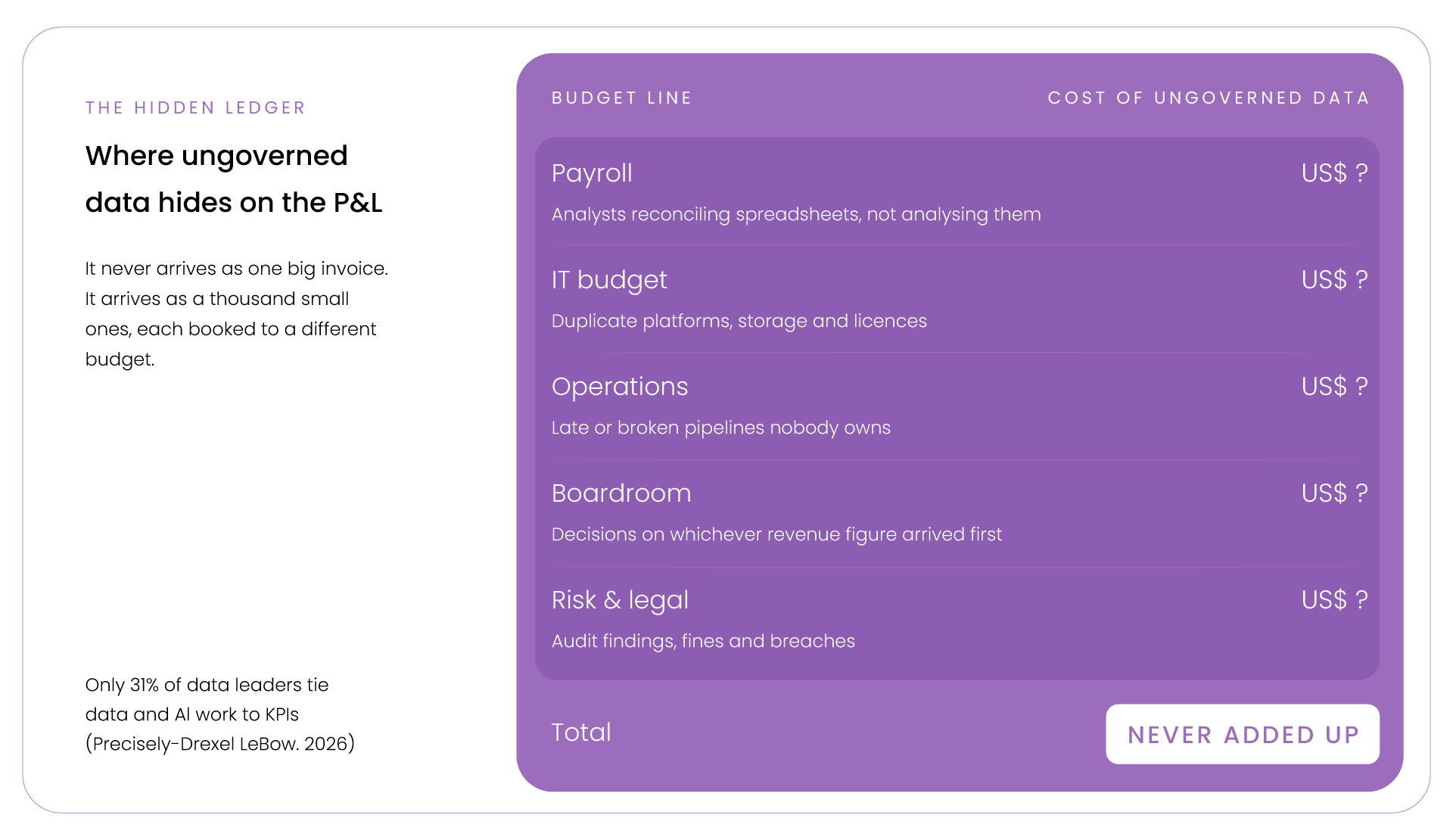
Because each cost belongs to a different budget, no single executive sees the total. And because few organizations measure data quality at all, the total is never added up. In the 2026 Precisely–Drexel LeBow study, only 31% of data leaders tie their data and AI work to actual KPI metrics [3].
The symptoms are getting worse, not better. Between the 2024 and 2025 surveys, the share of data leaders who do not fully trust the data they use for decisions rose from 55% to 67%. The share rating their own data quality average or worse rose from 66% to 77% [2]. Data volumes, sources and consumers are growing faster than manual controls can keep up.
AI has made the invisible cost visible
For two decades, organizations could live with messy data. A human analyst would notice the odd number, query the duplicate and fix the report before it reached the board. AI removes that safety net. A model or an agent will act on whatever data it is given, at machine speed and at scale.
The results are now measurable:
- AI projects stall. MIT’s 2025 GenAI Divide study found that 95% of organizations saw no measurable return from US$30–40 billion of enterprise GenAI spending [4]. Gartner predicts that through 2026, organizations will abandon 60% of AI projects unsupported by AI-ready data [5].
- Breaches cost more. IBM’s 2026 Cost of a Data Breach report puts the global average at a record US$4.99 million, up 12% in a year. Breached organizations reporting shadow AI — tools used without approval — more than doubled to 43%, and 92% of those with an AI-related incident lacked proper AI access controls [6].
- Confidence outruns readiness. In the 2026 Precisely–Drexel study, 88% of leaders said their data was ready for AI, yet 43% named data readiness as their single biggest obstacle [3].
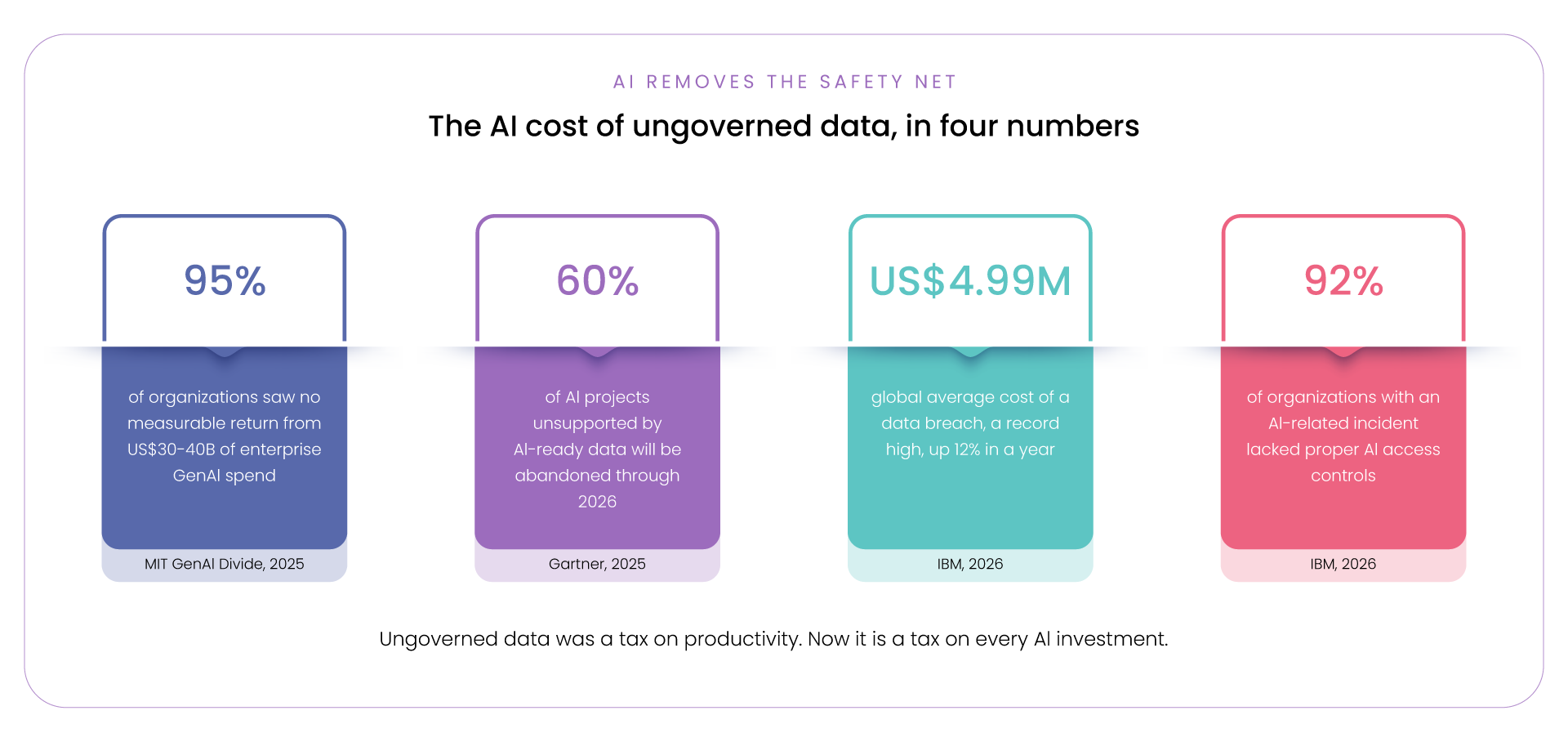
In other words, ungoverned data used to be a tax on productivity. It is now a tax on every AI investment the company makes, and a growing source of security and regulatory exposure.
The platforms have moved. Have you?
The good news is that governance has never been cheaper to do. In 2026, the three platforms most enterprises are standardizing on all made governance the control plane for AI:
- Databricks extended Unity Catalog, used by more than 14,000 organizations, to govern models, agents and tools through a single AI gateway, with attribute-based access control, data classification and lineage to external systems [7].
- Snowflake turned Horizon Catalog into a shared layer of business context, policy and lineage for AI agents. It added verified identities for each agent and opened governance to Apache Iceberg and external engines [8].
- Microsoft Fabric brought OneLake security roles and Microsoft Purview data loss prevention, insider risk and data quality controls to its unified data estate [9].
The economics follow. Forrester’s commissioned Total Economic Impact studies put three-year ROI at 379% for Microsoft Fabric, 354% for Snowflake and 331% for Azure Databricks, each with payback in under six months [10].
But there is a catch worth stating plainly. Those same studies largely leave governance benefits out of the ROI, and the platforms leave three jobs to you:
- Ownership. No catalog appoints an accountable owner for customer data or agrees what “active customer” means. Gartner predicts that 60% of organizations that ignore governance culture will fail to govern AI by 2027 [11].
- Master data. The 2026 announcements center on access, context, and agents. Matching and merging records into one trusted customer, product or supplier view still takes deliberate MDM design.
- Cross-platform consistency. Many enterprises run two or three of these platforms. Keeping one policy, one glossary, and one set of metrics across them remains the customer’s problem.
Buying a modern platform switches on the tools for governance. It does not, by itself, make the data governed.
Putting ungoverned data on the balance sheet
Treating ungoverned data as a real cost changes the conversation from “governance overhead” to “recovered value”. Four moves make that shift.
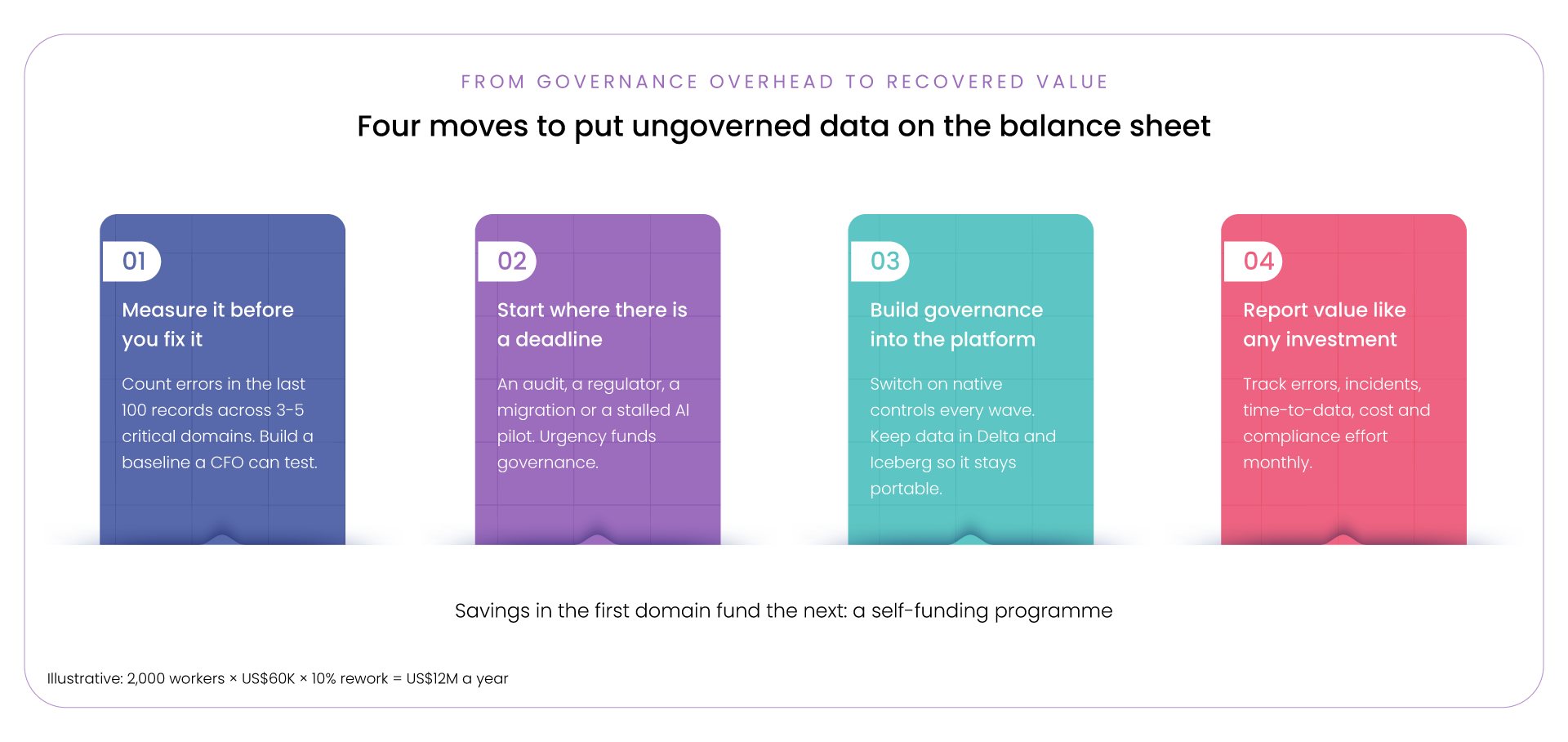
1. Measure it before you fix it. Take the last 100 records created in three to five critical domains and count the errors. Add incident counts, platform run cost, audit effort, and the AI use cases stalled on data. Within weeks you will have a baseline a CFO can test, which is worth more than any industry average.
2. Start where there is a deadline. Gartner predicts that 80% of data and analytics governance initiatives will fail by 2027, chiefly for lack of a real or manufactured crisis [12]. So pick the domain with a date attached: an audit, a regulator, an end-of-support migration, or a stalled AI pilot. Urgency funds governance; abstraction does not.
3. Build governance into the platform, not around it. Every migration or modernization wave should switch on the native controls: tags and classification, fine-grained access, lineage, quality checks and cost guardrails. Keep data in open formats such as Delta and Iceberg so that governance stays portable across Databricks, Snowflake and Fabric.
4. Report value like any other investment. Track error rates, incidents, time-to-data, platform cost and compliance effort monthly. When governance shows savings in its first domain, it funds the next. That is how a cost center becomes a self-funding programme.
The arithmetic is rarely close. For a company with 2,000 knowledge workers at a loaded cost of US$60,000, losing just 10% of their time to data rework costs US$12 million a year. Halving that pays for most governance programmes several times over, before counting a single AI use case unlocked or a breach avoided. These figures are illustrative; your baseline will give you your own.
The cheapest AI investment you will make
Every enterprise is now trying to become AI-first. Most are discovering that the binding constraint is not models or compute. It is whether they can trust, find, and safely use their own data.
That makes data governance the cheapest AI investment a company can make. It recovers money already being lost, lowers the risk that AI creates, and turns a sprawling estate into something models and agents can safely act on.
At Aspire Systems, this is the work we do every day. Our Data, Intelligence and Analytics practice — 15+ years of experience and 300+ specialists, backed by 450+ domain experts — builds governance into Databricks, Snowflake and Microsoft Fabric estates from the first migration wave, and keeps one governance model consistent across all three. Through continuous governance, DataOps and FinOps services, clients have reported 30–40% fewer data incidents, 20–35% lower platform cost and 50% faster data onboarding [13].
The question for every leadership team is simple: if ungoverned data is already your most expensive line item, why is it still not on your balance sheet?
Want to know what ungoverned data is costing your organization? Aspire’s 4–8 week Data & AI assessment measures your baseline and gives you a costed roadmap to recover it.
Sources
1. Forrester. Millions Lost in 2023 Due to Poor Data Quality. July 2024.
2. Precisely & Drexel LeBow. 2025 Outlook: Data Integrity Trends and Insights. September 2024.
3. Precisely & Drexel LeBow. 2026 State of Data Integrity and AI Readiness. January 2026.
4. MIT Project NANDA. The GenAI Divide: State of AI in Business 2025. Summary in Virtualization Review, August 2025.
5. Gartner. “Lack of AI-Ready Data Puts AI Projects at Risk.” February 2025.
6. IBM & Ponemon Institute. Cost of a Data Breach Report 2026. Summary in eSecurity Planet.
7. Databricks. “What’s new with Unity Catalog at Data + AI Summit 2026.” June 2026.
8. Snowflake. “Snowflake Advances Trusted AI with Snowflake Horizon Catalog.” June 2026.
9. Microsoft Fabric Community. “FabCon and SQLCon 2026: What’s new in Microsoft OneLake”; Petri, “Microsoft Fabric Gets New Purview Data Protection and Governance Capabilities.” 2026.
10. Forrester Consulting TEI studies, commissioned by the vendors: Microsoft Fabric (May 2024), Snowflake AI Data Cloud (October 2024), Azure Databricks (July 2026).
11. Gartner. “Gartner Predicts 60% of Organizations That Ignore Data Governance Culture Challenges Will Fail to Govern AI Successfully by 2027.” September 2026. Summary in CDO Magazine.
12. Gartner. “Gartner Predicts 80% of D&A Governance Initiatives Will Fail by 2027.” February 2024.
13. Aspire Systems. Data, Intelligence and Analytics Capability Overview and Data & AI Go-to-Market, 2026. Outcomes as reported by Aspire.
Frequently Asked Questions
1. What is ungoverned data, and why is it so costly?
Ungoverned data is data with no clear owner, definition or controls: duplicate customer records, conflicting revenue figures and unmonitored pipelines. It is costly because the losses are spread across payroll, IT, operations, risk and the boardroom. Forrester found more than a quarter of affected organizations lose over US$5 million a year to poor data quality.
2. Why do AI projects fail without data governance?
AI models and agents act on whatever data they are given, at machine speed and at scale, with no human analyst to catch errors. Without governed, AI-ready data, projects stall. Gartner predicts organizations will abandon 60% of AI projects unsupported by AI-ready data through 2026.
3. How do you measure the cost of poor data quality?
Start with a baseline. Take the last 100 records created in three to five critical domains and count the errors. Then add incident counts, platform run cost, audit effort and the AI use cases stalled on data. Within weeks, this gives a figure a CFO can test.
4. Do Databricks, Snowflake and Microsoft Fabric solve data governance on their own?
No. Databricks Unity Catalog, Snowflake Horizon Catalog and Microsoft Fabric with Purview provide strong governance tools for AI. But three jobs remain with the enterprise: appointing accountable data owners, designing master data management, and keeping one policy, glossary and set of metrics consistent across platforms.
5. What is the ROI of data governance?
Governance recovers money already being lost. For a company with 2,000 knowledge workers at a loaded cost of US$60,000, losing 10% of their time to data rework costs US$12 million a year. Halving that pays for most governance programmes several times over, before counting AI use cases unlocked or breaches avoided.
In This Article
- A cost hidden in plain sight
- AI has made the invisible cost visible
- The platforms have moved. Have you?
- Putting ungoverned data on the balance sheet
- The cheapest AI investment you will make