
 TL;DR
TL;DR
AI in software engineering is transforming how applications are built by automating coding, testing, and deployment processes while enhancing developer productivity and innovation. By leveraging generative AI, intelligent automation, and predictive analytics, organizations can accelerate development cycles, improve code quality, and deliver scalable, high-performance software solutions.
Introduction
The software engineering landscape is undergoing a radical transformation driven by rapid advancements in Artificial Intelligence (AI). From automating repetitive tasks to enabling AI-powered software development, AI is reshaping how developers build, test, and deploy applications. The future of software engineering is being rewritten by generative AI, intelligent automation, and AI-accelerated innovation, leading to unprecedented levels of efficiency and creativity.
As businesses push for faster digital transformation, the role of AI in software engineering has become increasingly strategic. This article explores how AI is revolutionizing the field, the key technologies driving this change, and what the future holds for developers and enterprises.
1. The Rise of AI in Software Engineering
Traditionally, software development has been a labor-intensive process involving manual coding, debugging, testing, and deployment. However, with AI-driven practices, many of these operational tasks are now automated, significantly reducing manual effort and accelerating delivery cycles.
- Automated Code Generation: Tools like Codespell.ai, GitHub Copilot, and Amazon Q Developer use generative AI to suggest contextual code snippets, drastically reducing manual coding time.
JetBrains Marketplace
- Bug Detection & Fixing: AI-powered static code analyzers identify vulnerabilities early and suggest automated fixes prior to deployment.
- Predictive Maintenance: Machine learning models predict system failures by analyzing telemetry data, optimizing software reliability.
These innovations highlight the role of AI in digital transformation, enabling businesses to innovate at an unprecedented pace.
2. AI-Powered Software Development: Enhancing Efficiency & Creativity
Intelligent Automation in Software Development
AI automates repetitive, time-consuming tasks, allowing developers to focus on complex problem-solving and architectural design:
- Automated Testing: AI-driven testing tools (such as Codespell.ai) execute test cases faster and with higher accuracy.
WebCatalog
- DevOps Optimization: AI enhances CI/CD pipelines by predicting deployment failures, proactively resolving performance bottlenecks, and optimizing build workflows.
- Natural Language Processing (NLP): Advanced NLP converts high-level functional requirements into executable code, bridging the gap between business stakeholders and engineering teams.
Generative AI in Software Development
Generative models, such as Codespell.ai, OpenAI’s ChatGPT, and Google’s Gemini, are transforming how software is built:
JetBrains Marketplace
- Real-Time Code Completion: AI engines suggest intelligent code snippets based on surrounding context, improving speed and reducing cognitive load.
- Documentation Automation: AI tools automatically parse codebases to generate clean, readable technical documentation, saving hours of manual effort.
- Prototyping & Design: AI capabilities in tools like Figma accelerate UI/UX workflows by converting visual designs into initial layout code.
These capabilities illustrate how AI is evolving from a simple utility into a true collaborative partner across the development lifecycle.
3. AI-Accelerated Software Innovation: Faster, Smarter Development
The market demand for rapid software delivery and evolving user expectations has made AI-accelerated software innovation a strategic imperative. Organizations adopting AI are realizing measurable returns:
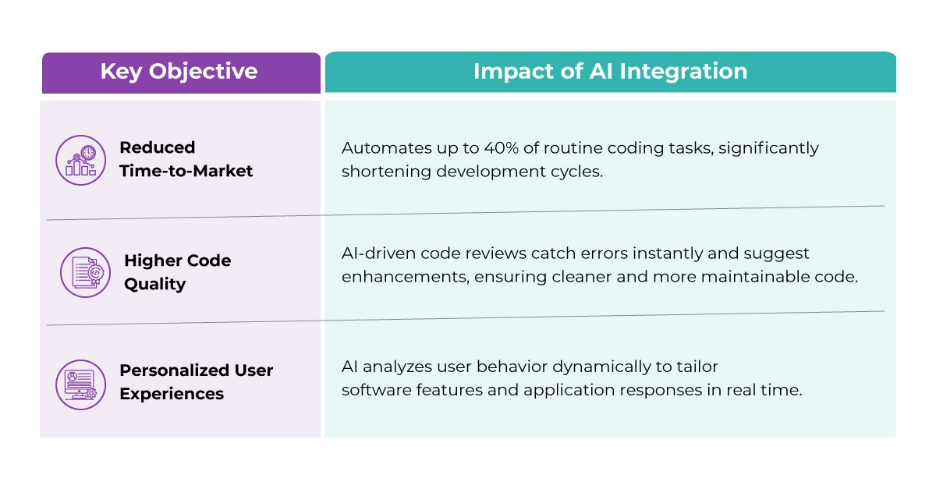
4. The Future of Software Engineering with AI
As foundational AI technology matures, the future of software engineering will witness three major shifts:
- Self-Learning Systems: Autonomous platforms that continuously monitor real-world usage to self-correct bugs and optimize operational performance.
- Low-Code/No-Code Dominance: AI-driven natural language platforms enabling non-technical users to build complex applications without writing manual code.
- Ethical AI Development: Standardized frameworks that embed transparency, bias mitigation, and responsible data privacy directly into AI systems.
Organizations that embrace AI-first development strategies today will lead to the next wave of digital innovation.
5. Challenges & Considerations
Despite its clear advantages, adopting AI in software engineering introduces critical operational considerations:
- Security Risks: AI-generated code may introduce vulnerabilities or compliance issues if not properly audited.
- Skill Gaps: Engineering roles are shifting toward prompt design, code auditing, and system architecture, requiring developers to upskill continuously.
- Model Bias: Ensuring fairness and deterministic accuracy in AI-driven logic remains essential.

Addressing these challenges directly will be key to maximizing the value of AI across enterprise software development.
How AI is Shaping Software Engineering: Insights from Aspire Systems?
Aspire Systems is leading this change by integrating AI into core software development workflows. By automating routine coding tasks and improving software quality, Aspire Systems helps enterprises accelerate delivery timelines without sacrificing reliability.
In DevOps, AI streamlines delivery pipelines and detects deployment issues early. For legacy applications, AI assists in mapping architecture to enable seamless modernization journeys. Additionally, engineering teams embed intelligent capabilities, such as virtual assistants, recommendation engines, and context-aware search, directly into client software products.
Ethical implementation remains central: Aspire Systems designs transparent, accountable, and secure AI solutions. As technology evolves, Aspire Systems remains committed to driving innovation and delivering smarter, faster, and more secure software for tomorrow’s needs.
Conclusion
The future of software engineering is being rewritten by AI-powered software development, generative models, and intelligent automation, enabling businesses to innovate at unprecedented speed. As organizations race to stay ahead in the digital era, partnering with forward-thinking technology leaders like Aspire Systems amplifies the benefits of AI-accelerated innovation.
Aspire Systems helps enterprises integrate AI tools seamlessly across their development lifecycles, empowering businesses to:
- Reduce development cycles and accelerate time-to-market.
- Enhance software quality with AI-powered testing, debugging, and review workflows.
- Drive digital transformation through scalable, intelligent solutions.
The future of software engineering is not just about adopting AI; it is strategically embedding intelligence into every phase of development. With Aspire Systems as a trusted partner, companies can unlock the full potential of AI in digital transformation, ensuring they remain agile, competitive, and prepared for the next wave of technological evolution.

- AFTA: An AI-Powered Test Automation Framework for Enterprise-Scale Quality - October 12, 2026
- Innovation at Speed: How AI is Transforming Software Engineering - September 28, 2026
- Enterprise Application Development: Process, Benefits, Architecture & Best Practices - September 17, 2026
 Write to Us