
 TL;DR
TL;DR
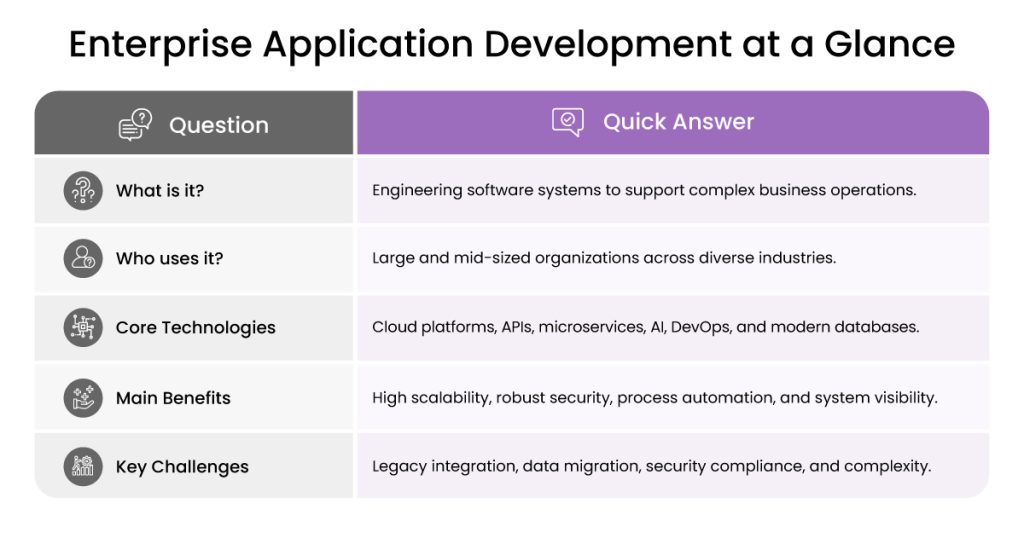
Enterprise application development involves designing, building, integrating, and maintaining software that supports complex business operations in large organizations. Modern enterprise development uses cloud-native architectures, APIs, microservices, DevOps, and AI to construct flexible, secure, and scalable systems.
Enterprise application development helps organizations build scalable, secure, and high-performing software systems for critical business operations. Leveraging cloud-native architectures, AI, and DevOps enables faster innovation, seamless integration, and improved efficiency.
Key Takeaways
- Enterprise apps support mission-critical workflows across departments.
- Scalability, security, integration, and reliability are core requirements.
- Microservices, cloud infrastructure, and APIs enable flexible integration and rapid deployment.
- DevOps and CI/CD streamline delivery, while AI drives intelligent process automation.
- Success requires grounding projects in clear business goals and measurable KPIs.
What Is Enterprise Application Development?
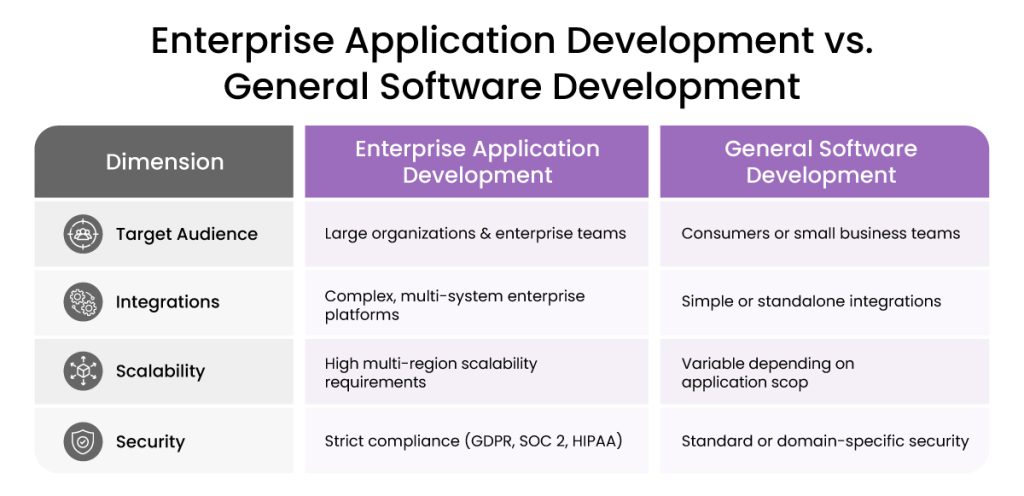
Enterprise application development is the end-to-end engineering of software tailored to complex organizational needs. Consumer apps focus on individual users, whereas enterprise software processes massive data volumes and handles high user traffic across interconnected business units. These platforms integrate deeply with existing IT infrastructure (such as CRM, ERP, and HRMS systems) while prioritizing strict data security and compliance.
Enterprise Trends for 2026
- Autonomous AI Agents: AI agents executing complex multi-step background workflows.
- Platform Engineering: Internal developer portals simplifying cloud infrastructure provisioning.
- Zero-Trust Security: Continuous identity verification embedded in system architectures.
- Composable Architecture: Assembling modular business platforms using API-first capabilities.
- AI Observability & Sustainability: Automated telemetry paired with green coding practices to reduce compute energy consumption.
Types of Enterprise Applications
- ERP (Enterprise Resource Planning): Manages finance, procurement, inventory, and supply chain operations.
- CRM (Customer Relationship Management): Handles sales pipelines, marketing, and customer support.
- HRMS (Human Resource Management): Streamlines payroll, recruiting, and workforce operations.
- SCM (Supply Chain Management): Coordinates logistics, vendor communication, and distribution networks.
- BI (Business Intelligence): Analyzes enterprise data to deliver actionable insights.
- ECM (Enterprise Content Management): Organizes, stores, and distributes digital documents.
Benefits and Challenges
Custom enterprise applications automate manual workflows, boost employee productivity, and unify fragmented software tools. Elastic cloud infrastructure handles heavy traffic surges, while enterprise-grade security controls like role-based access and encryption protect sensitive corporate data.
However, development teams face notable hurdles. The primary challenges include integrating with legacy software, managing data migration risks, navigating technical debt, and controlling long-term costs.
Enterprise Application Architecture
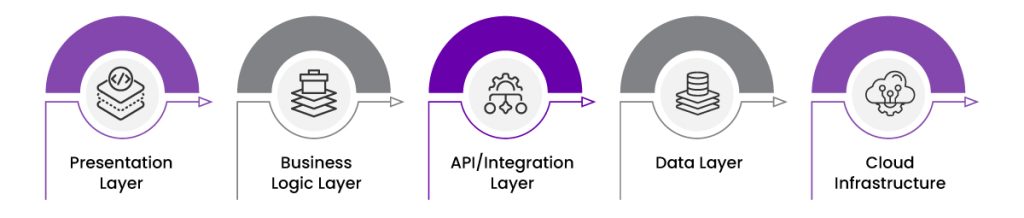
A standard enterprise application architecture is organized into horizontal layers:
- Monolithic: Best for simpler tools; offers simpler initial setup.
- Microservices: Best for large platforms; enables independent module scaling.
- Service-Oriented (SOA): Best for cross-departmental integration; maximizes service reusability.
- Cloud-Native: Best for modern elastic apps; ensures high resilience and auto-scaling.
- Event-Driven: Best for real-time stream processing and low-latency messaging.
The Enterprise Application Development Process
- Requirements & Scope: Establish business objectives and set KPI baselines.
- Architecture & Tech Stack: Select an optimal architecture pattern, databases, and cloud platforms.
- UX/UI Design: Prototype intuitive user journeys to maximize employee adoption.
- Iterative Development: Build modular components in Agile sprints.
- System Integration: Connect the platform with central ERPs, CRMs, and APIs via secure gateways.
- Testing & QA: Perform security audits, load testing, and user acceptance testing (UAT).
- Deployment: Launch via automated CI/CD pipelines.
- Monitoring & Modernization: Track system health using telemetry and maintain application updates over time.
Best Practices, Cloud-Native, and AI Integration
Teams should adopt Agile methodologies and DevOps practices to shorten delivery cycles. Incorporating security early through multi-factor authentication and code analysis prevents vulnerabilities. Decoupling applications into microservices allows high-traffic components to scale independently.
Deploying on cloud-native environments like AWS, Azure, or GCP speeds up feature delivery via CI/CD pipelines while reducing overhead. Furthermore, embedding AI enhances performance. AI coding assistants boost developer output, internal analytics automate business decisions, and Generative AI (RAG models) powers intelligent search and autonomous workplace agents.
Build vs. Buy Decision Matrix
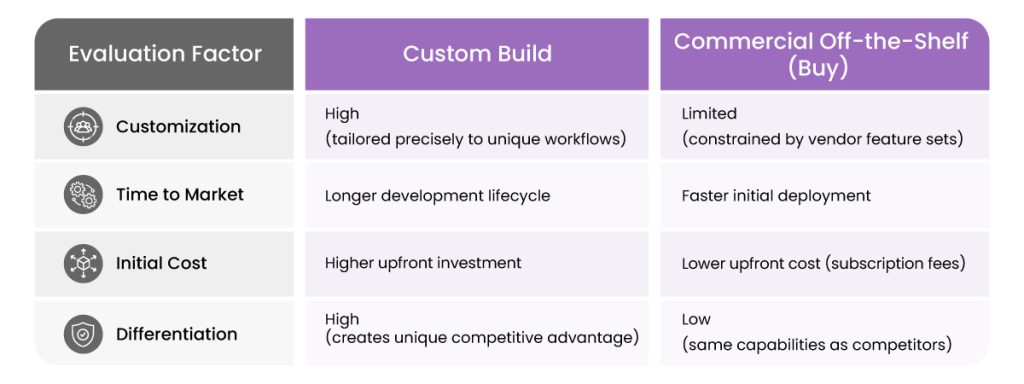
Organizations should choose custom development when their core processes, security policies, or competitive differentiators are not satisfied by commercial software.
Why Partner with an Expert?
Developing complex enterprise software requires deep technical expertise and strong security practices. Partnering with specialists like Aspire Systems provides access to engineering teams experienced in cloud-native development, legacy application modernization, DevOps pipelines, and enterprise-grade microservices transformation.
Conclusion
Enterprise application development enables organizations to build secure, scalable, integrated, and intelligent software systems that support critical operations. Combining modern architecture, cloud infrastructure, DevOps practices, and AI capabilities allows businesses to innovate with confidence.
Looking to build or modernize an enterprise application?
Discover how Aspire Systems application transformation services can help your organization design, build, and scale future-ready enterprise applications.
FAQ
- What are common examples of enterprise applications?
Examples include ERP, CRM, HRMS, supply chain management, business intelligence, enterprise content management, and custom business platforms.
2. What architecture is best for enterprise applications?
Microservices, cloud-native, event-driven, or modular architectures are chosen based on scalability, integration needs, security, and performance goals.
3. How does AI improve enterprise software?
AI enhances enterprise apps through intelligent automation, predictive analytics, natural-language interfaces, automated document processing, and decision-support systems.
4. What is the difference between development and modernization?
Enterprise application development creates brand-new software solutions, whereas application modernization updates existing legacy systems to improve security, scalability, and cloud readiness.

- AFTA: An AI-Powered Test Automation Framework for Enterprise-Scale Quality - October 12, 2026
- Innovation at Speed: How AI is Transforming Software Engineering - September 28, 2026
- Enterprise Application Development: Process, Benefits, Architecture & Best Practices - September 17, 2026
 Write to Us