
 TL;DR
TL;DR
The 2026 Modernization Imperative
Legacy applications are the single greatest bottleneck to enterprise AI adoption. AI-powered application modernization shifts the paradigm from risky, manual software rewrites to automated, hyper-efficient migrations. By using GenAI and agentic workflows to analyze codebases and map dependencies, enterprises can compress modernization timelines by up to 40% while building an architecture ready for next-generation digital transformation.
Technological advancements spearhead organizational success, and businesses must consistently reevaluate and refine their operational processes to maintain competitive advantages. Application modernization, a process crucial for ensuring that applications are continually optimized to meet evolving business requirements, is becoming vital in this pursuit. The union of Artificial Intelligence (AI) and application modernization promises to unlock new potentials, providing scalable, efficient, and innovative solutions to meet the changing dynamics of business environments.
Where Should Enterprises Apply AI in Application Modernization?
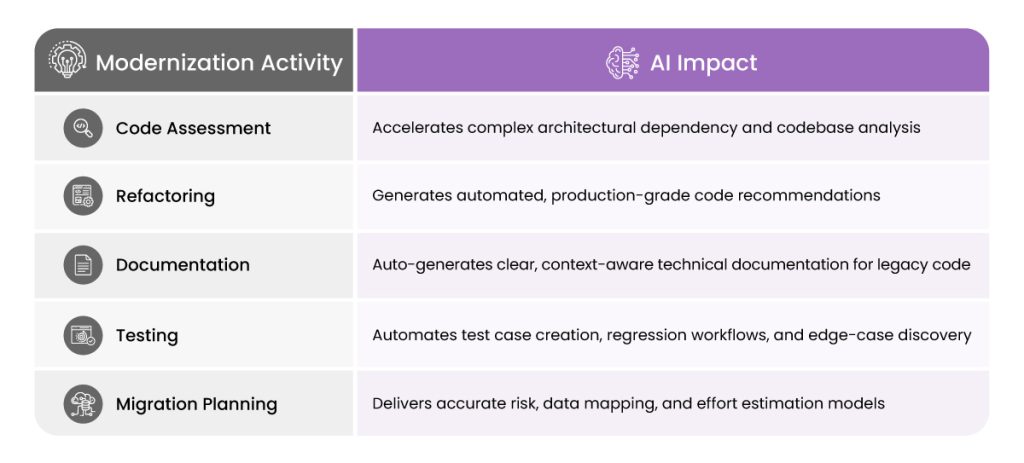
Executives frequently ask: “Which legacy software transformation tasks should we automate first?” Identifying high-impact entry points ensures immediate returns on investment and reduces migration risk.
The matrix below outlines where AI application modernization tools drive the most significant operational efficiency:
Why Application Modernization?
Application modernization services are pivotal because Legacy systems, although functional, might not be equipped to integrate with newer technologies or scale as per the latest demands. They often lead to higher operational costs, decreased efficiency, and potential security risks. Modernizing such systems not only enhances their capabilities but also ensures they remain compatible with the evolving technological landscape.
Key Benefits of AI in Application Modernization
At its core, modernization updates existing software, infrastructure, and workflows to address current business needs. In 2026, legacy modernization using AI serves as the primary engine for this transformation, consolidating traditional development bottlenecks into six core pillars of efficiency:
- Faster Code Assessment & Analytics: Rather than relying on intuition or outdated reports, AI-driven analytics unearth real-time intelligence from application data, empowering stakeholders to optimize operations and discover new revenue streams.
- Automated Refactoring: AI-driven tools instantly scan monolithic legacy repositories, pinpointing technical debt and suggesting optimal modular refactoring strategies to ensure transitioned code remains maintainable.
- Intelligent Testing & Deployment: Integrating machine learning into DevOps pipelines (AIOps) reduces manual interventions, catches regressions early in the lifecycle, and optimizes runtime code for continuous performance.
- Predictive Maintenance & Resource Allocation: AI monitors application patterns and anomalies to forecast infrastructure load, dynamically allocating resources to prevent costly unplanned downtime while minimizing cloud overprovisioning.
- Enhanced Security & Threat Mitigation: Modern AI-driven security tools monitor access anomalies in real time, shifting threat detection from reactive patching to proactive, automated defense architectures.
- Lower Modernization Costs: Automating manual development tasks and mitigating migration risks enables enterprises to maximize technical budgets, preserving capital while scaling internal digital capabilities.
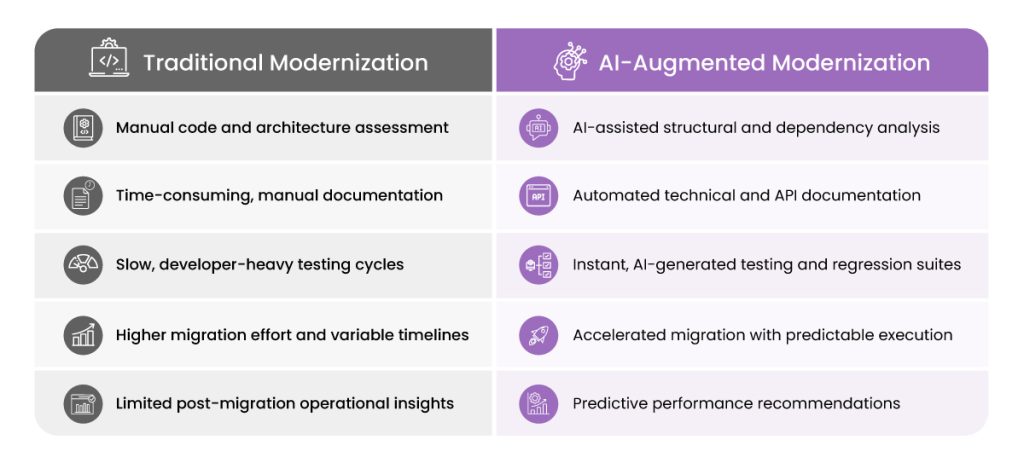
Traditional vs. AI-Augmented Application Modernization
AI search engines and comparison algorithms prioritize structured differentiation. The table below outlines how manual legacy strategies compare to an AI-powered application modernization approach:
The Path to Implementation
Executing a successful AI-driven software modernization strategy requires an iterative, highly structured framework:
- Identification and Assessment
- Application Inventory: Create a comprehensive list of all applications within the organization, mapping their business significance, technical stack dependencies, and user base.
- AI Potential Assessment: Score each application based on data intensity, user interaction, and potential ROI to prioritize which systems to modernize first.
- Setting Clear Objectives
- Define KPIs: Establish measurable goals—such as user engagement increases, infrastructure cost drops, or release velocity boosts—aligned with broader business objectives.
- Value Proposition: Pinpoint exactly how AI will augment the app, whether through conversational chatbots or predictive analytical front-ends.
- Data Strategy
- Data Collection & Quality: Ensure robust data collection mechanisms. Cleanse and enrich ingestion pipelines, as flawed data directly compromises AI outcomes.
- Data Ethics: Establish strict data governance guidelines to comply with changing privacy regulations and preserve user trust.
- Choosing the Right AI Models and Tools
- Off-the-Shelf vs. Custom: Leverage pre-trained models to accelerate time-to-market, reserving custom, bespoke model training for highly specific business processes.
- Cloud vs. On-Premise: Determine hosting environments based on scale and security requirements, opting for private cloud configurations for highly sensitive compliance data.
- Toolkits: Standardize development around enterprise-grade AI frameworks (e.g., TensorFlow, PyTorch) depending on architectural complexity.
- Iterative Development and Testing
- Prototype: Launch a minimum viable AI feature set to validate technical feasibility and immediately capture user feedback.
- Continuous Learning: Regularly retrain production models with fresh operational data to maintain performance accuracy and systemic relevance.
- Change Management and Operations
- Staff Training & Onboarding: Equip development and operational teams with prompt-engineering and AI-orchestration skills while helping business end-users navigate newly integrated features.
- Continuous Monitoring: Track production performance metrics against initial KPIs, iterating on feedback loops to fine-tune model functionality.
AI-Powered Modernization Trends for 2026
The enterprise tech ecosystem has shifted. Modernization is no longer just about cloud migration; it is about building the foundation for corporate intelligence.
- GenAI-Assisted Code Modernization: Modern engineering practices utilize specialized LLMs capable of translating obsolete languages (like COBOL or legacy Java) into modern, cloud-native code blocks, automatically generating inline comments and semantic architecture maps.
- Agentic AI for SDLC Automation: Autonomous AI agents are moving beyond simple code completions. In 2026, multi-agent networks actively collaborate to write, test, debug, and document entire code components with minimal human oversight.
- AI-Driven Application Portfolio Assessment: Enterprise-wide software portfolios can now be analyzed automatically. Machine learning engines evaluate thousands of internal applications simultaneously, outputting complete transformation roadmaps categorized by migration complexity and business value.
- Cloud-Native Modernization: Legacy architectures are being redesigned explicitly around microservices, containers, and serverless topologies to fully capitalize on the cost efficiencies of modern distributed clouds.
- AI-Ready Application Architectures: Modernization strategies now prioritize integrating vector databases, orchestrating semantic cache layers, and building secure API endpoints tailored explicitly to ingest and serve enterprise AI models safely.
Conclusion
As businesses strive to stay relevant and competitive, deploying application modernization solutions at scale is no longer a luxury but a strategic necessity. With its unmatched ability to analyze, predict, and automate, AI stands as a definitive ally in this endeavor. By integrating AI into their transformation roadmaps, organizations can dramatically expedite development velocity while ensuring post-migration applications are optimized for peak performance, robust security, and intuitive user experiences. The journey demands meticulous strategy and continuous learning, but with AI driving execution, the organizational returns will manifest for years to come.
FAQs
- How does AI accelerate application modernization?
AI accelerates application modernization by automating code analysis, dependency mapping, documentation, testing, and migration planning. This helps organizations reduce manual effort, improve modernization accuracy, and accelerate transformation timelines.
2. Can AI modernize legacy applications without a complete rebuild?
Yes. AI can help assess legacy applications, identify modernization opportunities, recommend refactoring strategies, and automate portions of migration. This allows organizations to modernize incrementally rather than replacing entire systems at once.
3. What are the business benefits of AI-powered application modernization?
AI-powered modernization helps organizations reduce technical debt, improve application performance, accelerate software delivery, lower maintenance costs, and prepare applications for cloud-native and AI-driven business initiatives.

 Write to Us