
 TL;DR
TL;DR
While generative AI adoption is accelerating, concerns around data security, compliance, and accuracy cause enterprise hesitation. Successful adoption requires pairing technology with robust risk management and responsible AI development.
Why Are Companies Afraid of Generative AI?
Most business leaders do not fear the technology itself; they fear data leaks, regulatory penalties, hallucinations, and erosion of customer trust.
Generative AI is no longer a futuristic proof-of-concept, it is a baseline requirement to stay competitive. Enterprises deploy generative AI solutions to automate back-office workflows, build hyper-personalized customer experiences, and accelerate software development. However, behind executive enthusiasm lies quiet anxiety as leaders balance the pressure to innovate against operational, legal, and ethical risks. Moving from hesitation to deployment requires breaking down these specific challenges into practical strategies.
The Elephant in the Room: Common Fears About Generative AI
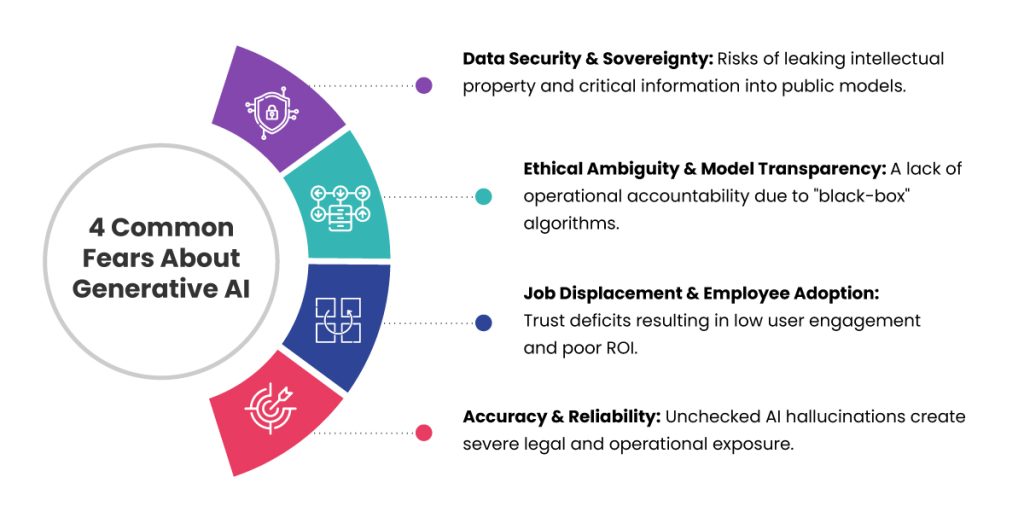
Corporate skepticism is driven by high-stakes, real-world mishaps, such as chatbots, hallucinating financial advice or leaking proprietary data. The core enterprise anxieties include:
- Data Security & Sovereignty: Risks of leaking intellectual property and critical information into public models.
- Ethical Ambiguity & Model Transparency: A lack of operational accountability due to “black-box” algorithms.
- Job Displacement & Employee Adoption: Trust deficits resulting in low user engagement and poor ROI.
- Accuracy & Reliability: Unchecked AI hallucinations create severe legal and operational exposure.
Top Enterprise AI Adoption Challenges
Enterprise concerns have shifted from vague skepticism to highly specific operational hurdles. Today, the core risks impact businesses directly across multiple strategic vectors.
| Challenge | Business Impact |
| Data Security & Sovereignty | Intellectual property leaks and severe compliance risks. |
| AI Hallucinations | Defective outputs leading to wrong decisions and legal exposure. |
| Model Transparency | Black-box algorithms causing a lack of operational accountability. |
| Employee Adoption | Trust deficits resulting in low user engagement and poor ROI. |
| Regulatory Compliance | Heavy penalties from evolving global AI safety frameworks. |
Why Enterprise AI Projects Fail
Despite heavy investments in generative AI development services, many corporate initiatives stall during execution. High-intent deployments usually collapse due to five systemic flaws:
- Lack of an Overarching AI Strategy: Deploying tools as isolated novelties rather than tying them to specific KPIs.
- Poor Data Quality: Relying on fragmented or legacy data architectures. Clean data requires robust Data Engineering Services to feed models effectively.
- Unrealistic Expectations: Assuming AI can instantly solve structural business issues without iterative tuning.
- No Governance Framework: Deploying models without guardrails for bias, security, or accuracy.
- Insufficient Employee Training: Failing to upskill the workforce to collaborate with automated workflows.
Enterprise AI Governance Framework: A Practical Approach
- Mitigating risk requires an enterprise-grade AI governance system. Organizations must integrate these practices into their broader IT ecosystem, often utilizing comprehensive AI Governance Solutions:
- Responsible AI Guidelines: Ethical standards ensuring fairness, equity, and privacy protection.
- Human-in-the-Loop (HITL) Review: Mandatory human oversight for high-stakes AI outputs to prevent unchecked errors.
- Strict Security Controls: Enterprise guardrails preventing proprietary data from leaking into public LLMs.
- Continuous Risk Assessment: Rigorous pre-deployment testing for vulnerabilities, bias, and model drift.
- Compliance Monitoring: Automated checks against shifting regional and global legislation.
Generative AI Adoption Maturity Model
Enterprises can assess their current positioning and plan their scaling roadmap using this structural maturity model to guide steady, managed growth:
| Stage | Description |
| 1. Exploration | Initial ad-hoc AI experiments and basic prompt engineering sandbox tests. |
| 2. Pilot | Limited, low-risk use cases launched within isolated departments. |
| 3. Production | Department-level deployment of tailored enterprise generative AI solutions. |
| 4. Scale | Enterprise-wide AI adoption across core workflows with active governance. |
| 5. Optimization | Continuous improvement utilizing customized fine-tuning and AIOps frameworks. |
How Different Industries Are Responding to Generative AI
BFS Sector: Compliance Nightmares & Customer Trust
Financial institutions operate under strict frameworks (e.g., GDPR, SOX, PCI-DSS). Generative AI’s “black-box” nature complicates audit trails, making compliance difficult to prove. A single data breach or a biased lending algorithm can destroy customer trust and trigger lawsuits.
- Example: A multinational bank recently faced backlash when its AI loan approval system disproportionately rejected applicants from marginalized communities, proving that responsible AI development is an operational prerequisite.
- Solutions: Partner with regulators early to co-create compliance frameworks; implement explainable AI systems; conduct third-party bias audits; and prioritize hybrid models where AI supports human judgment.
Insurance: Fears Over Accuracy & Ethics
Insurers worry about AI misinterpreting complex policy details, leading to incorrect claim denials. False positives in automated fraud detection risk alienating legitimate policyholders, while using sensitive health data raises massive regulatory scrutiny (e.g., HIPAA in the U.S.).
- Example: A European insurer faced backlash when its AI tool denied claims for chronic illness patients due to flawed training data.
- Solutions: Deploy AI for initial claims triage and document analysis, but require human adjusters to approve final decisions; train models on decentralized, anonymized data; and provide clear, plain-language explanations for premium adjustments.
ISVs: Integration Hurdles & Scalability Anxiety
Independent Software Vendors face technical debt and legacy system friction when embedding native AI features, which can destabilize workflows or degrade performance. Customization costs are high because off-the-shelf models rarely align with niche requirements, and continuous model maintenance drains lean development teams.
- Example: A healthcare SaaS ISV struggled for months to integrate an AI patient record summarization feature because the tool initially slowed down their platform performance.
- Solutions: Adopt modular architectures to isolate and test AI integrations before full deployment; leverage cloud-based AI services and Cloud Modernization Services to reduce infrastructure costs; and focus on vertical-specific use cases.
Broader Industry Landscape
- Healthcare: Focuses on clinical summarization and diagnostic support while maintaining strict patient data privacy and HIPAA compliance.
- Retail: Leverages AI for hyper-personalized marketing campaigns, inventory optimization, and conversational commerce.
- Manufacturing: Drives predictive maintenance schedules and automated supply chain logistics to reduce downtime.
Telecom: Deploys virtual assistants for high-volume billing triage and automated technical support troubleshooting.
Future-Proofing Generative AI Adoption: 4 Best Practices
Although industry-specific strategies matter, broader structural principles can guide businesses toward sustainable, long-term AI adoption:
- Start Small, Think Big: Pilot generative AI in low-risk internal areas like automating internal reporting or customer service chatbots before scaling to customer-facing code. Success here builds organizational buy-in.
- Invest in Governance Early: Form cross-functional AI ethics and compliance committees to oversee development, review automated workflows, and manage risks.
- Upskill, Don’t Replace: Train employees to act as editors, validators, and risk-managers alongside AI (e.g., training underwriters to validate AI-generated risk assessments), maximizing your return on generative AI software development.
- Collaborate Across Ecosystems: Partner with specialized vendors for tailored Enterprise AI Services, banks can ally with fintech providers for compliant tools, and ISVs can leverage cloud providers to access cutting-edge, secure infrastructure.
From AI Fear to AI Readiness: Next Steps for Enterprise Leaders
Enterprise adoption of AI does not have to be a blind leap of faith. Addressing fears head-on with clear governance, transparency, and strategic patience transforms uncertainty into measurable growth. For enterprise leaders, the time to act is now, but the wisest actions will always balance aggressive innovation with rigid operational integrity.

 Write to Us