

Beyond Core Replacement: Why Overlay Intelligence Is Becoming the Operating Model for Insurance Modernization
Share this Article on


 TL;DR
TL;DR
Overlay intelligence is an orchestration layer that helps insurers modernize operations without immediately replacing their core systems. It connects legacy and modern platforms, orchestrates workflows, externalizes business logic, and enables governed AI while the underlying core continues to operate. Read the article to explore how insurers can modernize without rip-and-replace disruption.
Insurance digital transformation has reached an inflection point. Core systems built for slower, document-heavy operating models are under pressure from real-time customer expectations, complex risk environments, digital distribution, ecosystem partnerships, and AI-led decisioning.
As highlighted in a McKinsey’s article, P&C carriers are under pressure to modernize core systems as operational inefficiencies, rising IT maintenance costs, and expectations for instant quotes and faster claims payouts intensify.
Yet the industry’s modernization challenge is not only technical, it is operational. Replacing a policy administration, billing, or claims platform can improve the technology base, but it does not automatically redesign underwriting decisions, claims journeys, compliance controls, or servicing workflows. If business processes remain fragmented, insurers risk carrying old inefficiencies into new systems.
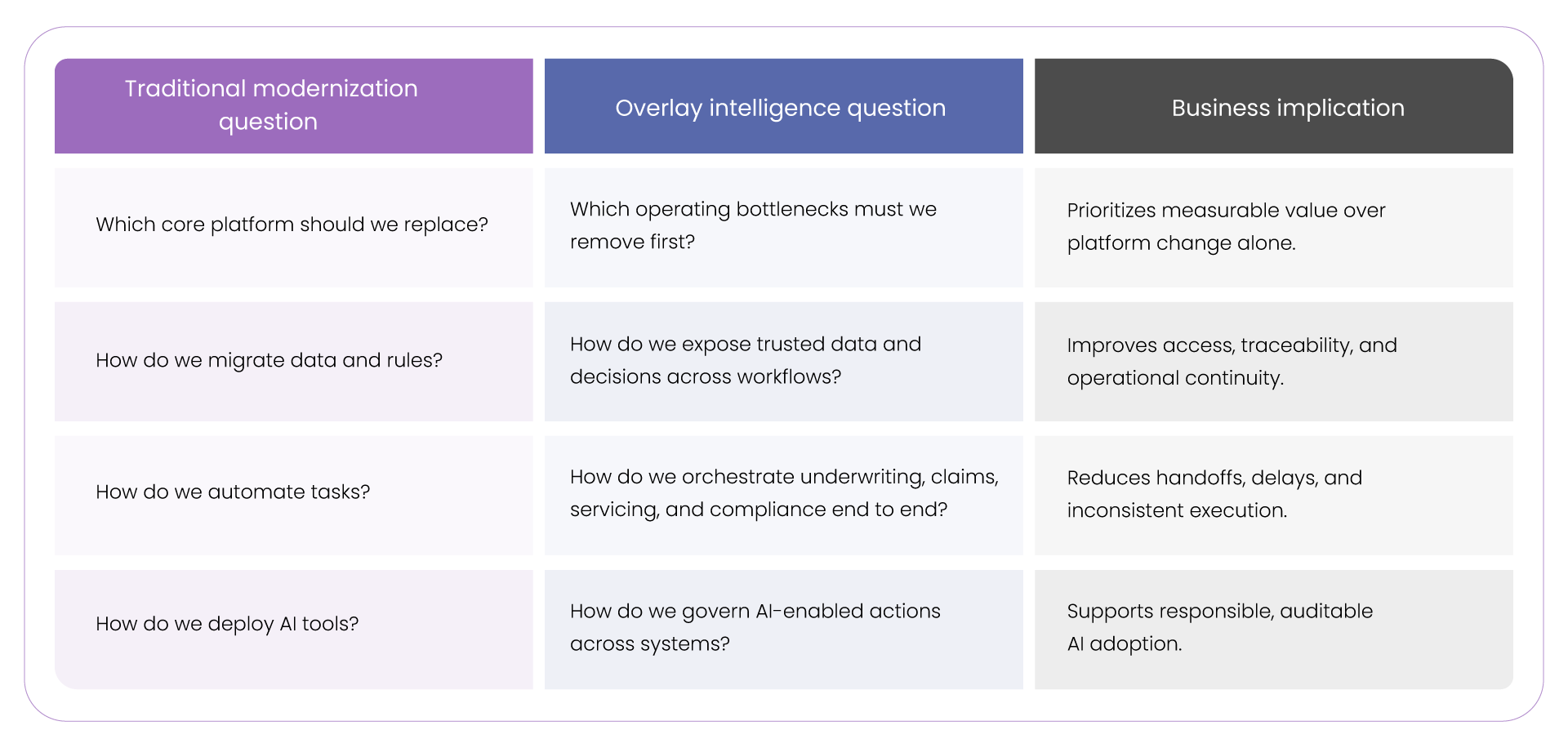
That is why a new modernization approach ‘overlaying intelligence’ is gaining relevance. It does not argue against core transformation. Instead, it recognizes that insurers need an intelligent operating layer that can connect legacy and modern systems, externalize business logic, orchestrate processes, govern AI-enabled decisions, and deliver business value while long-term platform change continues.
Overlay intelligence is not a replacement for core modernization. It is a way to create business value while core transformation is being planned, sequenced, or executed.
The modernization problem is no longer just the core
For many insurers, the core remains in the system record. It stores policy, billing, claims, and customer data; executes transactions; and preserves decades of embedded business logic. These systems can be difficult to replace because they carry product rules, actuarial assumptions, regulatory variations, integration dependencies, batch jobs, and operational workarounds accumulated over time.
McKinsey’s 2026 article, ‘Can agentic AI finally modernize core technologies in insurance?’ underscores that legacy cores are socio-technical systems with under-documented rules, custom interfaces, data semantics, reconciliation needs, and cutover risks. It also notes that a disproportionate share of migration effort often sits in understanding business rules, data conversion, quality control, operational readiness, and stabilization rather than simply rebuilding code.
This explains why many carriers pursue incremental modernization, component upgrades, hollowing-out strategies, or cloud-enabled integration while keeping critical systems stable. The strategic objective is not merely to make the core newer. It is to make the enterprise more responsive, governed, and adaptable.
From core-centric modernization approach to overlay intelligence modernization approach
What overlay intelligence means in insurance
Overlay intelligence is an orchestration layer that sits above existing and modern systems. It connects applications, data sources, business rules, APIs, automation workflows, AI models, and user interfaces without forcing an immediate rip-and-replace program. The core continues to serve as the transactional backbone, while the overlay coordinates how work moves across the organization.
For business leaders, this creates a route to making faster decisions, better SLA management, and improved customer and distributor experience. For technology leaders, it introduces a decoupled architecture where reusable services, event-driven workflows, API integrations, data fabrics, and AI capabilities can evolve without overloading core systems.
The distinction matters. Automation executes tasks. Orchestration coordinates processes. Overlay intelligence goes further by combining orchestration with context, rules, AI recommendations, exception management, and governance.
Where the business value appears first
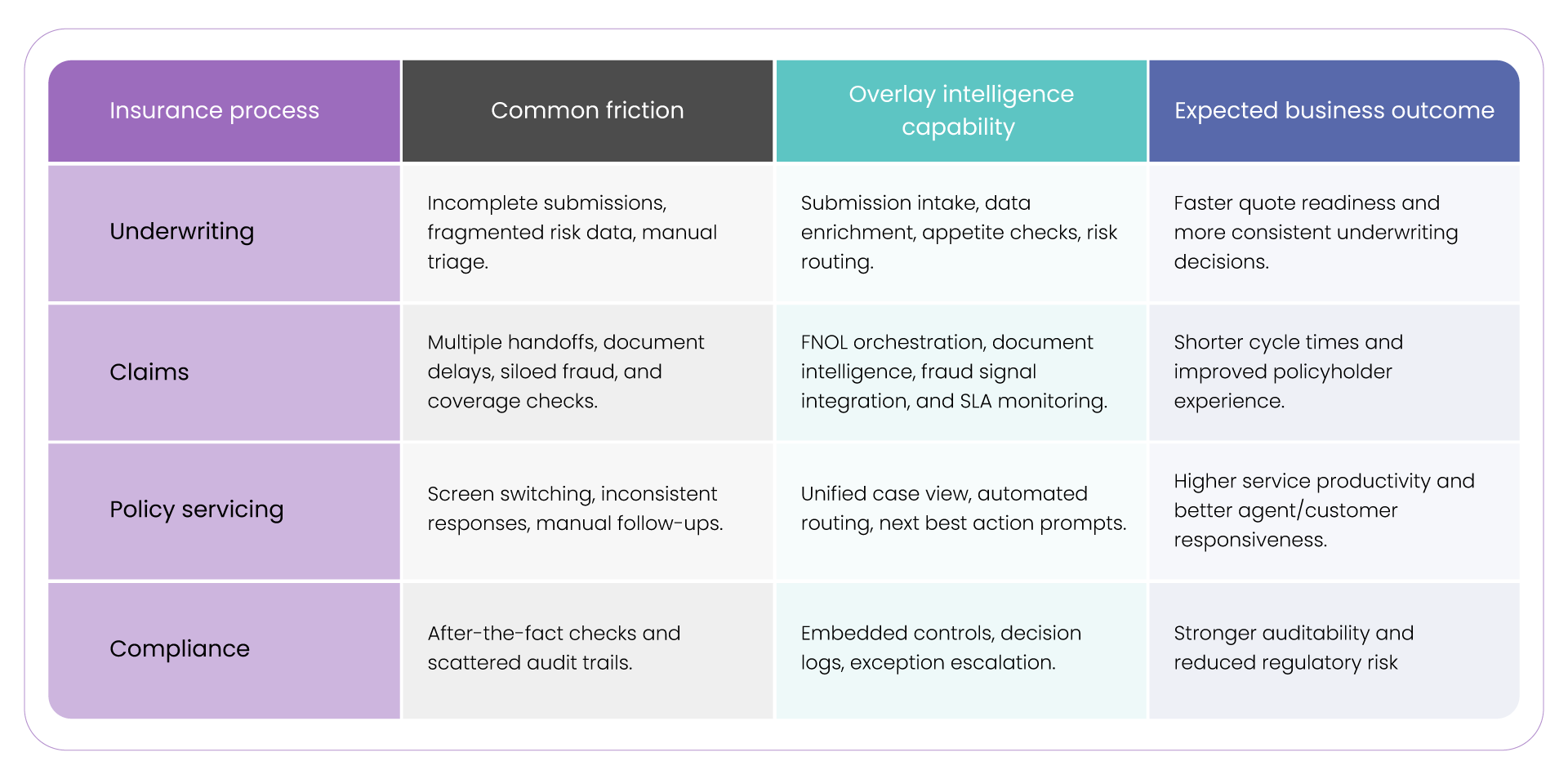
The strongest use cases are not abstract technology scenarios. They sit in the highest-friction insurance processes: underwriting, claims, servicing, compliance, and distribution.
In underwriting, overlay intelligence can consolidate broker submissions, third-party data, prior loss of information, appetite rules, pricing inputs, and document requirements into a unified workbench. It can triage submissions, flag missing details, route complex risks to senior underwriters, and recommend the next best actions while keeping the underwriter in control.
In claims, it can orchestrate FNOL intake, coverage validation, document classification, fraud indicators, repair network coordination, medical or property assessment inputs, reserve updates, and customer communication. This is especially valuable because claims is rarely a linear process. It involves policy checks, evidence collection, vendor coordination, approvals, settlement logic, and regulatory obligations.
In policy servicing, overlay intelligence can improve endorsement handling, renewals, cancellations, billing queries, agent requests, and customer service case resolution by giving employees a single operational view across multiple platforms.
Overlay intelligence across insurance processes
Why AI makes overlay-intelligence more urgent
Deloitte’s article on insurance technology trends highlights the expanding role of AI across pricing, customer experience, claims, operations, and insurance-specific decision support. But AI value depends on more than model performance. It requires governed data access, workflow context, integration, controls, explainability, and human oversight.
The National Association of Insurance Commissioners’ regulatory Model Bulletin on use of artificial intelligence system by insurers reinforces this direction by emphasizing governance, fairness, accountability, transparency, compliance with insurance laws, risk management, documentation, and oversight across AI systems used throughout the insurance lifecycle. For insurers, this means AI cannot be treated as a disconnected innovation layer. It must operate within auditable, controlled, and explainable processes.
Overlay intelligence provides the structure for that operating model. It enables AI agents or copilots to retrieve information, trigger workflows, identify missing evidence, recommend actions, monitor service levels, and escalate exceptions while preserving human-in-the-loop decisioning where judgment, compliance, or customer impact requires it.
Architecture principles for modernization without migration
Insurers evaluating overlay-led modernization should avoid treating it as a cosmetic integration layer. It must be designed as a durable architecture pattern with clear principles.
- Keep the core as the system of record: Policy, claims, billing, and customer systems should continue to own authoritative transactions until a deliberate migration path is chosen.
- Externalize business logic where appropriate: Rules for triage, routing, eligibility, documentation, and exception handling should be made visible, testable, and reusable.
- Use APIs and events to reduce dependency: Modern workflows should communicate through integration patterns that limit hard-coded dependencies on legacy platforms.
- Build governance into the workflow: Audit trails, approvals, model monitoring, and exception paths should be part of the design, not afterthoughts.
- Prioritize process value over technology novelty: The first investments should target measurable bottlenecks in underwriting, claims, servicing, and compliance.
How insurers should sequence the journey
A practical insurance digital transformation roadmap begins with process discovery. Insurers should map where work slows down, where employees rekey data, where decisions depend on undocumented knowledge, where SLAs are missed, and where customers or distributors experience friction. From there, they can identify a high-value process, define the minimum orchestration layer required, integrate priority systems, apply automation and AI selectively, and measure value before scaling.
This sequencing helps insurers avoid two common traps:
- Delaying all value until a multi-year migration completes
- Launching AI pilots that cannot scale because they are disconnected from real operating workflows.
Our point of view
At Aspire Systems, insurance modernization is viewed as a business-operating-model challenge as much as a technology challenge. Core transformation remains important where legacy platforms constrain growth, scalability, compliance, or product agility. But insurers do not have to wait for full migration to improve decision velocity, process transparency, and customer outcomes.
Through integration, cloud enablement, data modernization, intelligent automation, AI-led operations, and insurance platform expertise, Aspire Systems helps insurers identify where overlay intelligence can unlock value now while supporting a longer-term modernization roadmap. The goal is not modernization for its own sake. It is to help insurers build a connected, governed, AI-ready enterprise where underwriting, claims, servicing, and compliance can operate with greater speed and control.
The next competitive edge
The next phase of insurance modernization will not be defined only by which carrier replaces its core first. It will be defined by which carrier can connect decisions, data, workflows, systems, and governance fastest.
Overlay intelligence gives insurers a pragmatic way to modernize without forcing a binary choice between stability and innovation. It preserves what works, improves what slows the business down, and creates the foundation for responsible AI adoption. In an industry where speed, trust, compliance, and customer experience must move together, modernization without migration is not a shortcut. It is a smarter operating model for the future of insurance.
References
1. McKinsey & Company’s article (May 2025): How P&C insurers can successfully modernize core systems.
2. McKinsey & Company’s article (April 2026): Can agentic AI finally modernize core technologies in insurance?
3. Deloitte’s 2025 report: Insurance Technology Trends of 2025
4. National Association of Insurance Commissioners’ regulatory model bulletin (adopted December 2023): Model Bulletin: Use of Artificial Intelligence Systems by Insurers
In This Article
- Modernization problem is no longer just the core
- What overlay intelligence means in insurance
- Where the business value appears first
- Why AI makes overlay-intelligence more urgent
- Modernization without migration
- How insurers should sequence the journey