

Cost-Aware Architecture: A FinOps Playbook for CXOs
Share this Article on


 TL;DR
- Your cloud bill is decided at design time, not on the invoice. Traditional FinOps finds waste after the architecture is already deployed. Cost-aware architecture makes cost a measurable non-functional requirement from design onwards, alongside performance, availability and security.
- The old playbook has stalled. Estimated cloud waste stands at 29%, even though 63% of organisations now run dedicated FinOps teams. With 98% of FinOps teams now managing AI spend, new consumption patterns are outpacing billing-led optimisation.
- Engineer cost across five layers: demand, compute, data, AI and governance. Use caching, right-sizing, data lifecycle policies, model routing, policy-as-code and FOCUS-standardised billing data.
- Measure value, not just spend. Track unit economics such as cost per transaction, claim, order or resolved AI conversation. Pair them with cost elasticity, where a figure below 1.0 means costs grow more slowly than the business. For AI, cost per resolved outcome matters more than cost per token.
- Shift FinOps left and prove it in 90 days. Put cost fitness functions into CI/CD, start with two pilot workloads, build guardrails and present the unit-cost improvements to leadership.
What if your next cloud cost overrun has already been approved? Not by the CFO, but by a pull request that merged weeks earlier.
A microservice making unnecessary cross-zone calls, application logs configured with indefinite retention or a premium AI model handling routine queries can all create recurring expenditure. Each decision may pass technical review without anyone evaluating its financial impact.
By the time FinOps identifies the cost anomaly, the architecture is already deployed and remediation competes with business priorities. This is the fundamental limitation of traditional cloud cost management: it often identifies waste after the architectural decisions responsible for it have been implemented.
Cost-aware architecture changes the sequence. It integrates cloud cost optimisation into design, development and deployment, enabling engineering teams to evaluate the economic impact of technology decisions before committing resources.
For CXOs, the objective is not simply reducing cloud expenditure. It is ensuring that cloud and AI investments generate measurable business value at sustainable unit economics.
Why 2026 Is an Inflection Point for FinOps?
Cloud environments are becoming more complex as organisations adopt multi-cloud platforms, cloud-native applications, managed services and generative AI.
Industry research highlights the challenge:
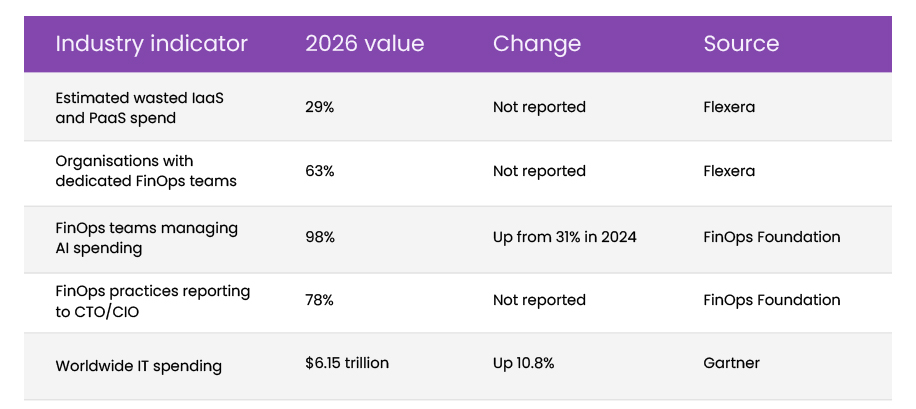
These findings reveal an important shift. Enterprises are improving cloud financial management, but AI workloads and distributed architectures are introducing new consumption patterns that traditional optimisation approaches cannot fully address.
FinOps must therefore move beyond billing visibility and become an integral part of cloud architecture, platform engineering and technology investment governance.
What Is Cost-Aware Architecture?
Cost-aware architecture is the practice of treating cost as a first-class, measurable non-functional requirement alongside performance, availability, scalability and security. It embeds cloud financial management into architecture decisions, engineering workflows and operational governance, ensuring technology expenditure scales sustainably with business outcomes.
For example, a digital banking platform could establish a target infrastructure cost per transaction, with defined performance and availability requirements. This turns cloud cost management into an engineering discipline rather than a month-end financial exercise.
The Five-Layer Framework for Cost-Aware Architecture
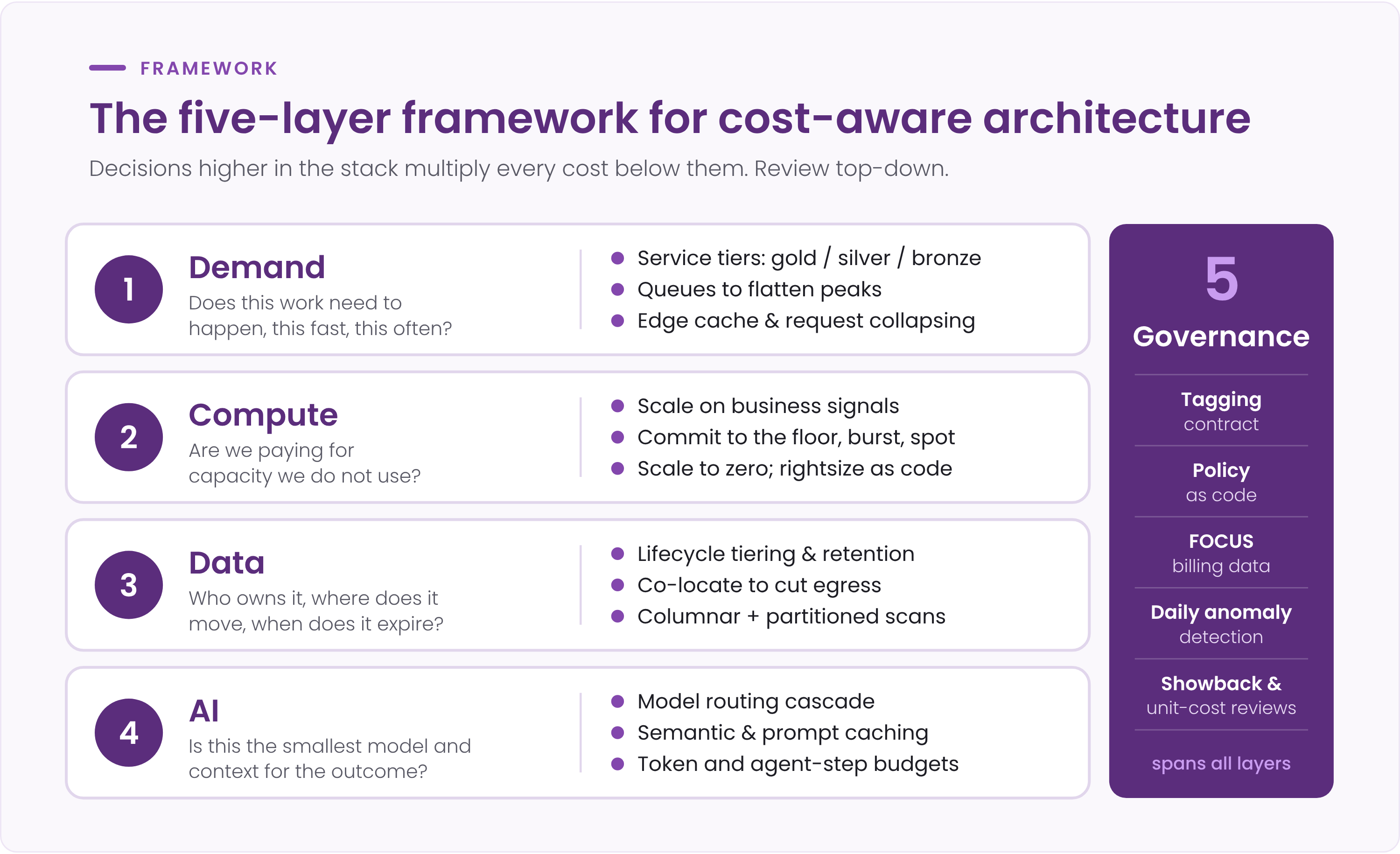
An effective cloud cost optimisation strategy must address the complete technology stack. The following five-layer framework provides a practical approach.
1. Demand – Optimise What You Process
The cheapest request is the one that does not need to be processed.
- Classify workloads by business criticality and latency requirements.
- Use caching and content delivery networks to eliminate duplicate processing.
- Introduce asynchronous processing and queues to smooth demand.
- Schedule deferrable workloads during off-peak periods.
- Use interruptible compute for workloads that support retries and recovery.
The key question: Does every workload genuinely need real-time processing?
2. Compute – Match Infrastructure to Demand
Cloud infrastructure cost optimisation starts with selecting the right compute capacity for each workload.
- Rightsize virtual machines, containers and managed services.
- Use autoscaling based on business demand and workload signals.
- Apply reservations or savings commitments to predictable workloads.
- Use spot instances for fault-tolerant processing.
- Scale eligible event-driven services to zero.
- Integrate cost estimation into Terraform and infrastructure-as-code workflows.
For Kubernetes platforms, resource requests, limits and cluster autoscaling should be included in cost governance.
3. Data – Control the Cost of Data Growth
Data storage, movement, processing and observability can become significant contributors to cloud expenditure.
- Implement lifecycle management across storage tiers.
- Define retention policies based on business and regulatory requirements.
- Reduce unnecessary cross-region and cross-zone data transfers.
- Optimise database queries, indexing and data partitioning.
- Apply cluster policies and automatic termination to lakehouse platforms.
- Use sampling, aggregation and tiered storage to manage observability costs.
For regulated industries such as banking, retention optimisation must preserve auditability and regulatory compliance.
4. AI – Engineer Cost Efficiency into AI Workloads
Generative AI and agentic AI introduce new dimensions of cloud cost optimisation.
AI architecture should account for token consumption, GPU utilisation, model inference, retrieval operations and agent orchestration.
Key practices include:
- Route requests to the smallest capable AI model.
- Implement semantic and prompt caching.
- Limit context size using retrieval-augmented generation.
- Set token, retry and agent execution budgets.
- Monitor GPU utilisation and inference throughput.
- Attribute AI expenditure to business use cases and outcomes.
The objective is to optimise cost per successfully resolved business outcome rather than simply cost per token.
5. Governance – Make Cost Accountability Continuous
Cloud cost governance ensures that engineering teams follow consistent financial and architectural standards.
- Enforce mandatory resource tagging through policy-as-code.
- Standardise cloud billing data using FOCUS.
- Introduce automated cost anomaly detection.
- Establish workload-level budgets and cost objectives.
- Provide engineering teams with unit-cost dashboards.
- Integrate cost controls into architecture reviews and CI/CD pipelines.
Together, these five layers establish a repeatable approach to engineering cost efficiency across cloud-native, hybrid and multi-cloud environments.
Shift-Left FinOps: Embedding Cost into Engineering
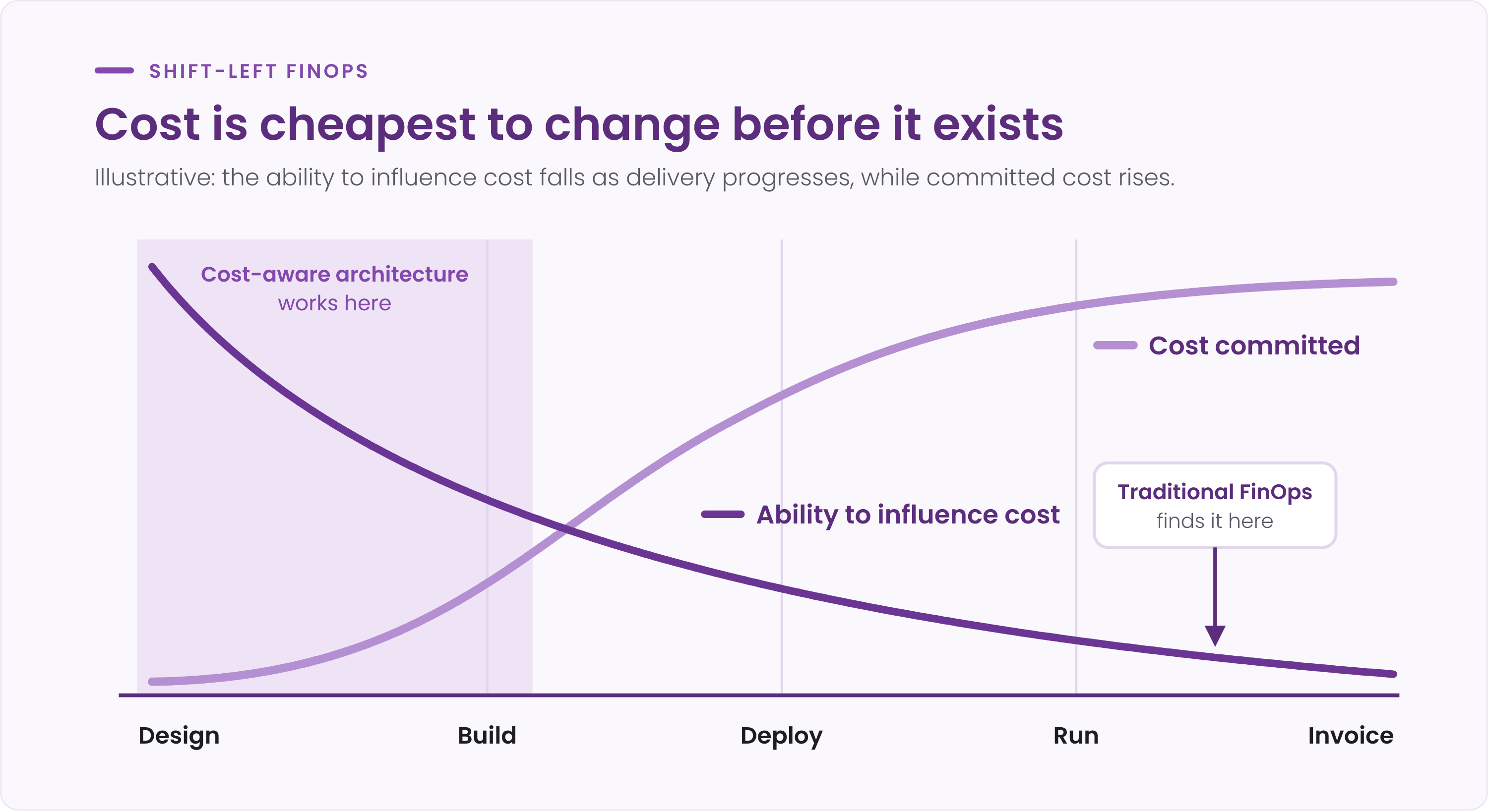
Shift-left FinOps brings cloud cost management into the software delivery lifecycle rather than limiting it to post-deployment reporting.
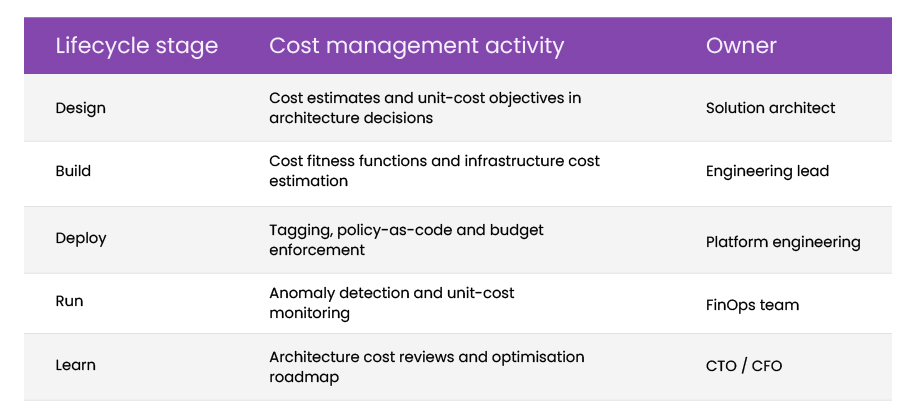
AI Cost Optimisation: Beyond Tokens and Model Pricing
AI cost governance requires a broader approach than monitoring model API consumption.
The total cost of an AI application includes:
- Input and output tokens.
- Embedding generation and vector database operations.
- Retrieval and context processing.
- GPU infrastructure and idle capacity.
- Agent orchestration and tool execution.
- Monitoring, evaluation and human escalation.
Consider two AI-powered customer support implementations. One resolves 60% of customer queries independently, while another resolves 90%. The second solution may use a more expensive model but deliver a lower cost per resolved outcome by reducing human intervention. Enterprises should therefore measure AI economics through cost per resolved outcome, model utilisation, inference throughput and successful task completion. For agentic AI, execution budgets, retry limits, tool-call restrictions and human approval thresholds should be explicit architectural controls.
Cost-Aware Architecture Maturity and the 90-Day Roadmap
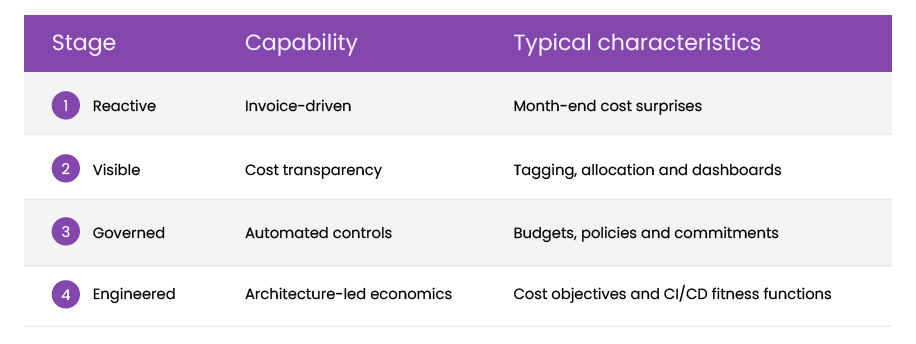
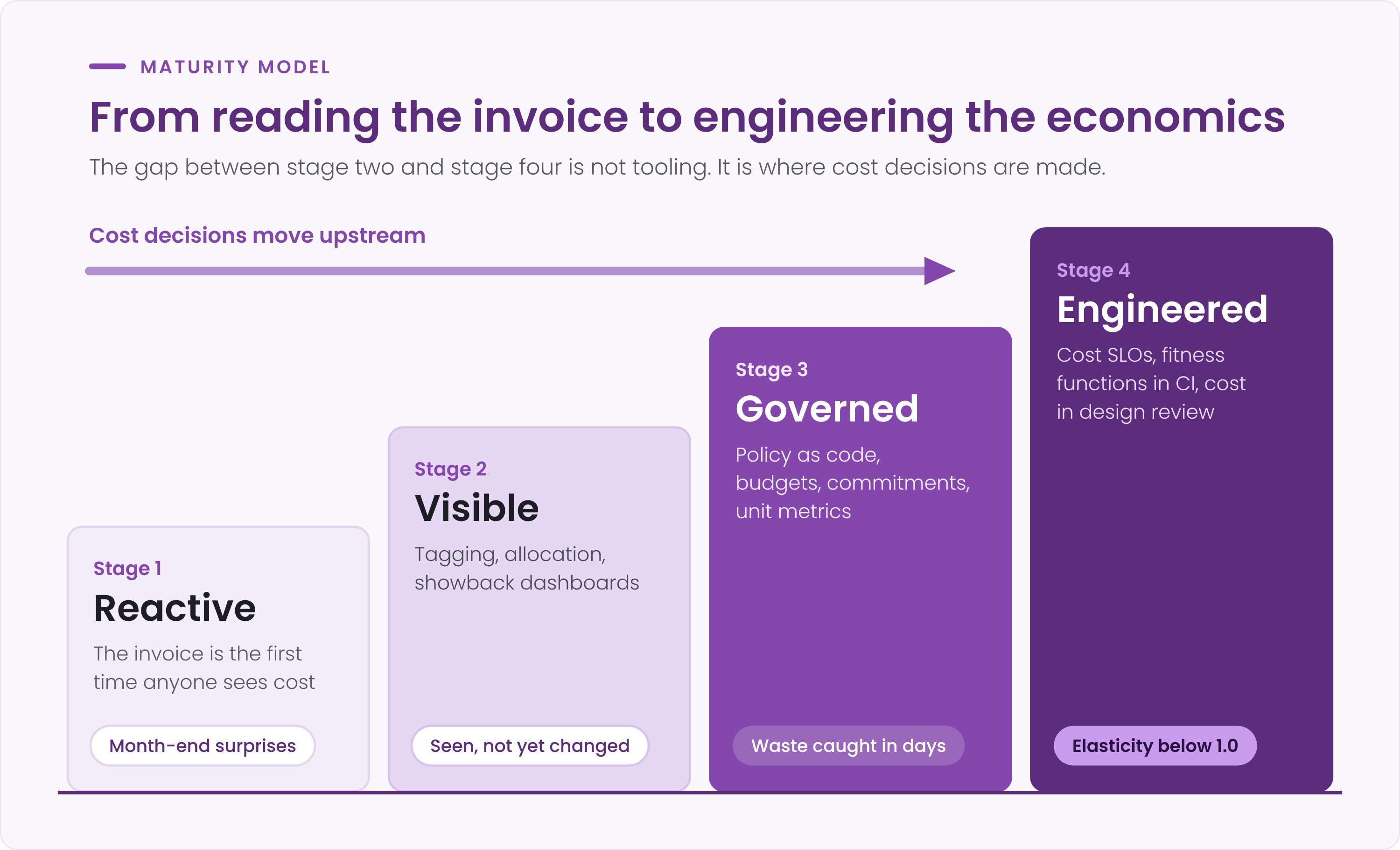
Enterprises can assess their cloud financial management maturity across four stages.
A Practical 90-Day Implementation Plan
Days 1–30: Establish the baseline
- Select two pilot applications or business products.
- Establish unit-cost metrics.
- Define resource-tagging standards.
- Normalise cloud billing data using FOCUS.
- Identify major architectural cost drivers.
Days 31–60: Introduce engineering controls
- Implement policy-as-code.
- Integrate infrastructure cost estimates into pull requests.
- Introduce cost objectives into architecture decision records.
- Establish budget and approval thresholds.
- Build unit-economics dashboards.
Days 61–90: Demonstrate measurable value
- Introduce workload-level cost objectives.
- Track cost elasticity.
- Prioritise the three highest-value optimisation opportunities.
- Implement cost anomaly detection.
- Present unit-cost improvements and the expansion roadmap to leadership.
Success should be measured against baseline unit economics while maintaining agreed performance, availability and security objectives.
The CXO Scorecard: Five Questions to Ask
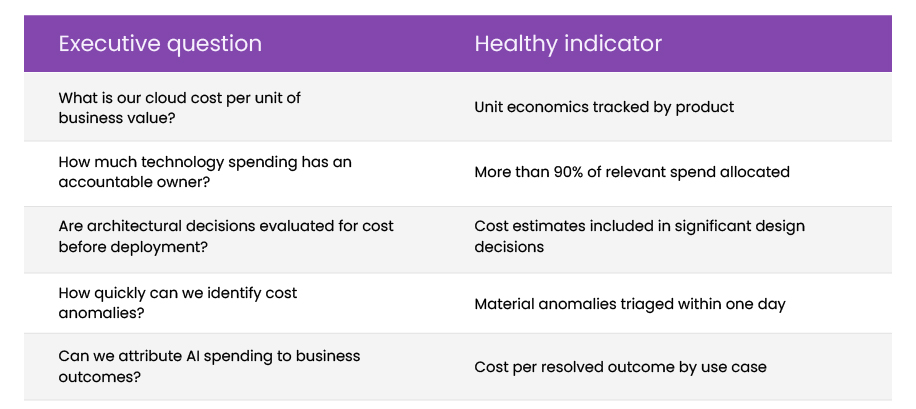
The ultimate measure is whether technology expenditure grows in line with business value without compromising customer experience, performance or reliability.
How Aspire Systems Can Help
Aspire Systems brings together Cloud Engineering, FinOps, Platform Engineering and Data & AI capabilities to help enterprises improve cloud financial management and technology investment efficiency.
Our capabilities include:
- Cost-Aware Cloud Architecture: Application and infrastructure assessments, workload optimisation and cost-efficient cloud design patterns.
- Engineering-Led FinOps: Unit economics, cost allocation, infrastructure-as-code policies and automated CI/CD cost guardrails.
- Cloud-Native Platform Engineering: Standardised provisioning, policy enforcement, automated scaling and observability.
- Data and AI Cost Governance: Cost visibility across data platforms, GPU infrastructure, model inference and agentic workloads, with usage budgets and outcome-based attribution.
Through a structured 90-day Cost-Aware Architecture Assessment, Aspire Systems can help enterprises establish baseline unit economics, identify architectural cost inefficiencies, implement engineering guardrails and develop a measurable optimisation roadmap.
Sources and Further Reading
1. Flexera – 2026 State of the Cloud Report.
2. FinOps Foundation – State of FinOps 2026.
3. FinOps Foundation – FOCUS Specification, Version 1.4.
4. Gartner – Worldwide IT Spending Forecast, February 2026.
Industry statistics reflect the cited research and survey populations. Financial examples and implementation targets are illustrative.
FAQ
1. What is cost-aware architecture?
Cost-aware architecture integrates cloud cost optimisation into architecture design, engineering and operations. It treats cost as a measurable non-functional requirement and establishes financial objectives for individual workloads and business outcomes.
2. How is cost-aware architecture different from FinOps?
FinOps provides the operating model for cloud financial management, accountability and value realisation. Cost-aware architecture applies those principles directly to technology design and engineering decisions. They are complementary disciplines.
3. What are the most important cloud unit economics metrics?
Common metrics include cost per transaction, cost per order, cost per active customer, cost per claim and cost per resolved AI conversation. These should be evaluated alongside cost elasticity and service-level objectives.
4. How can enterprises reduce AI infrastructure costs?
Enterprises can optimise AI costs through model routing, prompt caching, context optimisation, GPU utilisation, token budgets and agent execution controls. Measuring cost per resolved outcome provides a more complete view than model pricing alone.
5. How can a CXO measure the success of a cost-aware architecture programme?
Track unit-cost reduction, cost elasticity, spending allocation, anomaly detection time and savings reinvested into business initiatives. Improvements must be achieved without compromising performance, security or reliability.
In This Article
- Why 2026 is an inflection point for FinOps
- What is cost-aware architecture?
- The five-layer framework for cost-aware architecture
- AI Cost Optimisation
- Cost-Aware Architecture Maturity and the 90-Day Roadmap
- The CXO Scorecard