

Anticipatory Agents in BFS: Hyper-Personalization 2.0
Share this Article on


 TL;DR
TL;DR
Banking personalization is moving from reactive to anticipatory. AI agents now read real-time behavioral signals (a lapsed mortgage window, a life event, a market shift) and act before the customer even asks, powered by a unified data layer, a customer intelligence engine, and specialized banking agents under embedded governance. High-value use cases include proactive life-event banking, predictive churn intervention, real-time credit pre-qualification, and intelligent service escalation can all be enabled by Aspire's stack of FinEdgAI, its Databricks practice, BFS 360, SoftSpell, and AFTA. The competitive edge in banking is shifting from product and price to intelligence and anticipation.
The next frontier in banking is not serving customers better — it is serving them before they ask.
From Reactive to Anticipatory
For decades, personalization in banking meant sending out named customer correspondence or more recently having a banking personal follow-up on your investment needs. However, this method is rather antiquated for today's customers.
Hyper-personalization in banking has had a massive upgrade, which is not driven by asking customers what they need but anticipating what they might need and that is the promise of anticipatory AI in banking. Anticipatory AI is a model where AI agents predict intent, pre-empt friction, and deliver value before the customer approaches the bank with a request.
This strategic pivot is not incremental, but architectural and banking and financial institutes should embrace it as a platform transformation rather than a product upgrade or risk being outpaced by competition.
What Is Hyper-Personalization 2.0?
The first era of financial personalization was descriptive, such as sending out personal correspondence. This era was disrupted by the predictive phase where banking personals guessed at customer preferences.
Now with hyper-personalization 2.0, the era is anticipated. It analyzes customer behavior patterns and answers questions specific to customer needs at any moment in time. This distinction is crucial in BFS, as customer journeys usually span years or decades. These financial decisions are usually emotionally loaded, and one missed signal such as a lapsed mortgage window, an ignored investment trigger, an unrecognized life event may lead to serious loss in revenue and erode trust.
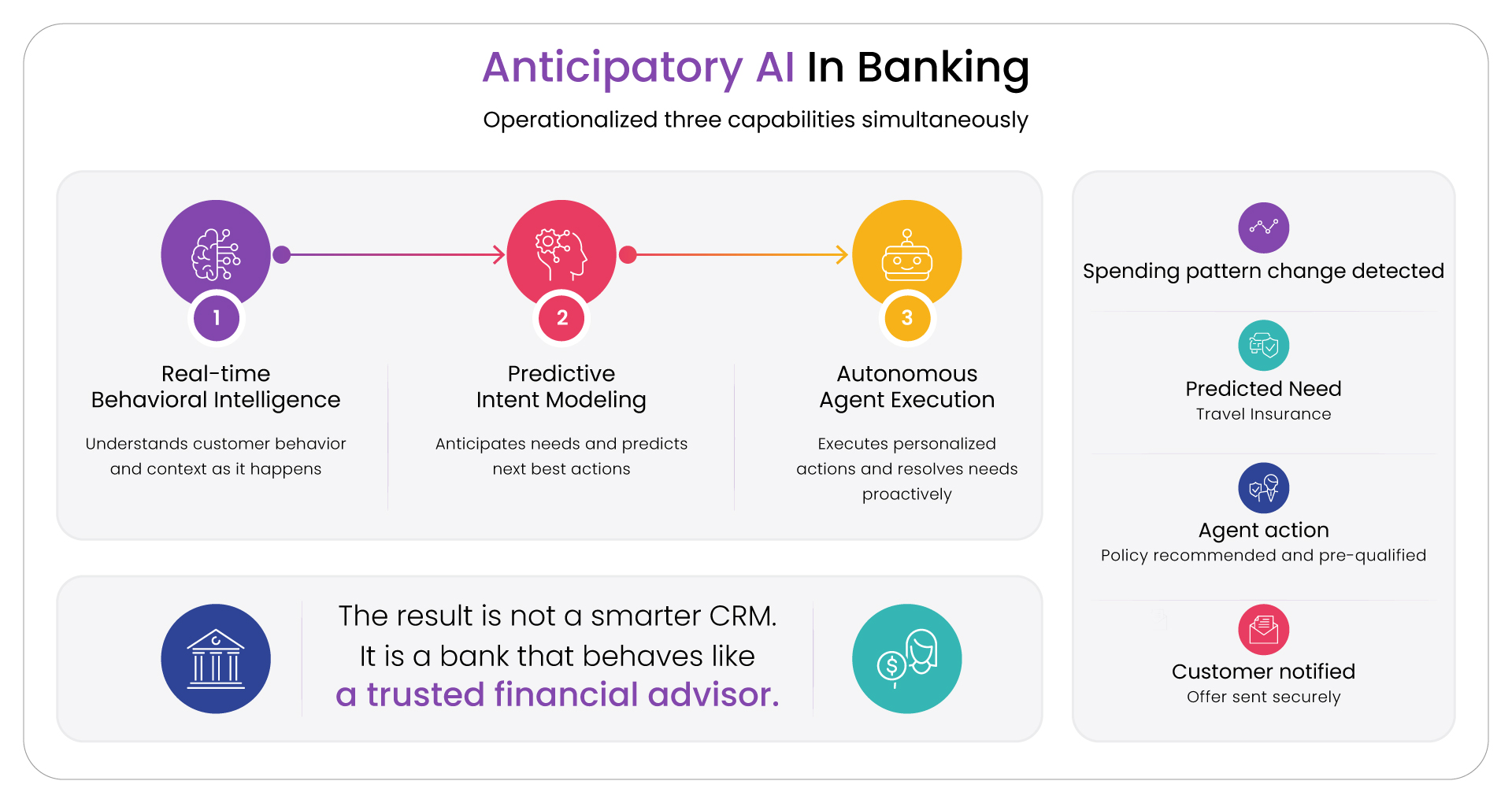
Anticipatory AI in banking operationalizes three capabilities simultaneously: real-time behavioral intelligence, predictive intent modeling, and autonomous agent execution. The result is not a smarter CRM. It is a bank that behaves like a trusted financial advisor, one that notices your salary hasn't arrived, reminds you of an EMI due tomorrow, or proactively adjusts your portfolio based on a market event, all without being asked.
Why BFS Is at the Inflection Point Now
Although hyper-personalization 2.0 is possible, the current BFS landscape has made it an absolute necessity.
- Data abundance has outpaced data intelligence. Banks are sitting on massive volumes of transactional, behavioral, and third-party data that are processed in cycles usually after the signals have long passed. A customer who searched for “home loan eligibility” at 9:47 PM has already moved on by the time the relationship manager calls the next morning.
- Matured banking AI agents. Modern agentic systems can autonomously plan, reason, call external APIs, and execute multi-step workflows within institutional guardrails.
- Customer expectations have been reset. Customers today are used to retail platforms hyper-personalizing recommendations within milliseconds. Such customers have no patience for bank that respond after days. With the bar set so high, BFS has no other option but to scale.
- Non-traditional competition is intensifying. The modern data architecture of Neobanks and fintechs can give them the edge over traditional banks.
The Architecture of Anticipatory Intelligence
Hyper-personalization 2.0 works best when data, intelligence and agent orchestrations work in sync and not in siloes.
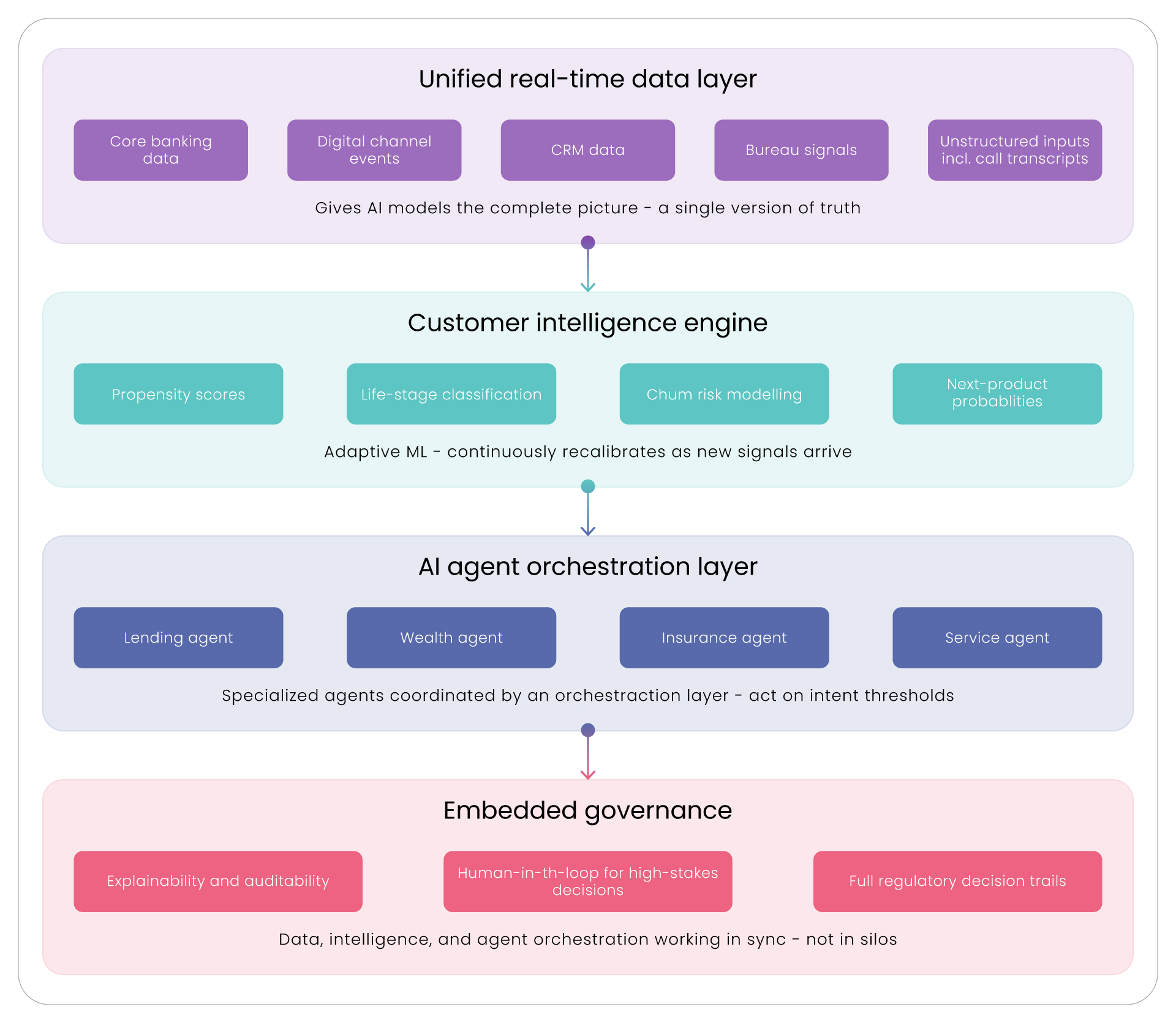
The foundation is a unified real-time data layer that combines core banking data, digital channel events, CRM data, bureau signals, and unstructured inputs like call transcripts. This is crucial as it gives the AI models the complete picture that it can train and work on.
On top of this sits a customer intelligence engine. The adaptive ML models that continuously compute propensity scores, life-stage classifications, churn risk, and next-product probabilities and constantly recalibrating as new signals arrive.
The intelligence layer then feeds a network of AI agents in financial services, each specialized by domain — lending, wealth, insurance, service — and coordinated by an orchestration layer. These agents act on intent thresholds without waiting for the customer to initiate.
Underpinning everything is embedded governance: explainability, auditability, human-in-the-loop mechanisms for high-stakes decisions, and full regulatory decision trails.
High-Value Use Cases
Proactive Life-Event Banking
When a customer's transactional patterns signal a major life event, such as marriage, home purchase, etc., anticipatory agents pre-position relevant products and send signals to relationship managers to contact customers immediately.
Predictive Churn Intervention
Churn is usually a long, slow process. However, anticipatory agents detect these weeks before departure and trigger personalized retention interventions.
Real-Time Credit Pre-Qualification
Rather than waiting for a loan application, AI agents continuously compute credit eligibility from real-time income flows. When a need is likely and a signal detected, the customer receives a pre-qualified offer. The application becomes a formality.
Intelligent Service Escalation
Anticipatory agents predict why a customer is calling before they speak based on recent transactions and app behavior. This allows pre-resolution of likely issues, reducing handle time, and freeing human agents for complex interactions.
How Aspire Systems Enables Hyper-Personalization 2.0
Delivering anticipatory banking requires engineering depth, BFS domain expertise, and the right platform foundation.
- FinEdgAI - Aspire Systems purpose-built data intelligence platform for financial services. It provides the foundational customer intelligence platform for banking, unifying disparate data sources, enabling real-time feature engineering, and surfacing actionable ML-driven insights at scale.
- Aspire Systems Databricks practice - brings the full power of the Data Intelligence Platform, like Delta Lake, Lakeflow, Unity Catalog, Mosaic AI to banking environments where governance, lineage, and compliance are non-negotiable. The lakehouse architecture eliminates the data silos that block real-time personalization, enabling banks to build, train, and deploy intelligence models on a unified governed platform.
- BFS 360 - Aspire Systems end-to-end banking transformation framework, spans core modernization, omnichannel digital platforms, AI and analytics, and cloud infrastructure thereby, embedding anticipatory AI as an integrated capability within the bank's existing technology estate, not a standalone bolt-on.
- SoftSpell - addresses the reality that most anticipatory AI ambitions are blocked at the legacy layer, not the strategy layer. Using GenAI, SoftSpell accelerates legacy code refactoring and surfaces deep insights into monolithic architectures to enable banks to modernize the core systems that feed the data layer without a full rip-and-replace.
- AFTA (Aspire Systems Framework for Test Automation) provides the quality assurance infrastructure that ensures agentic systems behave as designed across edge cases, regulatory scenarios, and system updates. This is a non-negotiable requirement for autonomous decision-making in regulated environments.
Frequently Asked Questions
What is anticipatory AI in banking? Anticipatory AI refers to multi-agent systems that predict customer needs before they are expressed and trigger autonomous actions to address them. They monitor continuous behavioral signals rather than waiting for customer-initiated events.
How is Hyper-Personalization 2.0 different from traditional banking personalization? Traditional personalization delivers segment-level offers based on historical data. Hyper-Personalization 2.0 uses real-time, individual-level intelligence to act on a specific customer's needs at the precise moment of need and often before that need is expressed.
What role do AI agents play in financial services personalization? AI agents for banking serve as the execution layer — monitoring signals, evaluating intent, and autonomously triggering actions at speed and scale that human teams cannot match.
Perspectives
The competitive moat in banking is shifting from product and price to intelligence and anticipation. AI agents in financial services are no longer a future capability. The difference between a bank that knows a customer needs a home loan and one that offers it before the search begins is the difference between relevance and irrelevance.
Hyper-personalization in banking at scale demands the right data architecture, the right intelligence layer, and the right agentic execution that are built by partners who understand both the technology and the regulatory reality of financial services.
In This Article
- From reactive to anticipatory
- What is Hyper-personalization 2.0
- Why BFS is at the inflection point now
- The architecture of anticipatory intelligence
- High value use cases
- Our Hyper-personalization 2.0 offer stack