

Insurance
Modern Insurance Systems Need More Than Surface-Level QA: Multi-Layered Testing for Stronger Go-Lives
Share this Article on


Insurance platforms today operate in a far more demanding environment than they once did. Modern policy administration systems are no longer single, self-contained applications. They support complex product configurations, frequent regulatory changes, integrations with multiple internal and external services, and always-on digital experiences for customers and agents.
A single policy transaction can now traverse multiple layers—user interfaces, APIs, rating engines, underwriting rules, compliance checks, billing services, data layers, reporting systems, and third-party integrations—before it ever reaches a customer or agent. As this scale and sophistication increase, expectations around stability, accuracy, and compliance rise just as quickly.
In this environment, success is no longer determined by whether one layer behaves correctly in isolation. It depends on how well logic, data, and integrations function across layers, and how consistently they do so under real-world conditions. Any weakness in this chain can ripple through the system, surfacing as failed releases, compliance gaps, or broken customer journeys.
Yet many insurers continue to rely on traditional testing approaches that focus on validating behavior at a single layer—often the UI or a limited set of APIs. While this may have been sufficient for simpler systems, in today’s tightly coupled insurance architectures it creates critical blind spots. Defects in rating logic, jurisdiction-specific rules, data transformations, or integrations can remain hidden until late in the release cycle—or worse, after production rollout.
These gaps are rarely the result of poor execution. More often, they stem from a testing model that has not evolved at the same pace as insurance platforms themselves. Traditional testing assumes that if one layer behaves as expected, the layers beneath or around it will too. In modern insurance ecosystems, that assumption breaks down quickly, exposing insurers to preventable release risk, operational disruption, and erosion of customer trust.
Why does traditional testing fail in modern insurance systems?
Hidden complexity across layers:
Much of an insurance system’s real complexity exists below the surface—in rating calculations, jurisdictional compliance logic, workflow orchestration, data transformations, and downstream integrations. Traditional testing methods, which often validate only one layer in isolation, struggle to adapt to this depth of interdependence. As a result, critical logic remains insufficiently tested, increasing the risk of post-release failures, system instability, and regulatory exposure.
Scalability and coverage constraints:
Exercising full business permutations through a single layer—whether UI, API, or batch—does not scale for insurance products with high variability across coverages, states, endorsements, and customer segments. These approaches are typically time-consuming and resource-intensive, forcing teams to limit coverage to meet release timelines. This trade-off often leads to delayed deployments, incomplete validation, and elevated operational risk.
Limited diagnostic value:
When failures are detected at only one layer, isolating the root cause across data, services, integrations, or messaging components becomes slow and complex. This lack of diagnostic clarity extends resolution cycles, increases downtime, and heightens the likelihood of customer dissatisfaction and financial impact—especially when issues surface in production or during regulatory audits.
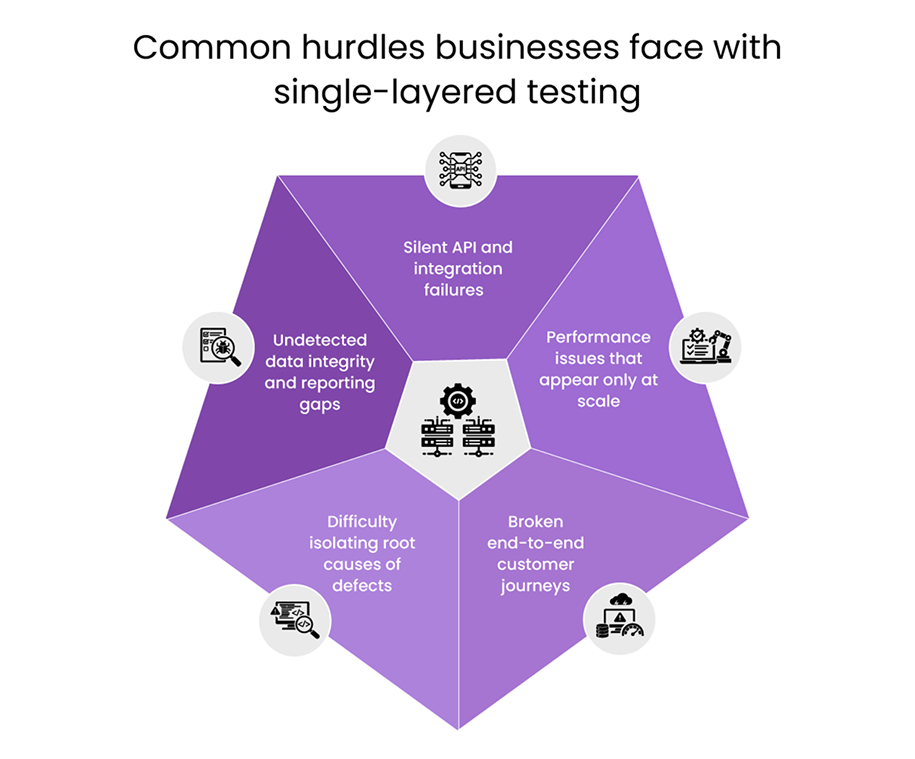
Hence, traditional testing provides limited assurance in modern insurance systems, leaving critical logic, integrations, and data flows insufficiently validated and increasing release risk.
To overcome these gaps, insurance testing strategies must evolve towards a multi-layered approach that distributes validation across APIs, services, data, and integrations, using each layer where it delivers the most value.
How does multi-layered testing help reduce risks in insurance software releases?
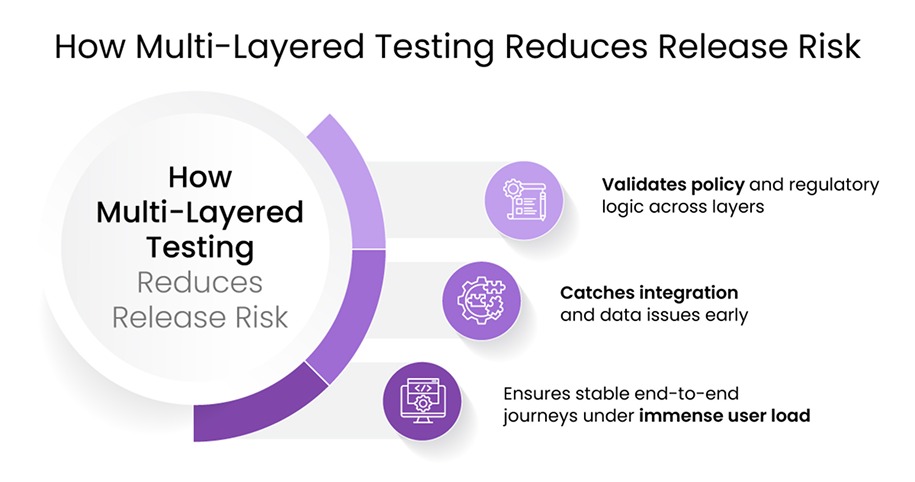
A multi‑layered approach combines functional, API, integration, workflow, performance, security, data integrity, and regression automation to give a complete view of release readiness. Aspire Systems’ insurance application testing services adopt this model—our Hyper‑Testing approach is designed to:
- Validate policy and regulatory logic at every layer by testing rating rules, underwriting guidelines, jurisdiction-specific compliance checks, and regulatory calculations not just at the UI, but across APIs, services, and data layers.
- Cover every layer with end-to-end automated and exploratory tests (UI ↔ API ↔ services ↔ data), ensuring policy changes or compliance updates do not break downstream processes such as billing, claims, reporting, or renewals.
- Include non-functional requirements such as performance, reliability, and security using best-in-class tooling critical for handling regulatory reporting loads, audit readiness, peak transaction volumes, and data privacy mandates.
- Improve economics by optimizing test design, execution, and maintenance, reducing rework caused by late-stage compliance defects and lowering overall TCO while improving ROI.
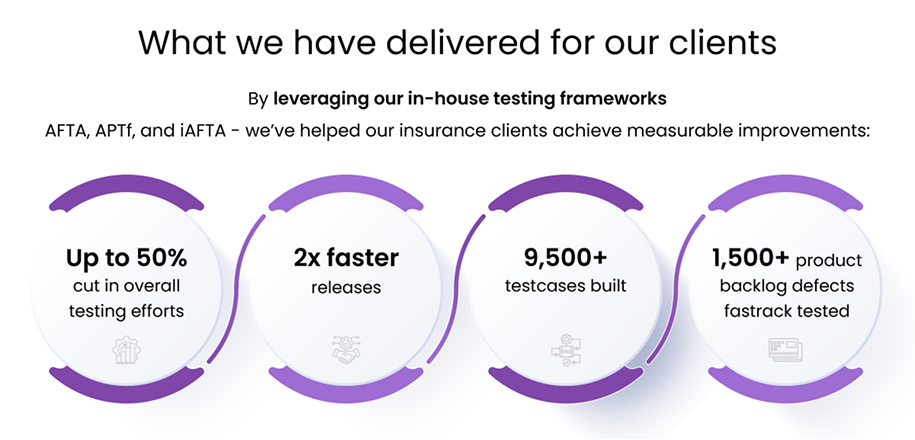
What multi-layered testing looks like in practice (illustrative layers):
1. UI & Accessibility — Policyholder self‑service for consistent, accessibility experiences from various ecosystems, quote‑to‑bind journeys, agent workflows.
2. API — Ensuring stable interactions with underwriting rules engines, rating APIs, claims services, billing APIs, third‑party risk and fraud systems.
3. Workflow — Testing underwriting queues, claims assignment rules, billing cycles, and event‑driven notifications with retries and timeouts.
4. Integration — Verifying seamless data flow with external data providers, payment platforms, adjuster/vendor systems, fraud tools, ISO/ACORD services.
5. Performance — Stress‑testing FNOL spikes, renewal loads, quoting surges, and CAT‑event claim volumes for throughput, latency, and failover.
6. Data Integrity — Reconciling policy, billing, and claims data with downstream reporting, actuarial inputs, commissions, and regulatory outputs.
How we leverage our home-grown frameworks and tools for multi layered testing and flawless releases
- AFTA (Aspire Systems’ Framework for Test Automation): AI/ML‑powered, Selenium‑based framework with self‑healing scripts and automated result analysis to cut script maintenance
- APTf (Aspire Systems’ Performance Testing framework): End‑to‑end performance coverage for speed, scalability, responsiveness, and endurance with real‑browser and simulation modes
- iAFTA (Guidewire testing service): Test automation framework for Guidewire products, supported by certified, product‑aware experts to ensure robust GT Framework implementation
TestSpell: Testing automated with entire SDLC
Alongside these frameworks, TestSpell fills the QA–development gap with requirement-driven automation aligned to your business goals. It creates test cases from JIRA, runs UI, API, and mobile tests in parallel, and delivers instant insights that shorten QA cycles and boost release confidence.
Strengthen your next go-live
These gaps are not the result of poor testing execution, but of a testing model that hasn’t kept pace with modern insurance architectures. Traditional approaches tend to validate functionality at a single touchpoint, assuming that supporting services, integrations, and data layers will behave as expected. In today’s insurance platforms where policy logic is spread across rules engines, workflows, microservices, and external systems, this assumption quickly breaks down. A change that appears safe at one layer can trigger failures elsewhere, and single-layer testing lacks the visibility to catch these cross-layer impacts. What emerges is an incomplete picture of release readiness, where systems pass tests but still fail in production, increasing operational risk, compliance exposure, and customer impact.
In This Article
- Why traditional testing fails in modern insurance systems
- The limits of single-layered testing
- How multi-layered testing reduces release risk
- What multi-layered testing looks like in practice
- How our home-grown frameworks and tools enable flawless releases
- TestSpell: Testing automated with entire SDLC