
Digital Software Engineering
Legacy Application Modernization ROI: What to measure and when to expect returns
Share this Article on


For businesses, legacy application/systems modernization is a strategic decision as it impacts business operations continuity, putting stress on growth. Legacy systems do support operations while constraining responsiveness, increasing costs, and limiting scalability. Additionally, modernization demands significant investment, and hence stakeholders are really worried about the investment and its return asking: “What is the ROI, and when do we see it?”
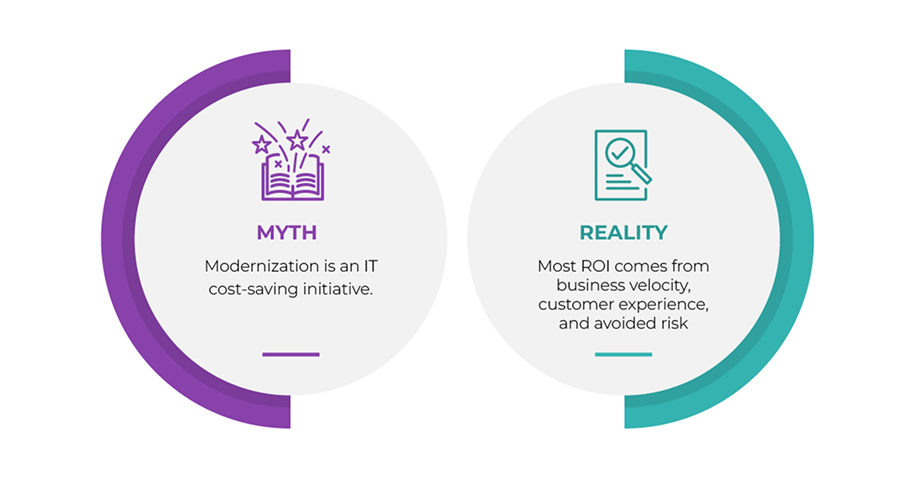
Most organizations measure modernization like a traditional IT cost-cutting project and end up with ROI models that look good on paper but mostly a recipe to failure. Business values of modernization are usually multi-dimensional and in a non-linear timeframe, making ROI assessment complex.
In this article we attempt to provide a practical framework to:
- Measure modernization ROI beyond cost-cutting key metrics that define success
- Set realistic timelines for returns
- Prioritize initiatives through data-driven investment that moves the needle fastest for your business
How Do Legacy Systems Increase Total Cost of Ownership (TCO)?
Legacy systems create costs beyond visible IT budgets, impacting hardware, software, process efficiency, and downtime. Expenses such as rising maintenance contracts, proprietary licenses, specialized staffing, and outdated hardware support compound over time. When fully loaded with depreciation and facilities, legacy infrastructure can cost in the range of 20–40% more than equivalent cloud environments.
Process inefficiency that never shows up as a line item
Manual workflows waste resources on data entry, paper processes, and error correction, slowing operations and inflating labor costs.
Legacy systems create:
- Manual re-keying of data between systems
- Paper workflows and offline approvals
- High error rates and rework
You rarely see ‘legacy tax’ in the P&L, but you feel it in:
- Slower order processing
- Longer onboarding cycles
- More people needed to do the same work
Reduced Total Cost of Ownership (TCO)
This metric extends beyond just licenses and servers. It includes:
- Downtime and incident response
- Security vulnerabilities and compliance risk
- Opportunity cost of delayed products and features
Modernization doesn’t just cut IT costs; it shifts spending from maintenance to funding new capabilities and strategic growth.
The 4-Vector Modernization ROI Model
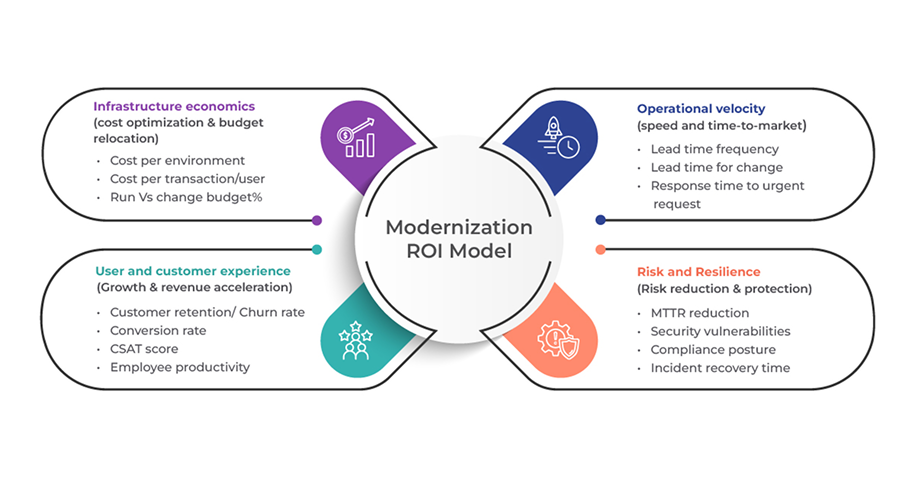
To make modernization ROI real, you need to measure impact across four dimensions: cost (infrastructure), operational velocity, customer experience, and risk.
Infrastructure economics
Key questions:
- What is your fully loaded monthly run cost for legacy (hardware, licenses, facilities, support, depreciation)?
- What does an equivalent cloud operating model cost at current usage?
Track:
- Cost per environment (prod, non-prod)
- Cost per transaction or per user
- % of IT budget spent on ‘run’ vs ‘change’
What you will discover: Beyond cost reduction, modernization enables organizations to reallocate IT spending from maintaining legacy systems toward innovation and growth initiatives. Leading enterprises aim to shift their IT budgets from a traditional 70% run and 30% change model toward a more balanced 50/50 split, unlocking greater capacity for strategic transformation.
Operational velocity
Modern architectures replace monoliths with systems designed for continuous change. The most revealing metrics are:
- Deployment frequency (releases per month)
- Lead time for change (idea → production)
- Time to respond to urgent business or regulatory requests
What you will discover: Effective modernization shifts releases from quarterly or annual cycles to weekly or daily deployments, enabling faster initiatives and quicker time-to-market. Smaller, frequent releases reduce risk, speed recovery, improve reliability, and create sustained competitive advantage.
User and customer experience (growth)
Modernized applications improve satisfaction, adoption, and efficiency for both customers and employees. The key metrics to track:
- Customer retention and churn
- Conversion rates and funnel drop-off
- CSAT scores
- Employee productivity (e.g., cases handled per agent per day and time to complete key tasks)
What you will discover: Modernizing customer-facing applications and internal systems directly fuels growth by removing friction from the user journey. When external applications are intuitive and responsive, user adoption rises, conversion funnels tighten, and customer churn drops dramatically. Simultaneously, upgrading internal systems eliminates clunky workflows for employees, yielding a substantial boost in daily productivity. Aligning the experience of both customers and employees allows companies to scale operations and drive higher revenue while lowering the overall cost to serve.
Risk and resilience
Modernization also changes your risk profile:
- Fewer critical vulnerabilities due to supported platforms
- Better observability and incident response
- Stronger compliance posture
Translate these into:
- Reduced probability and impact of major incidents
- Lower regulatory and reputational risk
- Faster recovery and continuity during disruption
What you will discover: Legacy systems increase hidden risks delayed security patches and poor observability lead to slower incident detection and higher business impact. Modernization reduces incident probability and cuts MTTR (Mean Time to Resolve) by 60–80%, minimizing downtime, regulatory exposure, and reputational loss.
How Long Does It Take to See ROI from Modernization?
One of the biggest mistakes is promising all the benefits in year one. Value arrives in phases.
0–6 months: early operational wins
You typically see:
- Declining infrastructure and license costs as environments move to cloud
- Visible performance improvements in migrated components
- Developer productivity gains as legacy bottlenecks are removed
This is where you build stakeholder confidence: show concrete, early wins with clean before/after metrics.
6–18 months: velocity and experience shift
As teams adopt agile practices, automation, and modern platforms:
- Release frequency rises, and changes are less risky
- Technical debt reduces in targeted domains
- Customer and employee experience begins to improve measurably
- Faster time-to-market for new features
- Better digital adoption and engagement
- Early revenue uplift from improved journeys
18–36 months: strategic flexibility
- At this stage, the conversation moves from IT to business models:
- Real-time insights enable new decision-making and pricing models
- Integrations with partners and ecosystems become easier
- Launching new products, regions, or channels takes weeks, not quarters
- Modernization becomes a strategic lever, not just an IT project
3+ years: modernization as an innovation engine
Over the long term:
- Enhancements that once took months are delivered in days
- Top talent is attracted by modern tools and ways of working
- Continuous improvement becomes cultural, not episodic
How can organizations maximize Modernization ROI?
Maximizing ROI on modernization requires detailed planning and disciplined execution. Organizations that adopt structured frameworks achieve stronger, more consistent returns than those relying on ad-hoc transformation efforts.
By assessing application portfolios to identify high-impact, lower-complexity opportunities—especially growth constraints, cost drains, and user pain points—businesses can secure quick wins that prove value, build confidence, and accelerate broader enterprise modernization.
Real-World ROI Success:
A US-based transportation company with a 40-year-old COBOL-based TMS (Transport Management System) faced scalability limits, manual inefficiencies, and knowledge gaps from churn. Aspire Systems deployed its legacy modernization services, reverse-engineering fragmented docs and auto-generating cloud-native microservices code, slashing project costs 40% and development effort by 20 to 25%.
Outcomes delivered multi-vector ROI—time to onboard a client reduced from 3 weeks to 48 hours (productivity), release cycles became shorter from 4 months to 3 weeks (velocity), invoice processing time minimized from 4.5 to 2 days with claims <1% (efficiency), coupled with low-defect delivery (risk). Early wins built momentum for sustained 2-3x returns over 18-36 months. Read the full case study here.
Conclusion
The key question is no longer, “Should you modernize?" but "How do you modernize in a way that maximizes strategic ROI and manages risk?"
When you approach modernization systematically, you:
- Convert technology from a constraint into a competitive capability.
- Redirect spend from maintenance to innovation.
- Build a durable platform for growth, resilience, and talent attraction.
With defined outcomes and continuous measurement across cost, velocity, experience, and risk, modernization stops being a one-time project, and becomes a predictable engine of business value.
In This Article
- How Do Legacy Systems Increase TCO?
- 4-Vector Modernization ROI Model
- Modernization ROI Timeline
- Optimizing Modernization ROI
- Conclusion