
 TL;DR
Cloud re-architecture is the process of redesigning an existing application’s code and structural patterns to exploit cloud-native features like dynamic auto-scaling, managed services, container orchestration, and serverless compute. Unlike basic cloud migration, it alters how the software functions to remove legacy limits, boost deployment velocity, and cut operational overhead.
Moving an application to the cloud is rarely enough. When enterprises lift-and-shift legacy workloads without changing their underlying design, they often trade physical data center constraints for unpredictable cloud bills and scaling bottlenecks. Executing a targeted cloud re-architecture strategy requires rethinking how software is built, decoupled, and deployed to fully leverage modern infrastructure.
By committing to a disciplined cloud application re-architecture, engineering teams eliminate structural tech debt, shorten release cycles, and turn legacy software into an engine for continuous innovation.
Why Basic Cloud Migration Falls Short?
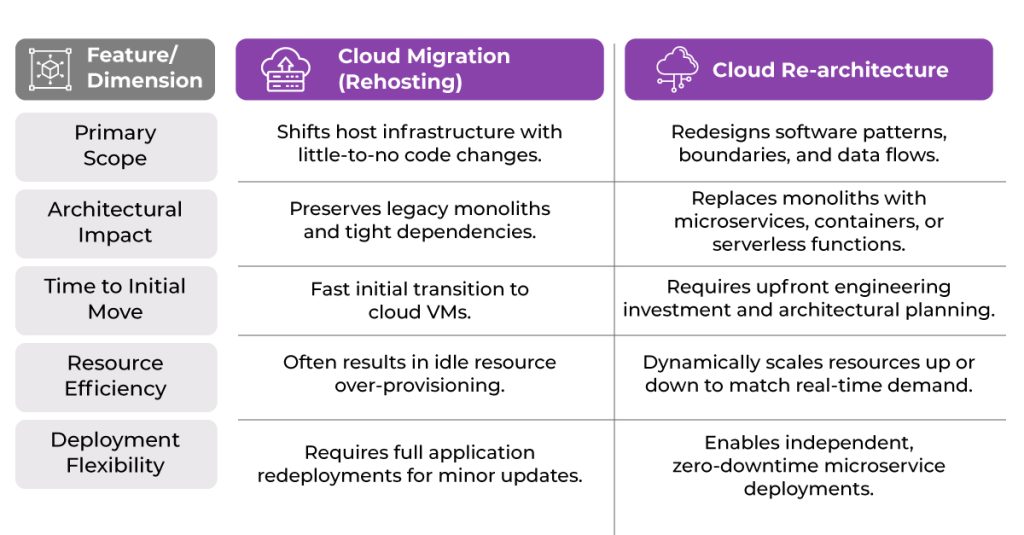
Most digital transformations stall because teams confuse migration with modernization. Rehosting (lift-and-shift) moves a monolithic application onto a cloud virtual machine as-is.
While it gets you out of the data center faster, it preserves all your existing architectural debt. Monolithic codebases, tight module coupling, and shared state stores remain intact. Re-architecting tackles the root cause breaking rigid monoliths into independent, distributed components designed specifically for cloud environments.
Cloud Migration vs. Cloud Re-architecture
When Should You Re-architect an Application?
You know your application needs a re-architecting pass when engineering velocity grinds to a halt. Look for these warning signs:
- The Monolith Bottleneck
Scaling requires provisioning capacity for the entire application rather than the single microservice under load.
- Cascading Failures
A minor defect in a reporting module unexpectedly takes down core payment processing.
- Release Gridlock
Monolithic build pipelines turn routine updates into high-risk, multi-hour deployment events.
- Integration Walls
Tightly coupled codebases struggle to connect with modern SaaS APIs, event streams, or AI tooling.
Key Cloud Re-architecture Strategies
Choosing the right pattern depends entirely on your workload requirements:
- Monolith to Microservices
Decomposes large systems into autonomous services centered around business domains, complete with independent databases.
- Containerization
Packages apps into lightweight containers (e.g., Docker) and manages them via orchestration platforms like Kubernetes for automated scaling.
- Serverless Compute
Moves bursty or event-driven workloads to fully managed services (e.g., AWS Lambda) to eliminate server management.
- API-First Design:
Establishes clean, contract-driven REST or gRPC boundaries to decouple front-end interfaces from backend logic.
- Event-Driven Architecture:
Replaces blocking, synchronous calls with asynchronous message brokers (e.g., Kafka) to maximize system fault tolerance.
The 8-Step Cloud Re-architecture Process
Step 1:
Assess Code & Dependencies: Run static analysis to map data flows, database constraints, and hidden tech debt.
Step 2:
Define Business Goals: Set hard targets for throughput, MTTR, release frequency, and cloud infrastructure cost baselines.
Step 3:
Select Target Patterns: Match workloads to microservice, container, or serverless topologies.
Step 4:
Design Target Architecture: Map out API contracts, security IAM roles, network boundaries, and state management.
Step 5:
Modernize Incrementally: Use the Strangler Fig Pattern to extract legacy modules step-by-step instead of risking a dangerous “big-bang” rewrite.
Step 6:
Automate Infrastructure (IaC): Use tools like Terraform or CloudFormation to make environments repeatable and version-controlled.
Step 7:
Verify Resilience: Run automated load testing, security scans, and chaos engineering drills.
Step 8:
Deploy & Observe: Roll out services using canary patterns while monitoring telemetry via distributed tracing.
Accelerating Time-to-Market and Innovation
Re-architecting directly removes the operational handcuffs that slow down product teams:
- Instant Provisioning: IaC spins up test and staging environments in minutes instead of weeks.
- Parallel Workflows: Decoupled service boundaries allow multiple squads to ship code simultaneously without stepping on each other’s toes.
- AI & Advanced Integration: Clean API interfaces make it straightforward to plug in cloud-managed AI/ML pipelines and real-time analytics engines.
Explore how automated release workflows enable this transition in our guide on DevOps and CI/CD Automation and Cloud Native Application Development Services.
Accelerate Your Transformation Journey
Cloud re-architecture turns legacy systems into agile, scalable assets. By tackling architectural debt head-on and automating delivery pipelines, organizations build a durable foundation for fast time-to-market and continuous growth.
To learn how expert guidance can streamline your architectural evolution, explore our Cloud Native Application Development Services or consult with our experts in Microservices Transformation.
FAQ
- What is the difference between cloud migration and cloud re-architecture?
Migration moves existing software to cloud infrastructure as-is. Re-architecture rewrites or restructures the application’s design patterns to fully leverage cloud-native services like auto-scaling, microservices, and serverless compute.
2. How does cloud re-architecture accelerate time to market?
It eliminates monolithic build dependencies, allows parallel feature development across teams, automates release pipelines with CI/CD, and enables instant infrastructure provisioning using Infrastructure as Code.
3. When should an enterprise re-architect a legacy application?
An enterprise should re-architect when monolithic constraints cause frequent downtime, slow release cycles, high operational costs, scalability caps, or difficulty integrating with modern APIs and cloud services.

- Cloud Re-architecture: Benefits, Process, Strategies & Time-to-Market Impact - October 15, 2026
- Embracing AI Automation: Future of Retail Software Testing with AI and ML - September 22, 2026
- The Performance Testing Paradox: Crack the code with APTf 2.0 - April 2, 2026
 Write to Us