
 TL;DR
What Is Technical Debt and Why Does It Matter?
Technical debt accumulates when temporary fixes or legacy design choices compromise long-term system maintainability. In legacy code modernization, unmanaged technical debt turns software development into a reactive maintenance loop. Engineering teams spend excess time fixing bugs, managing regression risks, and working around legacy constraints rather than delivering strategic business features.
Legacy applications often power critical business operations, but over time they accumulate layers of architectural friction, outdated patterns, and unoptimized code. Addressing technical debt in legacy applications is essential for organizations striving to maintain agility, scale operations, and execute a seamless legacy application modernization strategy. Modernizing legacy software without first eliminating technical debt is like building on an unstable foundation, it produces fragile systems that break under change.
What Is Technical Debt in Legacy Applications?
Technical debt in legacy applications is the cumulative cost and operational complexity caused by short-term design choices, outdated code structures, unmaintained dependencies, and tightly coupled architectures. It increases maintenance overhead, slows release cycles, restricts scalability, and impairs system stability. Organizations eliminate technical debt through static code analysis, architecture reviews, incremental legacy application refactoring, automated quality gates, and structured technical debt remediation frameworks.
How Technical Debt Impacts Enterprise Applications
Unmanaged technical debt presents serious risks to enterprise stability, operational efficiency, and top-line business growth:
- Slower Feature Delivery
Complex dependencies mean minor changes require extensive regression testing, increasing time-to-market.
- Increased Operational Costs
Engineering capacity shifts away from innovation toward constant bug fixing and emergency firefighting.
- Issues with Scalability
Monolithic bottlenecks and stateful designs hinder systems from scaling dynamically under heavy load.
- Security & Compliance Exposure
Outdated frameworks, unpatched third-party libraries, and hardcoded secrets create significant security risks.
- Integration Barriers
Legacy components lacking clean APIs struggle to connect with modern SaaS platforms and enterprise ecosystems.
- Developer Productivity Drops
Engineers working on fragile, overly complex legacy systems face burnout, lower velocity, and high onboarding friction.
Common Code Smells in Legacy Applications
Code smells are structural indicators of design flaws that build up technical debt and complicate cloud-native application modernization:
- Code-Level Smells
God Objects (classes with excessive responsibilities), long methods, duplicated code across modules, high cyclomatic complexity, and inactive dead code.
- Architecture-Level Smells
Tight coupling between components, cyclic dependencies, mixed presentation/business logic, and monolithic bottlenecks.
- Cloud-Readiness Smells
Hardcoded configurations, synchronous chains in distributed systems, lack of centralized logging, stateful designs, and manual scaling mechanisms.
5-Step Technical Debt Assessment Framework
Evaluating debt across code quality, architecture patterns, dependencies, and business impact ensures remediation investments deliver clear returns:
- Code-Level Assessment: Run static analysis tools to identify duplication, high complexity, security risks, and code smells.
- Architecture-Level Assessment: Evaluate module coupling, dependency topologies, shared database constraints, and state dependencies.
- Dependency Risk Assessment: Audit open-source libraries, commercial packages, and runtime environments for end-of-life status and unpatched vulnerabilities.
- Business Impact Assessment: Map code defects directly to business outcomes, such as support ticket volume, release delays, and system downtime.
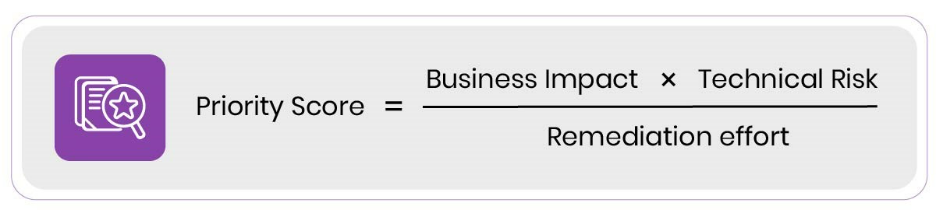
- Prioritization: Score and sequence remediation efforts using an impact-effort matrix:
Measuring Technical Debt: Key KPIs
Tracking software engineering and operational metrics helps teams establish quality baselines and measure improvement over time:
- Technical Debt Ratio (TDR): Maintain below 5% to keep remediation costs low relative to total application development cost.
- Code Duplication %: Keep under 3% to eliminate redundant logic and maintenance overhead.
- Cyclomatic Complexity: Target < 10 per method to simplify branch paths, lower defect density, and improve testability.
- Code Coverage %: Maintain > 80% automated test coverage to lower risk during large-scale refactoring.
- Deployment Frequency & MTTR: Track delivery agility and mean time to recovery to ensure high operational resilience.
Technical Debt Remediation Strategies
When executing technical debt management, selecting the right application transformation strategy depends on technical risk and business objectives:
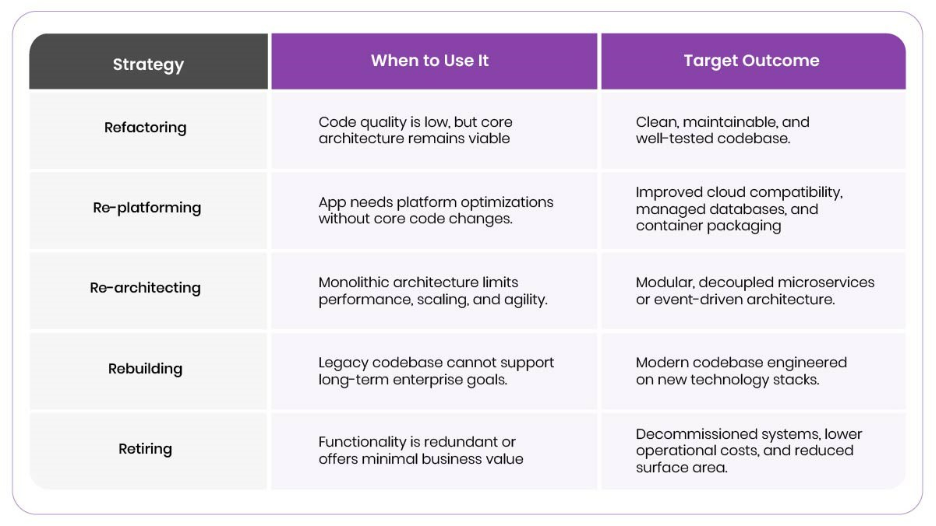
Refactoring vs. Replatforming vs. Re-architecting vs. Rebuilding
Understanding the differences between these core approaches ensures proper resource allocation across your application modernization strategy:
- Refactoring: Restructures existing code without altering external behavior (Low cost / Low risk).
- Replatforming: Upgrades runtime platforms, databases, or infrastructure with minimal code changes (Moderate cost / Low-to-Moderate risk).
- Re-architecting: Alters application structure and design patterns to unlock dynamic scaling and domain decomposition (High cost / Moderate-to-High risk).
- Rebuilding: Rewrites the application from scratch on modern frameworks to replace unsalvageable systems (High cost / High risk).
How Technical Debt Reduction Enables Application Transformation
Resolving technical debt is a vital enabler of broader digital transformation. High technical debt delays modern development workflows, slows automated pipelines, and blocks business adoption of modern platforms.
Eliminating code smells, externalizing configurations, and decoupling legacy applications enables organizations to transition smoothly from fragile monoliths to agile, scalable systems. To explore comprehensive frameworks for transforming mission-critical software, review our guide on Enterprise Application Transformation.
Cleaning core debt also prepares applications to adopt 12-Factor App principles and cloud-native practices. Learn more about these transitions in our articles on Modernizing Legacy Applications with the 12-Factor App Methodology and How CI/CD Powers Enterprise Application Transformation.
Set the Foundation for Sustainable Application Transformation
Managing technical debt is essential for building resilient, future-ready software. By systematically identifying code smells, measuring key metrics, and executing targeted refactoring workflows, organizations build stable platforms that drive ongoing business innovation.
Resolving technical debt transforms legacy software from a maintenance burden into a flexible, scalable asset. Partnering with experienced Application Modernization Services helps enterprises assess codebases, streamline refactoring workflows, and execute seamless application transformations.
FAQ
- What is technical debt in legacy applications?
Technical debt in legacy applications is the accumulated engineering cost caused by short-term fixes, outdated frameworks, redundant code, and monolithic architectural choices.
2. What is the difference between technical debt and legacy application modernization?
Technical debt is the underlying code and architectural friction within software. Legacy application modernization is the strategic process of refactoring, replatforming, or re-architecting systems to eliminate that debt.
3. When should an enterprise refactor vs. re-architect a legacy application?
Refactoring is best when the overall architecture remains viable but code quality needs improvement. Re-architecting is required when monolithic design, tight coupling, or state management blocks scaling and business agility.
4. How does reducing technical debt accelerate cloud migration?
Eliminating code smells, decoupling services, and externalizing configurations allows applications to move smoothly to cloud environments, unlocking elasticity and managed services without unexpected downtime.

- Technical Debt in Legacy Applications: A Practical Guide to Modernization - October 13, 2026
- FinOps 101: Elevating Cloud Cost Optimization for Business Value - September 11, 2025
- Migrating from AWS to Azure: A Comprehensive Guide - September 1, 2025
 Write to Us