
TL;DR
E-commerce platforms have evolved from rigid monolithic systems to flexible, composable architectures that better support today’s fast-changing retail landscape. Powered by MACH principles, composable commerce enables retailers to build scalable, modular, and customer-centric experiences while accelerating innovation and time-to-market. For retailers managing complex digital ecosystems, it provides the agility to adapt to changing consumer expectations, integrate new technologies, and create a future-ready foundation for sustainable growth.
The Evolution of the eCommerce Platforms
In 1869, Charles Darwin introduced “survival of the fittest,” emphasizing constant change. This concept is crucial in retail’s dynamic world, akin to nature’s evolution. The blog explores retail’s journey, emphasizing adaptability in eCommerce platforms.
The shift from monolithic platforms to composable commerce reflects the growing need for flexibility, scalability, and faster innovation. Understanding this evolution helps explain how retailers are adapting to changing customer expectations and increasingly complex digital ecosystems.
The Importance of Digital-Era Technologies
As customer expectations evolve, retailers are expected to deliver consistent experiences across channels while introducing new capabilities more quickly than before. Commerce platforms play an important role in supporting these goals by enabling faster updates, integrations, and customer-facing improvements.
Transitioning from monolithic systems to composable commerce highlights the necessity of adopting current technology as a smart strategy. This enables retailers to stay agile, meet evolving shopper expectations, remain competitive, and thrive in the fast-paced commerce landscape.
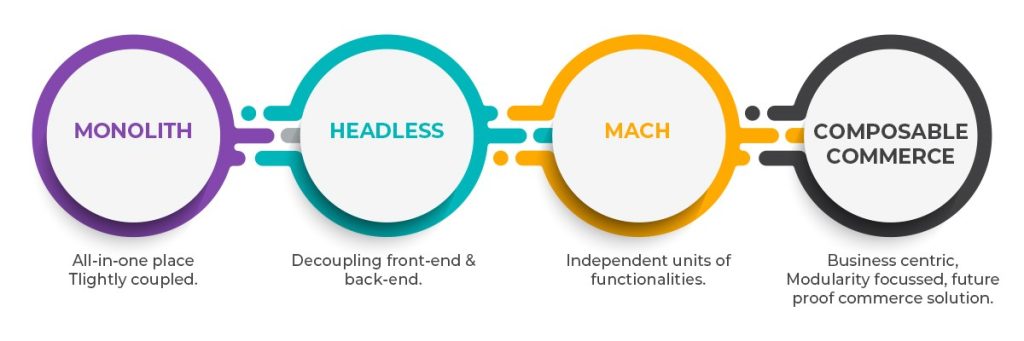
Having a quick look at the diagram below will give you an overview of the evolution journey:
The Monolith Era
What are Monolithic Platforms?
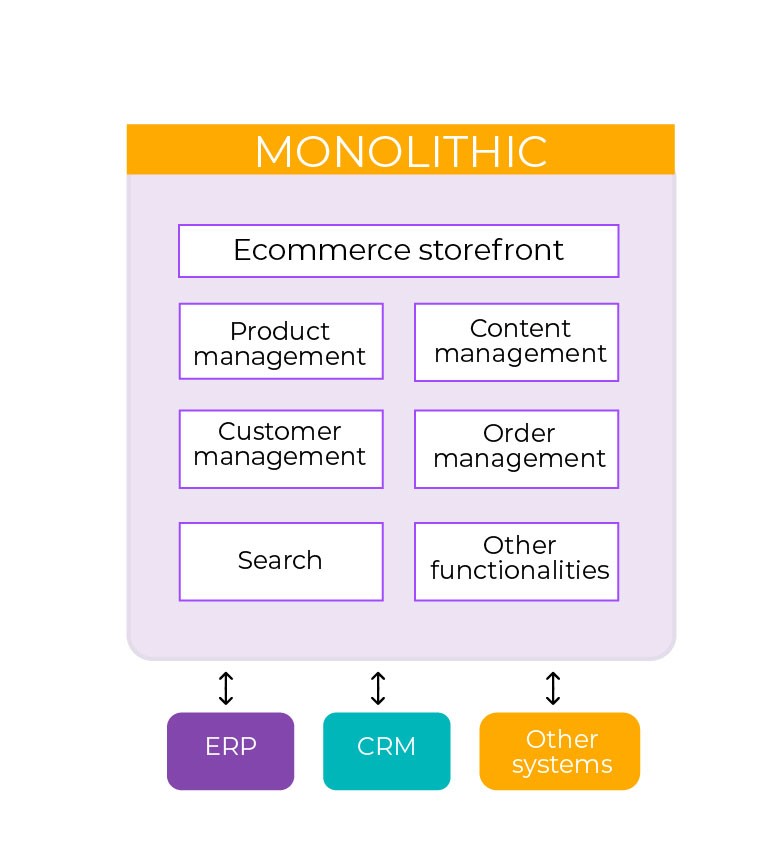
A monolithic eCommerce platform is an all-in-one system where all online retail components, such as inventory management and payment processing, are tightly integrated. While offering simplicity and ease of development, it may struggle with scalability and flexibility. Any modifications to one part can impact the entire platform, limiting adaptability to market changes and technological advancements. For example, because components are tightly coupled, changes often require updates and testing across multiple parts of the application. As transaction volumes and business demands grow, scaling individual functions independently can also be difficult, often requiring the entire application to be scaled, which can increase complexity and resource requirements.
What are the biggest limitations of a monolithic eCommerce platform?
Businesses relying on monolithic systems encounter several challenges in today’s dynamic and fast-paced digital landscape. Some of them of the crucial challenges that signal to take the leap of faith including the following:
- Scalability struggles: Monolithic platforms can struggle to keep pace with growing transaction volumes, expanding product catalogs, and omnichannel operations. Scaling often requires extensive modifications to the entire system, increasing costs, complexity, and the risk of performance bottlenecks.
- Rigidity and updates: Tightly integrated structure hampers flexibility, hindering swift adaptations.
- Extended development cycles: Cohesive design leads to lengthy development cycles, impacting agility.
- Integration hurdles: Challenges integrating with third-party applications or services.
- Maintenance complexities: System complexity poses challenges in troubleshooting and maintenance.
- Technology obsolescence risk: Difficulty keeping up with advancing technologies poses a risk of obsolescence.
- Reduced agility: Lack of modular components reduces adaptability to market changes.
- Limited innovation: Difficulty embracing innovative technologies, hindering competitiveness in a dynamic market.
The Headless Era
What are Headless Platforms?
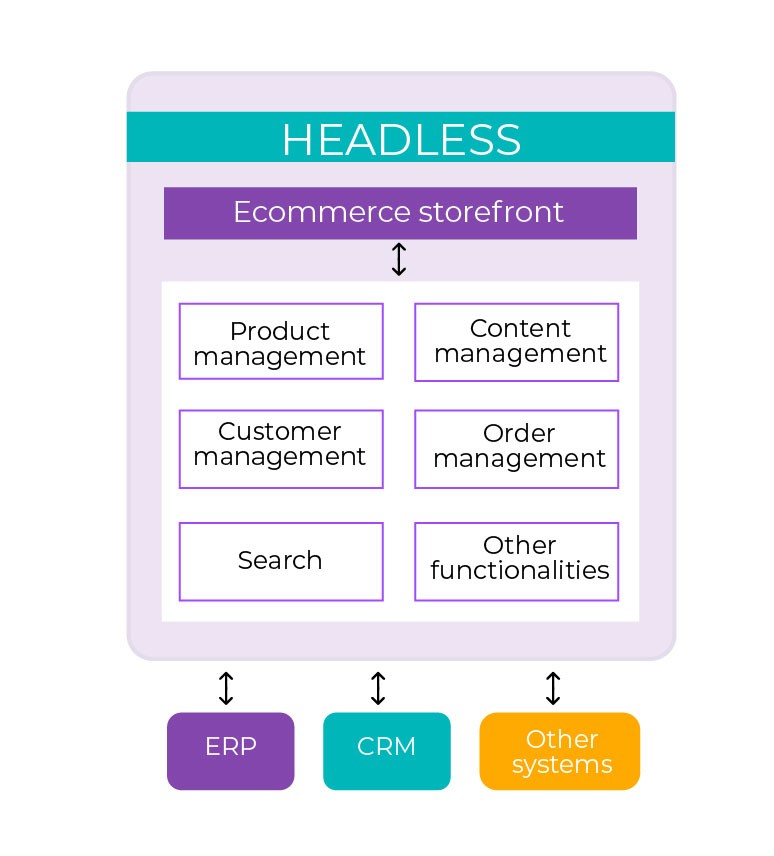
Headless eCommerce platforms revolutionize online retail by separating the front-end and back-end systems. In this architecture, the user interface (“head”) is decoupled from the content management system (“body”), offering unparalleled flexibility.
This decoupling allows seamless content delivery across diverse channels and devices. Developers can craft customized user experiences using various front-end technologies without compromising commerce functionalities.
Headless architecture laid the foundation for the next stage of commerce evolution: composable commerce. While headless focuses on decoupling the presentation layer from the back end, composable commerce extends this concept by enabling businesses to assemble and integrate independent best-of-breed commerce services across the entire technology stack.
What does the MACH architecture mean in practice, and why does it matter for enterprise retailers?
MACH (Microservices, API-first, Cloud-native, and Headless) enables retailers to build flexible, modular commerce ecosystems that can adapt quickly to changing business needs. Microservices and APIs simplify integrations, cloud-native architecture improves scalability and resource efficiency, and headless commerce supports personalized experiences across channels. For enterprise retailers managing complex operations, MACH accelerates innovation, reduces dependency on rigid platforms, and provides a future-ready foundation for delivering consistent and engaging customer experiences.
The rapid growth of omnichannel retail, rising customer expectations for personalized experiences, and the need to support emerging digital touchpoints have transformed the eCommerce landscape. Retailers are under increasing pressure to innovate quickly, integrate new technologies, and adapt to changing market demands.
Traditional monolithic platforms often struggle to deliver this level of agility, as making changes or introducing new capabilities can be time-consuming and complex. As a result, businesses are increasingly turning to composable commerce. This modular approach allows retailers to assemble and customize their digital infrastructure using best-of-breed components, enabling them to respond faster to customer needs, scale efficiently, and stay competitive in a dynamic market.
Composable commerce is crucial for businesses aiming to exceed expectations, adapt to trends, and seamlessly integrate new technologies, providing a scalable and future-proof solution in the evolving eCommerce landscape.
Defining Composable Commerce and its Key Elements
Composable Commerce is a modern approach to online business that’s like building with digital LEGO blocks. Instead of using a one-size-fits-all system, businesses can assemble, integrate, and manage individual commerce capabilities based on their specific requirements. Rather than relying on a single platform for every function, organizations can select and combine technologies that best support their business goals.
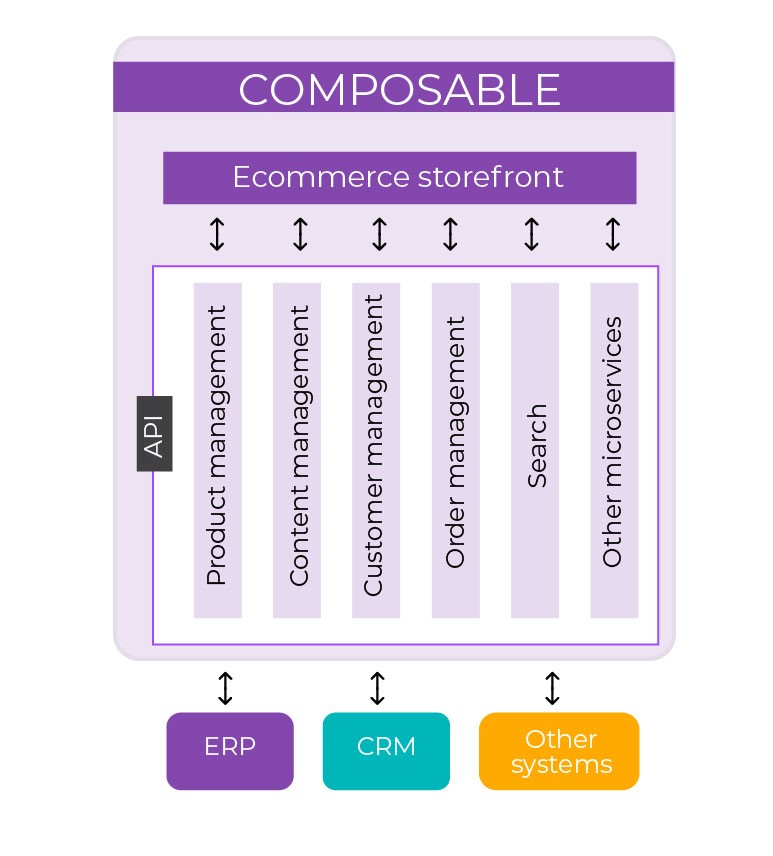
The key elements include modularity (breaking things into smaller, interchangeable parts), flexibility (making it easy to rearrange and customize), and scalability (being able to grow or shrink as needed).
With Composable Commerce, businesses have the power to create a tailored digital experience for their customers, adapting quickly to changes in the market.
Benefits of Composable Commerce
- Flexibility and customization: Composable Commerce allows businesses to choose and assemble individual components, offering flexibility in tailoring the eCommerce architecture to specific needs.
- Adaptability to change: With a modular structure, businesses can quickly adapt to changing market conditions, emerging trends, and evolving customer expectations.
- Rapid innovation: The composable approach enables swift integration of new technologies and features, fostering a culture of innovation and responsiveness in the eCommerce ecosystem.
- Scalability: Businesses can easily scale their operations by adding or removing components based on demand, ensuring efficient resource utilization and cost-effectiveness.
- Enhanced customer experiences: The ability to customize and optimize the eCommerce stack leads to improved and personalized customer experiences, increasing satisfaction and loyalty.
- Cost efficiency: Composable Commerce allows businesses to invest in and utilize only the components they need, reducing unnecessary expenses associated with traditional monolithic systems.
- Future-proofing: By embracing a composable approach, businesses position themselves for the future, as they can readily adapt to technological advancements and changing industry landscapes.
- Faster time-to-market: The modular nature of Composable Commerce facilitates quicker development and deployment of new features, reducing time-to-market for products and services.
Breaking Down Composable Commerce
Composable commerce enables businesses to build their commerce ecosystem using independent, best-of-breed components connected through APIs. Rather than relying on a single, all-in-one platform, retailers can choose specialized solutions for capabilities such as payments, search, inventory, and content management.
Built on MACH principles (Microservices, API-first, Cloud-native, and Headless), this modular approach allows individual components to operate and evolve independently, making it easier to adapt the technology stack to changing business needs.
How does it become possible?
Modularity and Flexibility at its Core
Composable commerce is a standout approach, emphasizing modularity and flexibility in the digital business landscape. It breaks down commerce systems into independent microservices, allowing businesses to update specific elements without disrupting the entire system.
This flexibility enables quick adjustments to meet evolving customer needs, making composable commerce dynamic and adaptable compared to traditional monolithic systems.
The API-first Architecture
Composable commerce revolves around API-first architecture, emphasizing connectivity and adaptability. This approach prioritizes designing system interfaces first, enabling seamless communication between components.
APIs act as bridges, fostering a modular and scalable ecosystem. For retailers, this makes it easier to integrate new technologies and connect third-party solutions without disrupting existing systems.
Consider composable commerce if
Retailers may consider composable commerce when:
- Existing commerce platforms make it difficult to introduce new features, customer experiences, or integrations quickly.
- Business growth is creating challenges in scaling across channels, markets, brands, or customer segments.
- Integrating new technologies, third-party applications, or commerce capabilities requires significant time and effort.
- Legacy or monolithic systems limit flexibility and slow down innovation.
- Different business units or regions require unique commerce experiences that cannot be easily supported by a single platform.
- Customer expectations for personalized, omnichannel experiences are outpacing the capabilities of current systems.
- Frequent platform upgrades or customizations are increasing operational complexity and costs.
- The business needs the freedom to adopt best-of-breed solutions without replacing the entire commerce stack.
The Way Forward for the Tomorrow’s eCommerce
As customer expectations continue to evolve, the limitations of monolithic commerce platforms have become increasingly apparent. Retailers need greater flexibility, scalability, and agility to adapt quickly to changing market demands and emerging technologies.
This shift has accelerated the adoption of MACH-based and composable commerce architectures, enabling businesses to select, integrate, and scale best-of-breed solutions without being constrained by a single platform. By decoupling commerce capabilities and embracing a modular approach, retailers can innovate faster, deliver better customer experiences, and future-proof their technology investments.
The future of commerce belongs to retailers that can adapt and evolve continuously. Composable commerce provides the foundation to do just that. Ready to explore what a composable future look like for your business? Connect with Aspire Systems to get started.

- Why Intent Is the New Currency in Retail and How Tanya Converts It into Sales - August 10, 2026
- Questions to Ask When Vetting Salesforce Implementation Firms - August 7, 2026
- Evaluating the Right Salesforce Partner: Criteria & Red Flags - July 24, 2026
 Write to Us