
Why Claims Success Is Now Measured in Customer Confidence, Not Just Cycle Time
Share this Article on


 TL;DR
Speed in insurance claims processing has become an industry standard, not a competitive advantage. The next frontier is customer confidence: built through decision accuracy, explainability, and consistent human-in-the-loop governance across the claims journey. Insurers that engineer decision quality and measure it through a Claims Confidence Index, combining NPS at closure, perceived fairness, and post-claim retention, will outperform those still optimising for cycle time alone.
For two decades, the claims function has been engineered on industrial logic: minimize elapsed time from First Notice of Loss to settlement, maximize straight-through processing, and drive touchless resolution ever higher. These metrics delivered real value, but they were always measuring execution, not outcome.
What was once a competitive edge has quietly become an industry baseline. Automated triage, AI-assisted damage assessment, and near-instant payouts are now standard across leading Insurance providers for low-complexity losses. When speed becomes universal, it stops conferring advantage and simply satisfies a threshold requirement.
When speed becomes the industry standard, it stops being an advantage. The next claims differentiator is already forming, and it has nothing to do with how fast the claim closes.
The next generation of insurance claims transformation will not be defined only by how quickly insurers process decisions. It will also depend on the accuracy, consistency, and explainability, of those decisions, and how clearly they are communicated to customers. Decision quality is the mechanism. Customer confidence is the outcome it produces. Insurers that treat these as separate initiatives will underperform those that engineer them as one connected system, where data, AI, automation, and human judgment work together across the value chain.
The Hidden Economics of Claims Confidence
The business case for this shift becomes clear when you trace what happens when customer confidence falls, and what becomes possible when it holds.
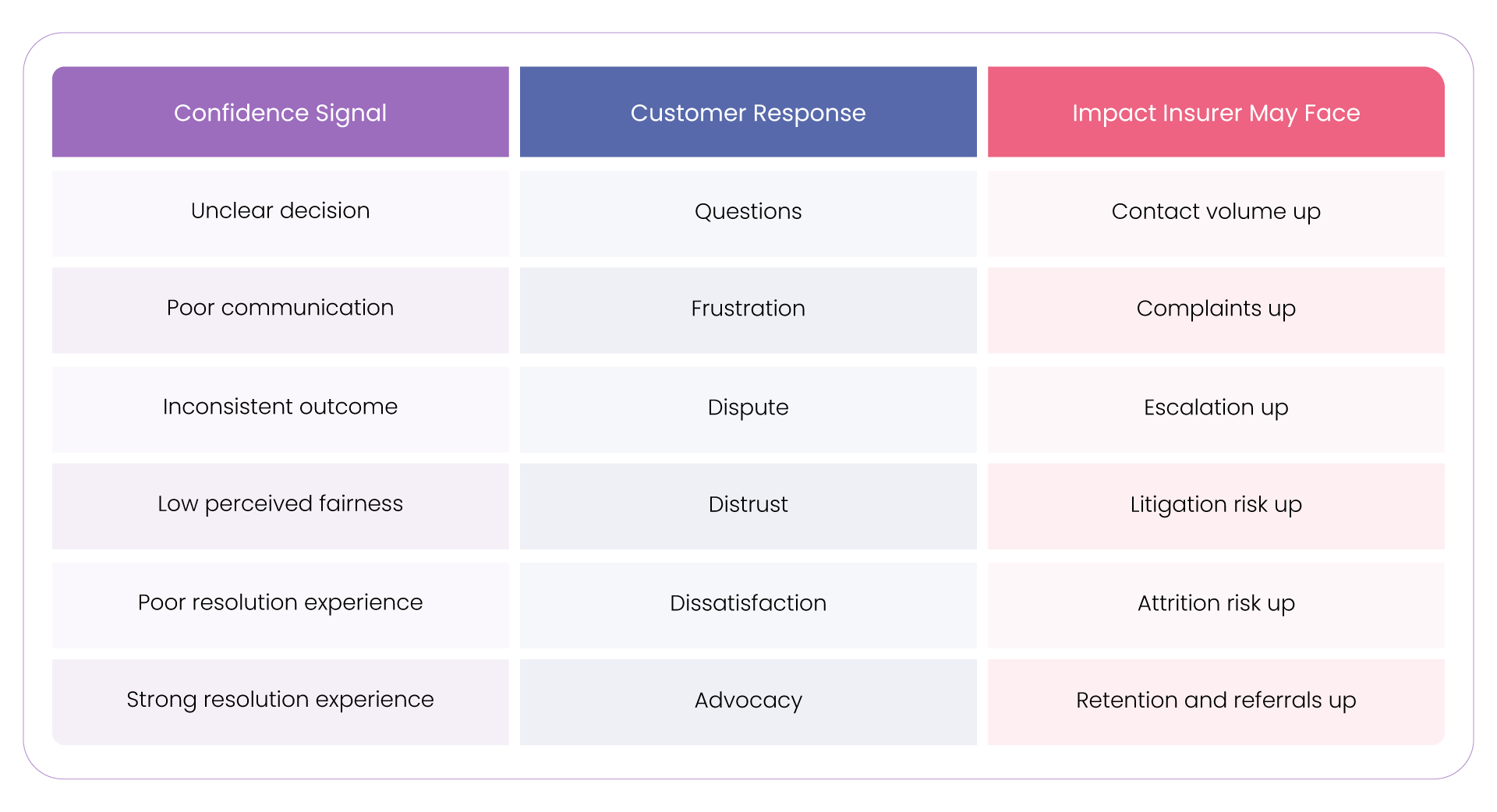
Every row is either a cost that compounds quietly, or a return that builds over time. The operational and financial consequences of low claims confidence, rising complaint volumes, legal exposure, and attrition at renewal, are measurable and material. Yet most Insurance providers still manage them as downstream service problems rather than upstream design choices. That is the gap this shift is designed to close.
A claim resolved in 48 hours but perceived as unfair still creates a detractor. A longer claim handled with transparency can turn a difficult outcome into a retained customer.
The Strategic Shift: From Throughput to Trust
Customer confidence is the policyholder’s conviction, at the point of loss, that the outcome will be equitable, transparent, and handled with genuine regard for their circumstances. That conviction is not manufactured through service gestures. It is earned through decision quality itself, then reinforced by how clearly the outcome is conveyed.
Effective insurance claims management today requires reframing the optimization target entirely. The relevant metrics are no longer automation rate alone, but decision accuracy, consistency across similar claims, explainability of AI-assisted determinations, and well-calibrated human intervention at the moments that need it.
This is measurable, and it correlates directly with retention, cross-sell, and litigation frequency. Insurers with mature voice-of-customer programs find that policyholders who report low trust in a claims decision are markedly more likely to retain legal counsel and to attrite at renewal, regardless of how fast the claim closed. A claim resolved in 48 hours but perceived as opaque still creates a detractor. A longer claim handled with proactive transparency can convert a contested outcome into a retained, referring customer.
Speed still matters. But it is no longer a complete account of insurance claims processing performance.
Engineering Confidence: The Operating Model Behind the Shift
Closing the gap between decision quality and customer confidence does not happen through point solutions. It requires an operating model where AI, data, automation, and human expertise are deliberately sequenced across the claims journey, with each stage designed not just to move the claim forward, but to build the policyholder’s trust as it moves.
At intake, this means capturing the loss accurately and reducing friction at the moment anxiety is highest, so the customer’s first interaction with the process feels handled, not processed. Across investigation and assessment, it means assembling policy history, documentation, and context in a way that stops customers from repeating information the insurer already holds, and that gives adjusters what they need without having to chase it. Throughout the journey, it means keeping customers informed before they have to ask, because people tolerate delay considerably better when they understand its cause and its timeline.
At the point of decision, the operating model faces its most consequential test. A well-explained adverse decision often preserves more customer confidence than an unexplained favorable one. That is the part most AI in insurance claims processing implementations underinvest in: optimizing the decision without engineering for how it lands.
A well-explained adverse decision often preserves more customer confidence than an unexplained favorable one. That is the part most AI implementations underinvest in.
What connects these stages is a claims intelligence layer, not a set of isolated tools, but a connected operating capability where each interaction captures something useful, each decision is traceable, and the logic behind every outcome is both defensible internally and comprehensible externally. AI handles volume, consistency, and context assembly. Human judgment handles complexity, edge cases, and the moments where the customer relationship is at stake. The strongest outcome is possible only when both work together.
Building the Claims Confidence Index
Forward-looking Insurance providers should consider not just how they execute this shift, but how they measure it.
Cycle time and combined ratio will remain on the executive scorecard, and they should. But alongside them, Insurance providers that are serious about confidence as a strategic lever are building what might be called a Claims Confidence Index: a composite measure combining net promoter score at closure, perceived fairness ratings, satisfaction with communication cadence, and post-claim retention by cohort.
This should not be viewed as a soft metric. It can help insurers identify potential litigation risk, renewal attrition, and customer advocacy trends that may strengthen or gradually erode the book of business. Insurers that track it consistently find it surfaces problems and opportunities that cycle time data alone may not reveal.
The insurance providers that pull ahead in the next five years will be the ones that deliberately engineer decision quality, measure the confidence it creates, and treat both as primary performance indicators. That is the competitive frontier that speed and insurance claims automation together, without the confidence layer, can no longer defend.
Where Aspire Systems Comes In
Aspire Systems works with enterprise insurers to design and implement the connected claims intelligence layer this shift requires. Our claims transformation services bring together AI-led automation, human-in-the-loop governance, and the integration capabilities needed to make this work across existing claims ecosystems, not just in greenfield environments.
If your leadership team is evaluating how to move from throughput metrics to confidence-led insurance claims management, or determining where to begin, we would welcome that conversation.
FAQs
Q: What is a Claims Confidence Index?
A: A composite performance measure combining net promoter score at closure, perceived fairness ratings, satisfaction with communication cadence, and post-claim retention by cohort, used by forward-looking insurers to track decision quality and its impact on customer trust alongside traditional metrics like cycle time and combined ratio.
Q: Why is speed no longer enough in insurance claims management?
A: Automated triage and near-instant payouts are now standard across leading carriers for low-complexity losses. When speed becomes universal, it satisfies a threshold requirement rather than conferring competitive advantage. Decision quality, explainability, and customer confidence have become the next differentiators in insurance claims transformation.
Q: How does AI improve customer confidence in claims processing?
A: AI in insurance claims processing improves confidence when it is sequenced with human judgment across the claims journey: handling volume, consistency, and context assembly while human expertise manages complexity, edge cases, and high-stakes decisions. The strongest outcomes require both working together within a governed, explainable operating model.
In This Article
- The Hidden Economics of Claims Confidence
- The Strategic Shift: From Throughput to Trust
- Engineering Confidence: The Operating Model Behind the Shift
- Building the Claims Confidence Index
- Where Aspire Systems Comes In