
Where Does Your Enterprise Stand on the AI Maturity Curve?
Share this Article on


From AI Experimentation to Enterprise Intelligence
The journey from using AI to operating as an AI-native business
 TL;DR
- AI maturity is not measured by the number of models, use cases or tools deployed. It is the ability to consistently convert data, intelligence, and automation into measurable business outcomes, and repeat that success across the enterprise.
- Enterprises progress through five stages: AI Curious, AI Enabled, AI Integrated, AI Orchestrated and AI Native. Different functions often sit at different stages.
- Five dimensions reveal true maturity: business value and economics, data and enterprise knowledge, AI and software engineering, workflow integration and autonomy, and people, governance and operating model.
- Avoid the pilot, platform, and autonomy traps. Establish your baseline, prioritize two or three high-value opportunities, build for reuse, transform workflows and scale proven value, not technology for its own sake.
Artificial intelligence is no longer a differentiator. How effectively an enterprise transforms AI into business outcomes is.
Every enterprise today has an AI story. Some are experimenting with copilots. Others are deploying generative AI applications, modernizing data platforms, automating business processes, or building intelligent products. A smaller group is beginning to redesign how work gets done, how decisions are made, and how business value is created.
Yet, there is a fundamental question that technology adoption statistics rarely answer:
Has AI changed how your enterprise operates, or has it simply added another layer of technology to the way it already works?
The answer reveals where an enterprise truly stands on the AI Maturity Curve.
The AI Maturity Curve Is Not a Technology Roadmap
AI maturity is often measured by the number of use cases deployed, models developed, employees trained, or AI platforms procured. These metrics indicate activity, but they do not necessarily indicate maturity.
An enterprise can have hundreds of AI experiments and still struggle to scale a single solution across business units. It can invest millions in a modern data platform while its business decisions remain dependent on spreadsheets and manual intervention. It can deploy generative AI across the organization without fundamentally improving customer experience, operational efficiency, or time to market.
True AI maturity is the ability to consistently convert data, intelligence, and automation into measurable business outcomes—and repeat that success across the enterprise.
This journey is not simply about moving from traditional AI to generative AI and then to agentic AI. It involves the progressive evolution of business processes, data foundations, engineering practices, decision-making, governance, and operating models.
The Five Stages of Enterprise AI Maturity
The following five-stage model provides a practical framework for understanding this evolution. Enterprises may occupy different stages across different functions; maturity is rarely uniform across the organization.
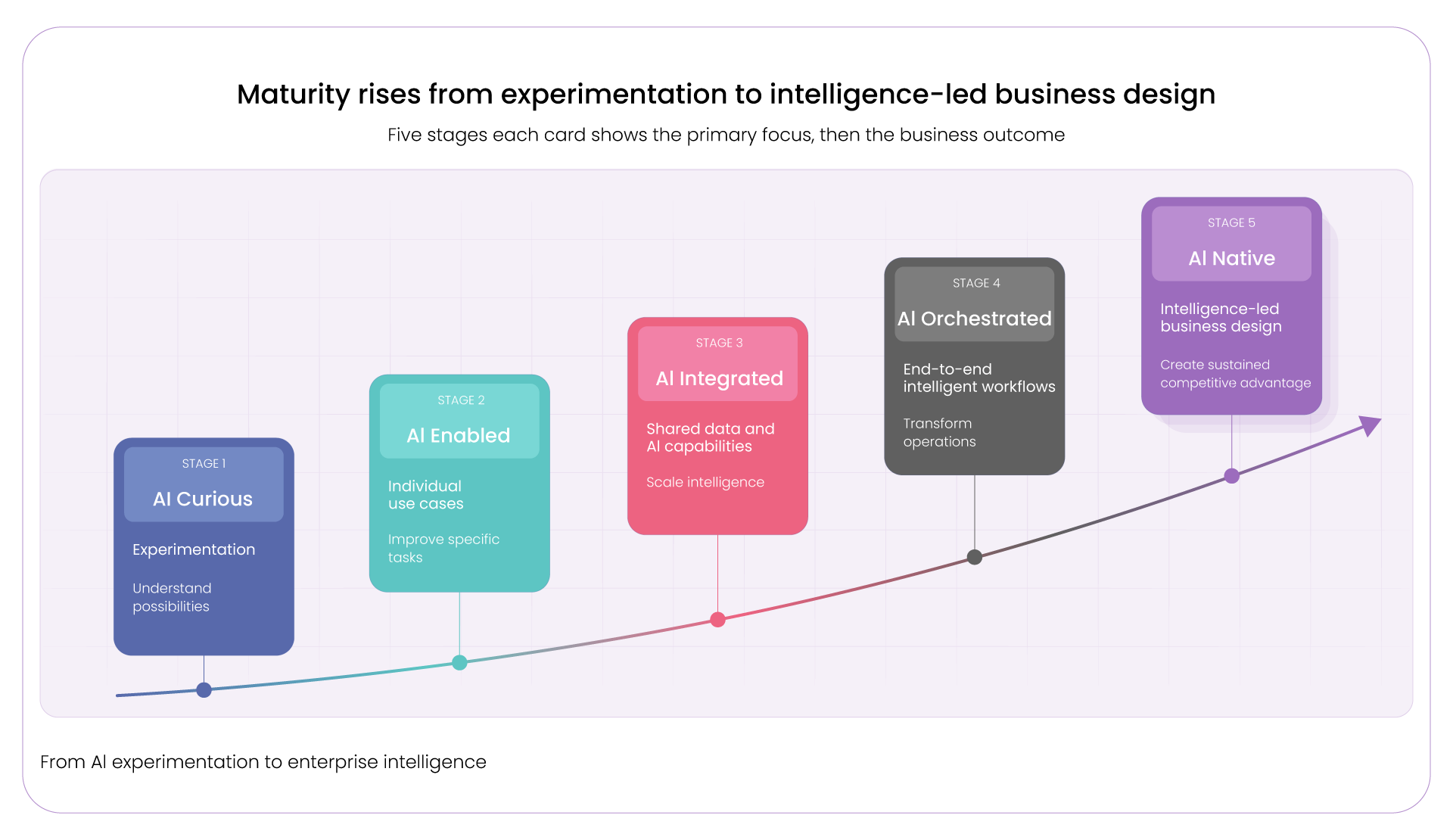
Stage 1: AI Curious — Exploring Possibilities
At this stage, AI is primarily an innovation initiative. Business leaders are exploring possibilities; technology teams are running proofs of concept, and employees are experimenting with publicly available or enterprise-approved AI tools.
Typical initiatives include chatbots, basic predictive models, generative AI assistants, and isolated automation projects.
The organization is asking, “What can AI do for us?”
The challenge: Experiments are often disconnected from strategic priorities. Success is measured by technical feasibility or demonstration quality rather than sustained business impact.
The next move: Identify high-value business problems, establish measurable baselines, and prioritize use cases based on business value, feasibility, data readiness, risk, and scalability.
The objective is not to generate more proof of concept. It is to identify the few opportunities worth industrializing.
Stage 2: AI Enabled — Solving Specific Business Problems
The enterprise begins deploying AI in production to solve defined problems. Predictive analytics, computer vision, natural language processing, intelligent document processing, recommendation engines, and generative AI applications start delivering tangible value.
Examples include improving demand forecasts, accelerating document processing, enhancing fraud detection, reducing customer service handling time, and assisting software engineers.
The organization is asking, “How can AI improve this business process?”
The challenge: Solutions often remain isolated. Each initiative may have its own data pipelines, integration patterns, monitoring mechanisms, and support model. A successful pilot in one department does not automatically translate into enterprise-wide adoption.
The next move: Establish reusable AI engineering practices, production-grade deployment, model monitoring, security controls, integration standards, and business ownership.
The objective is to transform promising use cases into dependable business capabilities.
Stage 3: AI Integrated — Building an Enterprise Intelligence Foundation
At this stage, AI is no longer treated as a collection of independent applications. It becomes an integrated capability supported by modern data architecture, enterprise knowledge, shared AI services, software engineering practices, and responsible AI controls.
The enterprise connects information across systems, establishes governed access to data, develops reusable components, and embeds intelligence into existing applications and workflows.
This is where data engineering, semantic layers, knowledge graphs, vector search, retrieval-augmented generation (RAG), model operations, and enterprise AI platforms become strategically important.
The organization is asking, “How do we make intelligence available wherever the business needs it?”
The challenge: Fragmented data ownership, inconsistent business definitions, legacy integration, unclear accountability, and disconnected technology investments can prevent AI from scaling.
A sophisticated model cannot compensate for inaccessible data, ambiguous business context, or a poorly designed business process.
The next move: Build an AI-ready data foundation, reusable enterprise knowledge services, a common architecture, and a governance model that enables teams to deliver intelligence securely and consistently.
The objective is to move from isolated intelligence to an enterprise-wide capability.
Stage 4: AI Orchestrated — From Applications to Intelligent Workflows
This is where the maturity curve begins to change the operating model.
AI is embedded across end-to-end workflows rather than confined to individual tasks. Generative AI, predictive models, business rules, traditional software, and intelligent automation work together to support complex business processes.
Agentic AI introduces systems capable of pursuing defined goals, using approved tools, retrieving enterprise information, coordinating multiple steps, and requesting human intervention when necessary.
For example, an insurance claims workflow may combine document understanding, policy retrieval, fraud-risk signals, eligibility rules, workflow automation, and human approval. The value comes not from any one model but from the coordinated intelligence of the entire process.
The organization is asking, “How can we redesign the workflow around intelligence rather than simply add AI to existing steps?”
The challenge: Agentic systems introduce new concerns around permissions, unreliable outputs, exception handling, traceability, operational resilience, and accountability. Greater autonomy without appropriate controls can increase risk rather than value.
The next move: Establish workflow-level orchestration, explicit decision boundaries, human-in-the-loop controls, observability, evaluation frameworks, and measurable service-level and business outcomes.
The objective is to optimize entire business processes—not merely individual tasks.
Stage 5: AI Native — Intelligence as a Core Business Capability
At the highest stage, AI is embedded into the enterprise's products, operations, decision-making, and business models.
The organization does not approach AI as a separate technology initiative. Intelligence becomes part of how it designs products, serves customers, allocates resources, manages risk, develops software, and responds to changing market conditions.
AI systems may continuously detect emerging patterns, recommend or execute permitted actions, personalize customer interactions, optimize operations, and help teams make better decisions. People remain accountable for strategic direction, risk, judgment, and decisions requiring human authority.
The organization is asking, “How would we design this business if intelligence were available at every meaningful decision point?”
The challenge: The enterprise must evolve its leadership model, workforce capabilities, governance, economics, and culture alongside its technology. AI-native operations cannot be achieved by deploying autonomous agents on top of fundamentally broken processes.
The next move: Continuously redesign business capabilities, develop AI-literate leadership, establish outcome-based investment models, and build an operating model in which humans and intelligent systems work together.
The objective is not maximum automation. It is a maximum sustainable business advantage.
The Curve at a Glance
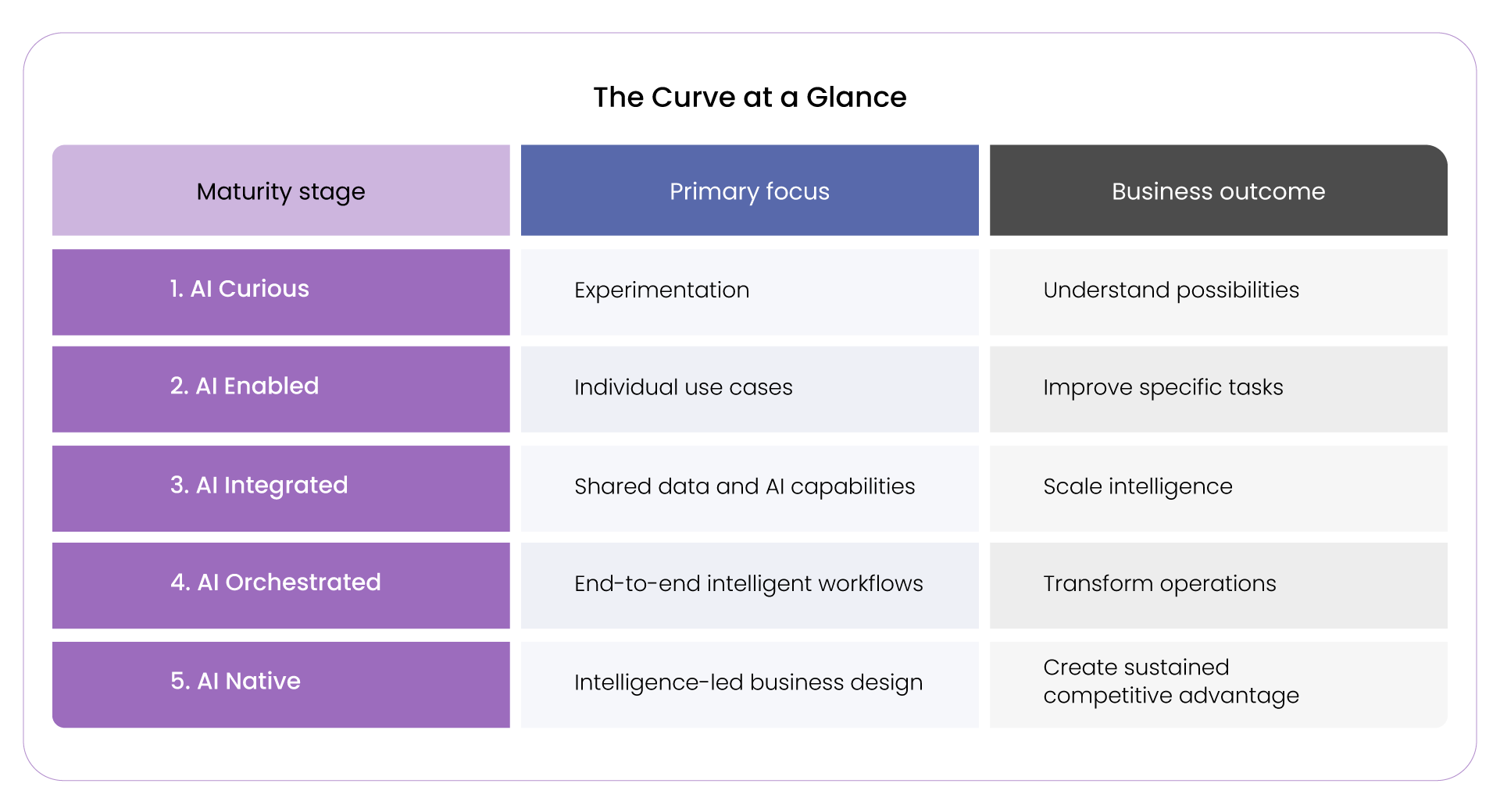
The progression is not strictly linear. An enterprise may be AI-native in customer recommendations, AI-integrated in software engineering, AI-enabled in finance, and AI-curious in supply chain operations. The real task is to understand these differences and prioritize the capabilities that matter most.
Five Dimensions That Reveal Your True AI Maturity
A meaningful assessment must look beyond technology deployment. Five dimensions help reveal whether the enterprise is progressing or merely accumulating AI initiatives.
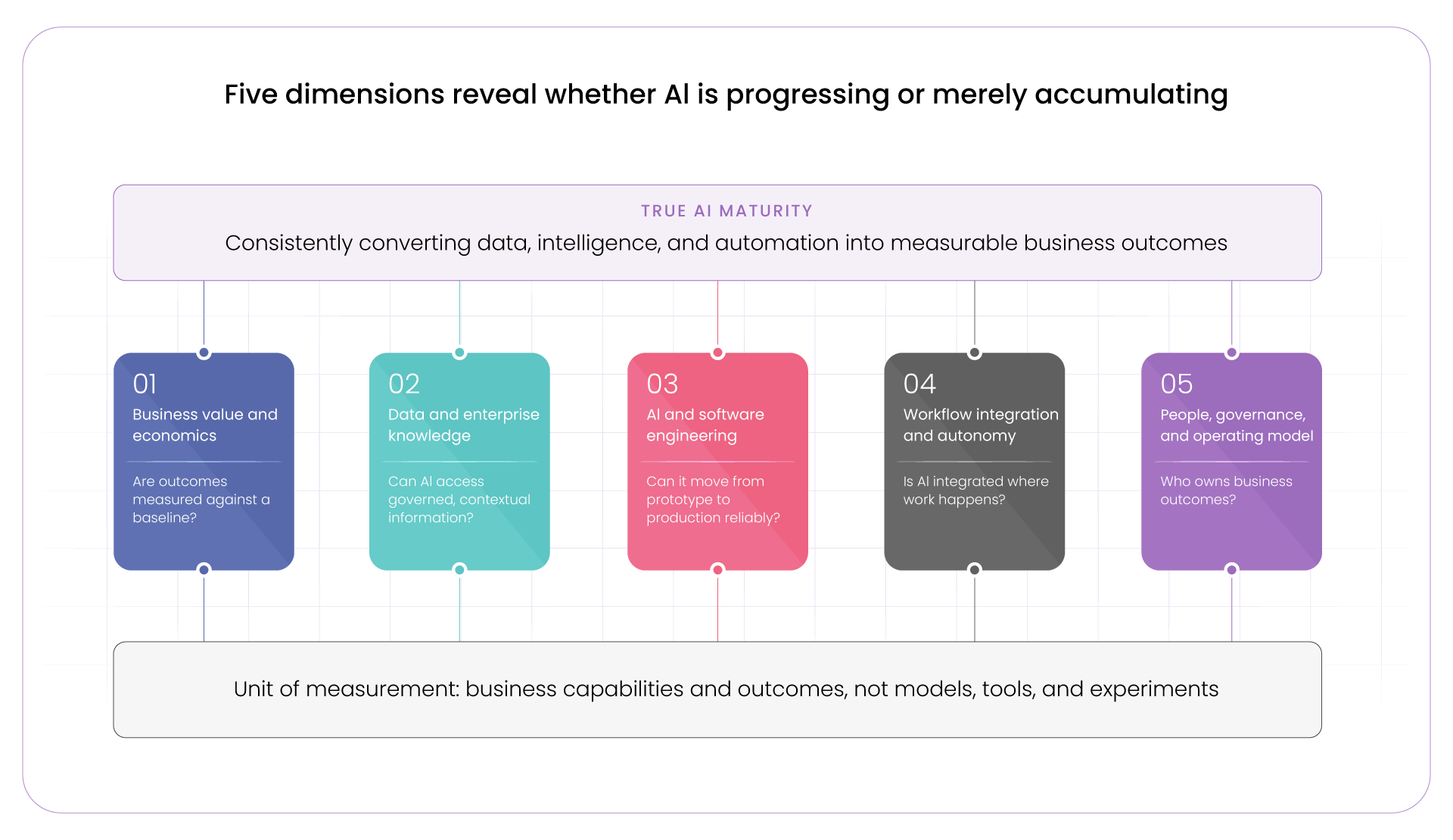
1. Business value and economics
Are AI investments linked to revenue growth, margin improvement, risk reduction, customer retention, or faster time to market? Are outcomes measured against a baseline, including implementation and operating costs?
An AI initiative without a clear value hypothesis is an experiment—not yet a business capability.
2. Data and enterprise knowledge
Can AI access accurate, governed, contextual information across relevant business systems? Are business definitions consistent? Can the enterprise connect information to the entities, relationships, and rules that give it meaning?
Data readiness is not just about collecting more data. It is about making the right information usable in the right context.
3. AI and software engineering
Can the organization move from prototype to production reliably? Does it have reusable architecture, evaluation pipelines, observability, security, integration, and lifecycle management?
AI models create potential. Engineering turns that potential into dependable products and services.
4. Workflow integration and autonomy
Does AI merely generate recommendations, or is it integrated into the systems and processes where work happens? Can multiple models, business rules, applications, and agents collaborate within defined permissions and controls?
The closer AI gets to the point where work is executed, the greater the potential for measurable transformation—and the greater the need for governance.
5. People, governance, and operating model
Who owns business outcomes? Who approves AI decisions? Are business, technology, data, risk, and operations teams aligned? Do employees have the skills and authority to adopt new ways of working?
AI maturity is as much an organizational capability as a technical one.
The Enterprise AI Maturity Paradox
One of the most important realities of the AI maturity journey is that the enterprise with the most AI technology is not necessarily the enterprise with the greatest AI maturity.
A company with fewer models but strong data foundations, disciplined engineering, clear business ownership, and deeply integrated workflows may outperform an organization with a much larger AI portfolio.
Three common traps
The pilot trap: Successful demonstrations are mistaken for scalable business solutions.
The platform trap: Investment in AI infrastructure is mistaken for business transformation.
The autonomy trap: Deploying AI agents is mistaken for achieving intelligent operations.
Escaping these traps requires a shift in the unit of measurement—from models, tools, and experiments to business capabilities and outcomes.
How to Move Up the Curve: A Practical Executive Agenda
Enterprises do not need to transform everything simultaneously. They need a deliberate sequence of investments.
First, establish the baseline.
Assess maturity across business value, data, engineering, workflow integration, and governance. Identify where the organization is today—not where its technology roadmap assumes it should be.
Second, select the right business priorities.
Identify two or three strategic opportunities with measurable outcomes, accessible data, accountable business sponsors, and a credible path to production.
Third, build for reuse.
Develop common data services, enterprise knowledge capabilities, AI engineering standards, security controls, and evaluation mechanisms. Reuse should accelerate delivery without forcing every business problem into the same technical pattern.
Fourth, transform workflows, not just applications.
Examine the complete business process, including handoffs, decisions, exceptions, and customer impact. Combine AI, deterministic rules, conventional software, and automation where each is most effective.
Fifth, scale through operating discipline.
Assign outcome ownership, monitor business and technical performance, establish human oversight, and continuously improve solutions based on real-world results.
The key principle is simple: scale proven value, not technology for its own sake.
The Next Competitive Divide
The next divide between enterprises will not be defined simply by who adopts generative AI first or who deploys the largest number of agents.
It will be defined by who can reliably connect enterprise data, domain knowledge, AI models, software engineering, and business workflows into a system that produces measurable outcomes.
For some enterprises, the immediate priority will be strengthening data foundations. For others, it will be industrializing existing AI solutions, integrating intelligence into software products, or redesigning entire workflows through agentic systems.
There is no universal starting point. There is, however, a universal requirement: understand the current maturity level before deciding on the next investment.
Because the real question is no longer whether your enterprise is using AI.
It is whether your enterprise is becoming fundamentally more intelligent in the way it creates value, makes decisions, and executes work.
That is where the AI Maturity Curve becomes more than a framework. It becomes a strategic lens for deciding what to build, what to scale, what to change, and what to stop doing.
So, where does your enterprise stand on the AI Maturity Curve—and what must change to reach the next stage?
Frequently Asked Questions
What is the AI maturity curve?
The AI maturity curve is a framework for understanding how an enterprise evolves from AI experimentation to operating as an AI-native business. Rather than counting models or tools, it measures the ability to consistently convert data, intelligence and automation into measurable business outcomes, and to repeat that success across the enterprise.
What are the five stages of enterprise AI maturity?
The five stages are AI Curious (experimentation), AI Enabled (solving specific business problems), AI Integrated (shared data and AI capabilities), AI Orchestrated (end-to-end intelligent workflows) and AI Native (intelligence-led business design). An enterprise can sit at different stages in different functions at the same time.
How do you assess your organization's AI maturity?
Look beyond technology deployment and assess five dimensions: business value and economics, data and enterprise knowledge, AI and software engineering, workflow integration and autonomy, and people, governance and operating model. Together they show whether the enterprise is progressing or merely accumulating AI initiatives.
Why do enterprise AI initiatives fail to scale beyond pilots?
AI initiatives often stall because of three traps: mistaking successful demonstrations for scalable solutions (the pilot trap), mistaking AI infrastructure for business transformation (the platform trap), and mistaking AI agents for intelligent operations (the autonomy trap). Fragmented data, isolated solutions and unclear ownership also prevent scale.
How can an enterprise move up the AI maturity curve?
Follow a deliberate sequence: establish a maturity baseline, select two or three high-value business priorities, build reusable data, knowledge and engineering capabilities, transform complete workflows rather than individual applications, and scale through operating discipline with clear outcome ownership and human oversight. Scale proven value, not technology for its own sake.
In This Article
- The AI Maturity Curve Is Not a Technology Roadmap
- The Five Stages of Enterprise AI Maturity
- The Curve at a Glance
- Five Dimensions That Reveal Your True AI Maturity
- The Enterprise AI Maturity Paradox
- How to Move Up the Curve
- The Next Competitive Divide