

Data and AI
From Assistant to Ally: How CXOs could bridge the Strategy - Execution Gap with AI Agents
Share this Article on


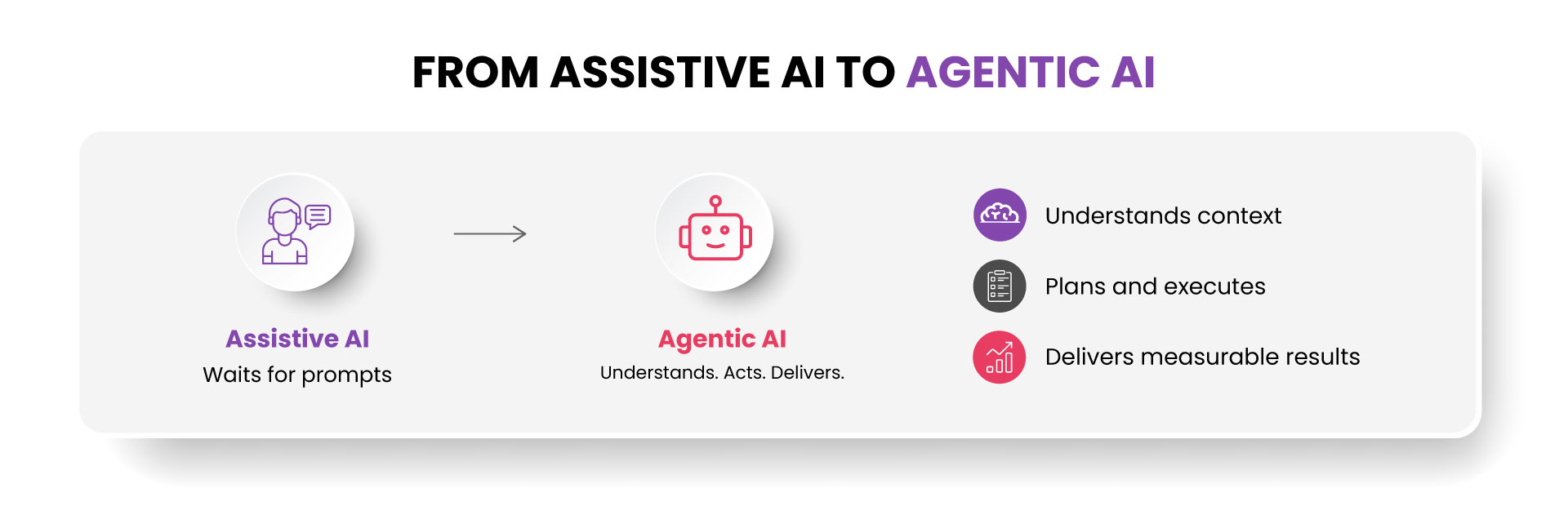
Today AI is an integral part of our day-to-day work life, and applications like “Co-pilot” have become a staple in assisting us to do the simplest tasks, such as suggesting the next code or generating financial document drafts for a report we are struggling with. However, with the slow ebbing of the initial novelty, there is one reality that is apparent. Co-pilots are passive! They wait to be prompted, require help and lack context to predict the eventual outcome of a project.
With the current industry shift skyrocketing towards “Assistive AI” mid-tier organizations need to pivot to stay competitive. We need to expand our horizons from the era of assistive to autonomous with Agentic AI taking the center stage and envision AI agents as digital colleagues that do not just plan and wait but implement and show results.
The Glass Ceiling of Assistive AI
The basic flaw of most Assistive AI is that the tools operate in silos. They can help you compose a document but cannot point out an error in the supply chain based on it. Similarly, the flaw with the current Co-pilots is fragmentation. The content generated by these assistive AIs does not interact with each other and requires a humanly prod in the right direction to move, verify, and implement the next step. This creates digital clutter and is a major cause of hallucinations.
Moreover, assistive AI agents are not platform-agnostic and can perform only in specific software ecosystems, unable to break the barriers between your legacy ERP and the modern CRM. It can create a plan but cannot execute it. It cannot fix 404 errors or broken APIs or substantiate data points with real world data. This creates a paradox cycle where resources keep spending their time prompting and fixing the AI rather than doing the actual work causing wastage of resource time.
The Agentic Advantage: Reasoning Over Commands
Agentic AI is the disruptive force that can bring about a change in thinking to the passive, instruction-dependent assistive AI like Co-pilot. You ask how? The answer is simple. Autonomous Agents understand the narrative, the end goal which assistive AI finds hard to assimilate. Ask the Agentic system a to optimize a payment schedule for procurement and it will objectify, identify necessary data sources, and most importantly self-corrects, if there is any glitch in the process and abracadabra you have the perfect payment schedule for your procurement cycle.
Let us compare the performance of an assistive and agentic AI in the scenario of student enrollment. If an assistive AI encounters a 404 error on a verification page, it stops there and needs a human input to move further, whereas an autonomous agent automatically reroutes to an alternative database, verifies the user, and recommends the courses as per the student profile. This ability to navigate an impasse in enterprise data makes the autonomous environment more stable and scalable. This scalability is encouraged by agents that interact with each other and create a seamless digital workforce that does not stop for instructions.
Small-Scale Sovereignty: The Mid-Tier Strategy
So how do mid-tier organizations embrace Agentic AI? One of the common misconceptions in the industry remains that adopting Agentic AI means big budgets. However, that is clearly not the case, if you can rely on small scale sovereignty. Mid-tier organizations should focus on finding the most cost-draining process and start with ‘small-models’ instead of monolithic LLMs that will increase the overall subscription cost.
Moreover, instead of replacing the entire tech, mid-tier organizations can build agentic layers on their existing ERP or CRM creating Agentic Specialists that can focus on domain-specific tasks. Such as an automated “Claims adjuster” for insurance. This would keep the price tag low and in turn maximize ROI.
The Knowledge Layer: RAG over Hallucinations
Another massive gamechanger for mid-tier organizations is Retrieval-Augmented Generation (RAG). The agents create a knowledge layer with the organization’s own data which promptly nullifies hallucinations. The agents act on the single version of truth that is fed to them which helps them understand business specific logic, compliance needs, customer history and so on. However, having a clean data core becomes an essential part of the infrastructure.
Human-on-the-Loop: The New Social Contract
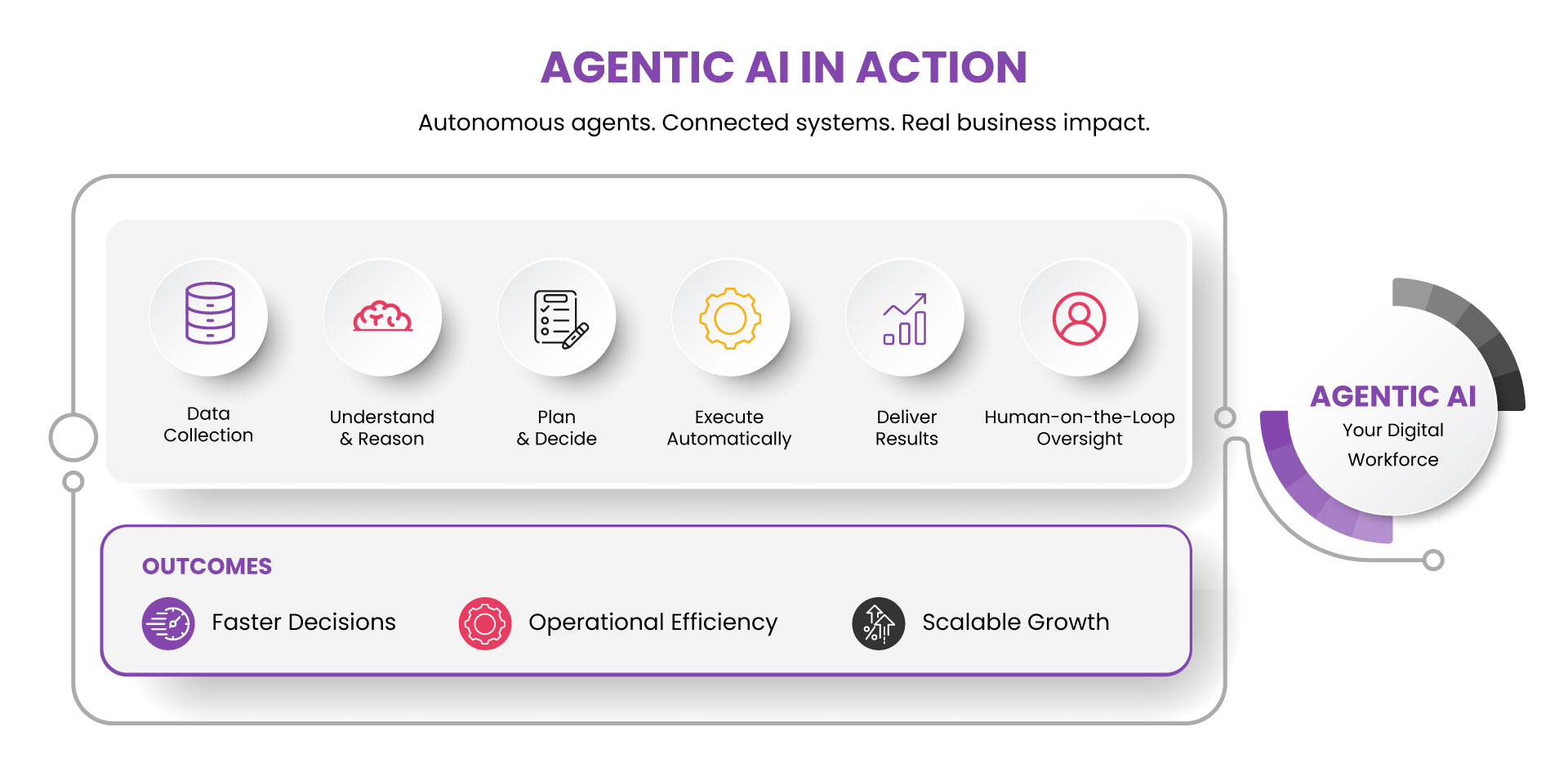
With this transition, it is time to address a critical issue. Is the tech replacing humans? The answer is simple it is a shift towards “Human-on-the-loop", where we facilitate the workforce with emancipation. This means we empower our human workforce to do the execution and auditing while the agents handle the mundane tasks such as data entry, scheduling, and manual tracking. The strategy therefore is transparent upskilling not workforce disruption.
Realizing Value: Velocity is the New Efficiency
The success of assistive AI was measured by the number of hours saved. However, with Agentic systems it is measured based on the velocity of the decision taken. An agentic system can complete an entire month’s invoice processing in minutes, allowing the organization to respond to current market shifts in real-time. This creates a repository of information for the agentic system to be used in the future, making them more aligned to your organization’s cultural and operational nuances.
Aspire Systems: Your Partner to Conquer the Agentic Frontier
At Aspire Systems, we have decoded that to ensure our client’s success in the Agentic space we need to create an entire ecosystem that can bridge the gap between your fragmented legacy systems and the autonomous future. Our agentic frameworks work on the dual policy of decision intelligence and cognitive automation to ensure agents are integrated with your organization’s data core.
Our agentic orchestration platforms provide mid-tier firms with the capability to manage, monitor and scale multiple agents seamlessly ensuring:
- Compliant and secure agent behavior
- Real-time tracking or performance
- Synchronized scaling of specialized agents to your workforce as your business grows.
Conclusion: Emancipating the Middle Management
According to Deloitte’s 2025 Global Human Capital Trends, 40% of the mid-management workforce time is wasted on cleaning the data core which includes manually moving information between systems, verifying them and processing errors. This not just takes a toll on productivity but also employee morale and motivation.
With agentic ops and RAG-driven agents, these mundane, time consuming, error-prone jobs get done in a moment, and your resources have the space to navigate strategy, innovation, and growth. When employees understand that the agents are not here to replace them but rather empower them, the ambiguity disappears and progress sets in.
In This Article
- The Glass Ceiling of Assistive AI
- The Agentic Advantage: Reasoning over Commands
- Small-scale Sovereignty: The mid-tier strategy
- Realizing Value: Velocity is the New Efficiency
- Aspire Systems: Your Partner to Conquer the Agentic Frontier
- Conclusion: Emancipating the middle management