
 TL;DR
Slow testing increases the business cost of weekly releases through delayed delivery, defect rework, automation maintenance, and reduced release confidence. AI-powered Quality Engineering helps address these bottlenecks through intelligent test generation, risk-based testing, self-healing automation, and faster defect analysis, enabling faster and more predictable releases without compromising quality.
Weekly releases are becoming a common goal for software engineering teams. The ability to deliver updates frequently helps organisations respond to changing business needs, address customer feedback, and bring new capabilities to market faster. However, releasing software every week requires more than faster development. Quality Engineering (QE) must keep pace without compromising software quality or release confidence.
When testing cannot keep up with development, the consequences extend beyond delayed releases. Teams spend more time fixing defects, maintaining automation, coordinating handoffs, and managing release risks. These hidden costs undermine the very delivery speed that frequent releases are meant to achieve.
Why testing becomes a bottleneck
In a weekly release cycle, development work moves continuously, leaving limited time for testing and validation. New features, code changes, integrations, and fixes all compete for the same testing capacity. AI-assisted coding adds to this load, because more code changes reach testing within the same week.
Traditional testing approaches struggle to keep pace when regression suites are large, test data is difficult to prepare, environments are unstable, or automation requires frequent maintenance. As a result, teams postpone testing, reduce coverage, or rely on late-stage validation to meet release deadlines.
The problem is not always the time taken to execute tests. Delays can occur at several stages, including test design, environment preparation, failure investigation, defect resolution, and release approval. Unless these constraints are addressed together, speeding up one activity may have little impact on the overall release cycle.
The hidden costs of slow testing
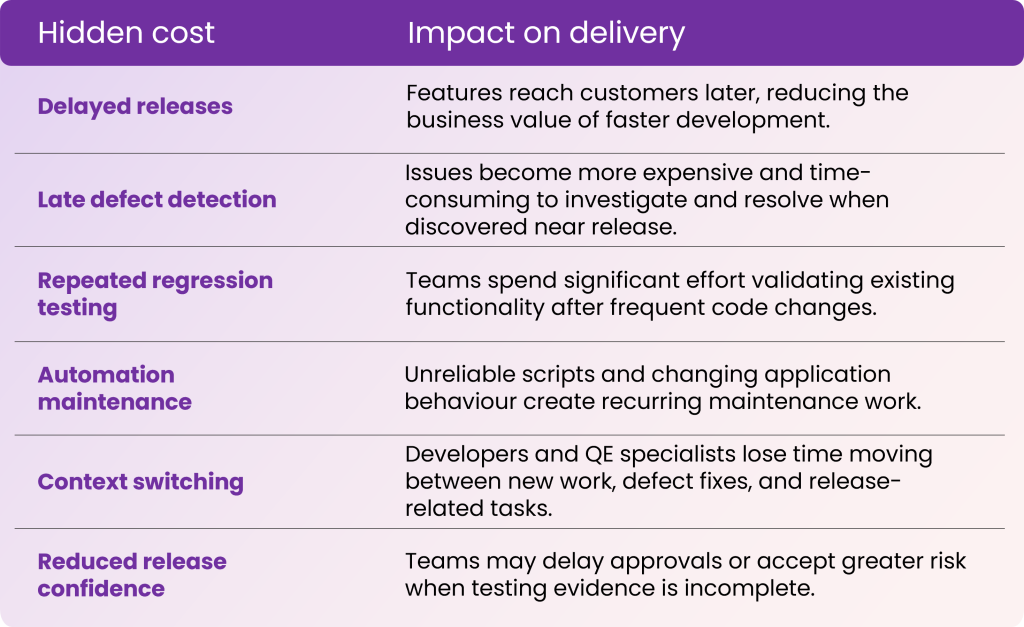
These costs are often spread across engineering, product, and operations teams. Consequently, they may not appear as a single testing expense, even when they affect delivery performance across the organisation.
How slow testing affects the economics of weekly releases
Consider a team that plans to release software every week. Development finishes on schedule, but regression testing and defect investigation take longer than expected. The team must then choose between delaying the release, reducing the scope, or proceeding with limited validation.
Each option has a cost. Delays postpone business value. Scope reductions affect planned functionality. Limited validation increases the risk of defects reaching production.
The same pattern can repeat every week, creating a persistent gap between planned and actual delivery. Developers may also spend time waiting for test results or fixing defects that could have been identified earlier. Over time, the organisation invests in faster development without achieving a corresponding improvement in delivery speed.
The following indicators can help teams identify where this gap originates.
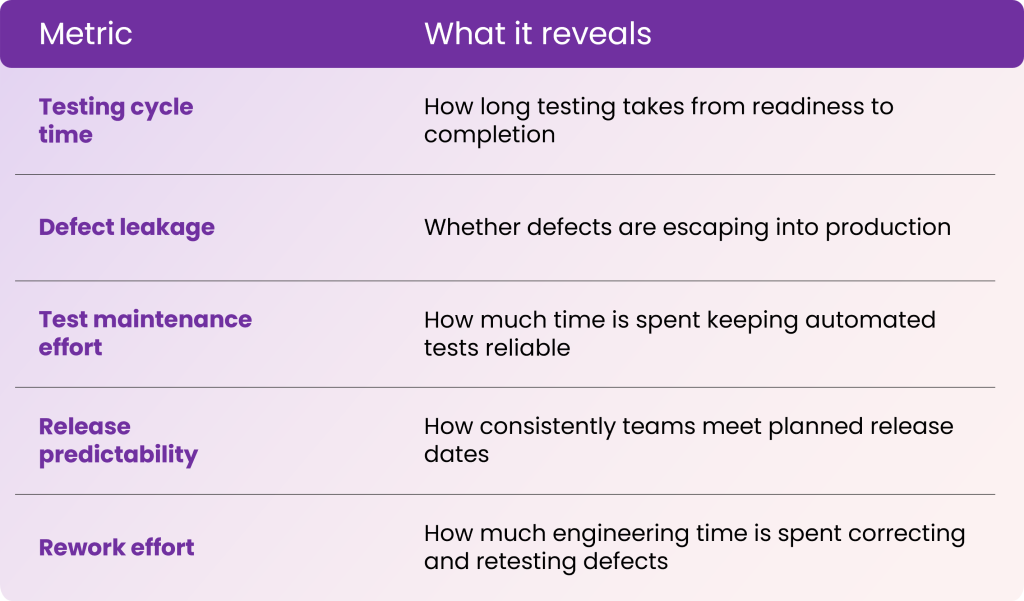
Looking at these measures together provides a more complete picture than tracking test execution speed alone.
How AI can help reduce testing delays
AI-enabled Quality Engineering can help address several activities that slow down frequent releases. However, the greatest value comes from applying AI to specific bottlenecks rather than introducing tools without a clear delivery objective.
At Aspire, AI is applied through a maturity-gated approach. Engineers review AI-generated output at each stage, and the level of AI autonomy increases only as a team’s practices, data, and governance are ready for it. This keeps the speed gains from AI without trading away release confidence.
1. Accelerate test design
AI can generate test scenarios from requirements, user stories, and application context. This can reduce the effort required to prepare tests for frequent changes. Engineers must still validate the scenarios for accuracy, coverage, and business relevance.
2. Improve regression testing
AI-assisted test prioritisation can help teams identify scenarios that are most relevant to recent code changes and areas of higher risk. This can help reduce unnecessary testing effort while maintaining appropriate coverage. The approach requires reliable change information and clear rules for deciding what must be tested before release.
3. Reduce automation maintenance
Self-healing capabilities adjust automated tests to changes in application interfaces, such as changed element locators, reducing manual script updates. Combined with appropriate validation, they let QE teams spend less time maintaining tests and more time improving coverage and investigating meaningful failures.
4. Speed up defect investigation
AI can assist with analysing logs, grouping similar failures, identifying patterns, and suggesting possible causes. This can help engineers narrow down investigations and prioritise fixes. The findings still need to be verified before corrective action is taken.
5. Bring quality checks earlier into development
Integrating automated and AI-assisted checks into continuous integration and delivery workflows allows teams to identify problems closer to the point of change. Earlier feedback can reduce the amount of rework required before a release.
Aspire Systems’ QE Studio applies these capabilities across the testing lifecycle: generating test cases from requirements, self-healing automation, impact-based test execution, failure analysis, and integration with CI/CD pipelines.
A practical approach to improving weekly release cycles
Organisations do not need to transform every testing activity at once. A focused approach can help teams identify where improvements will have the greatest impact.
- Map the release process. Identify where work waits, where handoffs occur, and which testing activities repeatedly delay releases.
- Establish a baseline. Measure testing cycle time, defect leakage, maintenance effort, and release predictability before introducing changes.
- Prioritise high-impact bottlenecks. Start with activities that consume significant engineering effort or repeatedly affect release schedules.
- Integrate improvements into existing workflows. Ensure that test generation, execution, defect analysis, and reporting support how teams develop and release software.
- Review outcomes continuously. Compare results against the baseline and adjust the approach based on actual improvements in delivery speed and quality.
This approach helps organisations connect QE investments to business outcomes instead of measuring success through the number of automated tests or AI capabilities deployed.
Faster releases require more than faster development
Weekly release cycles can help organisations deliver value more frequently, but only when quality engineering can support the pace of change. Slow testing introduces costs through delays, rework, maintenance, and reduced release confidence. These costs can remain hidden until they begin to affect delivery commitments and engineering productivity.
AI offers opportunities to reduce these constraints, but technology alone cannot resolve inefficient workflows, unclear ownership, or weak quality practices. Sustainable improvements require teams to combine intelligent automation with risk-based testing, reliable engineering processes, and measurable outcomes.
The objective is for quality to keep pace with development, so that organisations release software frequently, confidently, and consistently.
Follow us on Aspire Systems Testing to get detailed insights and updates about Testing!
Related Blogs
Putting AI to Work: Scaling Test Automation and Continuous Engineering
From Strategy to Execution: Architecting Your Enterprise Artificial Intelligence Adoption Roadmap
The QA Leader’s Guide to the Agentic STLC
The Speed Paradox: Why AI Assurance Is the Missing Pillar of Quality Engineering

- The Business Cost of Slow Testing in Weekly Release Cycles - November 2, 2026
- The QA Leader’s Guide to the Agentic STLC - October 1, 2026
- Make shift-left work across the software quality lifecycle with Aspire Systems’ QE studio - June 18, 2026
 Write to Us