
With tightening regulatory pressures, rising loss‑cost volatility, and elevated customer expectations, Insurance Technology Trends have shifted from optional innovation to operational necessity for insurers.
For CIOs, CTOs, and business leaders across the globe, the question is no longer what technologies to adopt—but how deeply they must be embedded into core insurance processes to deliver measurable outcomes that influence the combined ratio, cycle times, and risk accuracy.
The insurance digital transformation trends shaping the industry reflect this urgency. Product decisioning using AI has become mainstream, continuous, data-driven risk evaluation is now foundational to underwriting, and claims automation is evolving into intelligent orchestration. Collectively, these advancements mark the shift from incremental digital upgrades to platform‑driven, intelligence‑first insurance enterprises.
Key insurance trends defining 2026
In 2026, insurers are prioritizing AI operationalization across underwriting and claims, cloud-native architectures that support modular core systems, advanced claims automation that balances straight-through processing with control, and underwriting platforms that leverage real-time data and explainable analytics. These insurance trends defining 2026 are integrated into multi-year enterprise programs, reinforcing a move toward scalable, outcome-driven modernization.
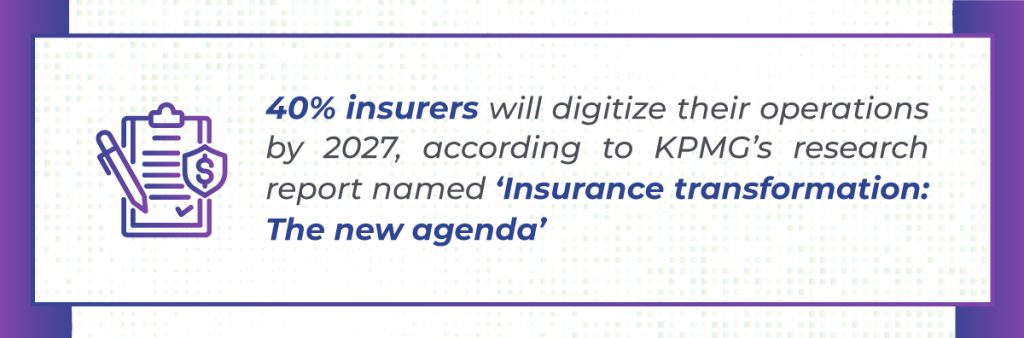
AI in insurance 2026: When intelligence becomes part of the platform
AI in insurance 2026 has moved far beyond analytics teams and pilots. Insurers are embedding AI directly into transactional systems—policy admin platforms, underwriting workbenches, claims engines, and fraud workflows—where decisions directly impact cost structures and customer outcomes.
Underwriting teams increasingly rely on ML‑based risk scoring consuming structured and unstructured data through API-first pipelines, enabling near real-time segmentation and pricing guidance. Explainability and governance are now mandatory due to global regulatory momentum, requiring transparent models, bias detection, and continuous monitoring built into the architecture itself.
In claims, AI has evolved from task automation to context-aware decision support. Advanced document processing extracts critical information from FNOL submissions and reports, while predictive models assess severity, leakage, and fraud. These insights feed dynamic rules engines that determine straight-through, assisted, or investigative routing at scale.
To sustain this shift, insurers are strengthening MLOps, governed release pipelines, and production-grade AI engineering to mitigate model drift and compliance risk. The theme for 2026 is clear: not just AI adoption, but responsible AI operationalization across the enterprise.
1) Multi-cloud strategy for core insurance platforms
Insurers across major geographies are adopting hybrid and multi-cloud strategies to modernize core systems while meeting data residency and regulatory obligations. Cloud adoption is now driven by the need for resilience, interoperability, and faster change cycles supporting the broader insurance digital transformation ecosystem.
Aspire Systems supports this shift with cloud consulting, migration, optimization, engineering, managed services, and deep AWS/Azure capabilities — modernizing applications while helping insurers reduce overhead and accelerate transformation.
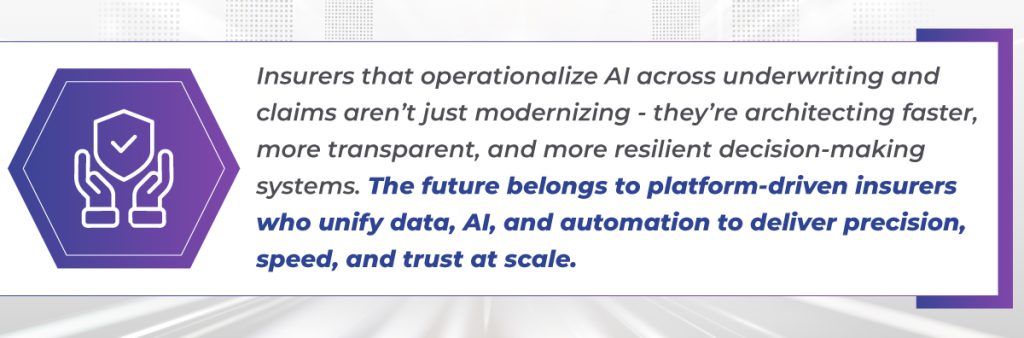
2) Underwriting transformation: From static assessment to reasoning engines
Underwriting modernization in 2026 signals a shift from static assessments to continuous risk monitoring, with telematics, IoT feeds, and external risk indicators integrated directly into underwriting platforms.
So what do insurers actually gain from underwriting automation?
Composable architectures let insurers plug in new data sources, scoring models, and rating engines without replatforming. Human underwriters remain essential but are supported by AI-driven tools embedded within workbenches. Aspire Systems helps insurers transition from rigid rules to reasoning-led underwriting using Agentic AI, reducing manual workload and accelerating policy issuance while improving consistency and decision quality.
As underwriting automation matures, its benefits don’t just stop with efficiency gains. Automated data ingestion, pre-risk scoring, and AI-assisted decisioning help insurers reduce manual effort, improve risk consistency and accelerate quote-to-bind cycles. The underwriters also gain a clear view of the risk context before-hand. In such a volatile and high-pressure environment, insurance’s underwriting automation becomes a direct lever for better loss ratios and scalable decision-making.
3) Claims automation: Intelligent orchestration that balances speed and control
Claims remain the most critical touchpoint for customer trust. As insurers modernize claims operations, a question increasingly surfaces across the leadership teams:
What are the key benefits of integrating AI for faster insurance claims processing by 2026?
By 2026, the real value of AI in claims lies in how quickly and confidently insurers move from the notification stage to the resolution stage. AI driven claims platform help reduce cycle times by automating FNOL intake, extracting data and applying predictive intelligence to evaluate the claim. Faster routing decisions means simple claims are settled in no time, while the complex ones are rerouted to the right level of human intervention.
Automation is reshaping claims by streamlining workflows, reducing errors, and accelerating decisions — while maintaining control over cost, cycle time, and compliance. Low‑complexity cases flow through straight‑through processing, while complex claims are routed dynamically based on severity and regulatory factors. Leadership teams gain real-time visibility into bottlenecks, leakage, and operational performance.
AI-led orchestration modernizes FNOL, assessment, settlement, and recovery with intelligent automation and data-led decisioning. Aspire Systems enables digital intake, AI-driven segmentation, and STP where feasible. Our Agentic AI tools bring subjective reasoning capabilities to support nuanced adjudication, while analytics and seamless system connectivity reinforce scalability and consistency.
Conclusion
The insurers who will lead in 2026 are those who treat technology not as incremental improvement but as a structural advantage. AI‑driven decisioning, cloud‑native platforms, and intelligent automation are no longer fringe innovations—they are becoming the operating backbone of modern insurance enterprises. By embedding intelligence into every step of underwriting and claims, carriers gain the ability to navigate volatility with precision, reduce operational friction, and deliver the transparency customers expect. The path forward is clear: build adaptive platforms, operationalize AI responsibly, and orchestrate processes around outcomes—not legacy constraints. The firms that do this will set the benchmark for speed, accuracy, and trust in the years ahead.

 Write to Us