
The Integration Awakening: Why Move Now?
Integration has always been the backbone of digital transformation connecting data, processes, and applications across the business landscape. But as the pace of change accelerates, teams still working with traditional, code-heavy integration platforms are starting to feel the pinch. Release cycles feel longer, maintenance costs keep rising, and adapting integration workflows to changing business requirements becomes increasingly difficult.
Boomi takes a fundamentally different approach to enterprise integration, providing a platform that enables developers—and even business users—to design integrations visually, shorten development cycles, and reduce reliance on repetitive boilerplate code.
So what does the journey look like for developers making this migration? Let’s break it down.
The Reality of Code-Driven Integration Environments
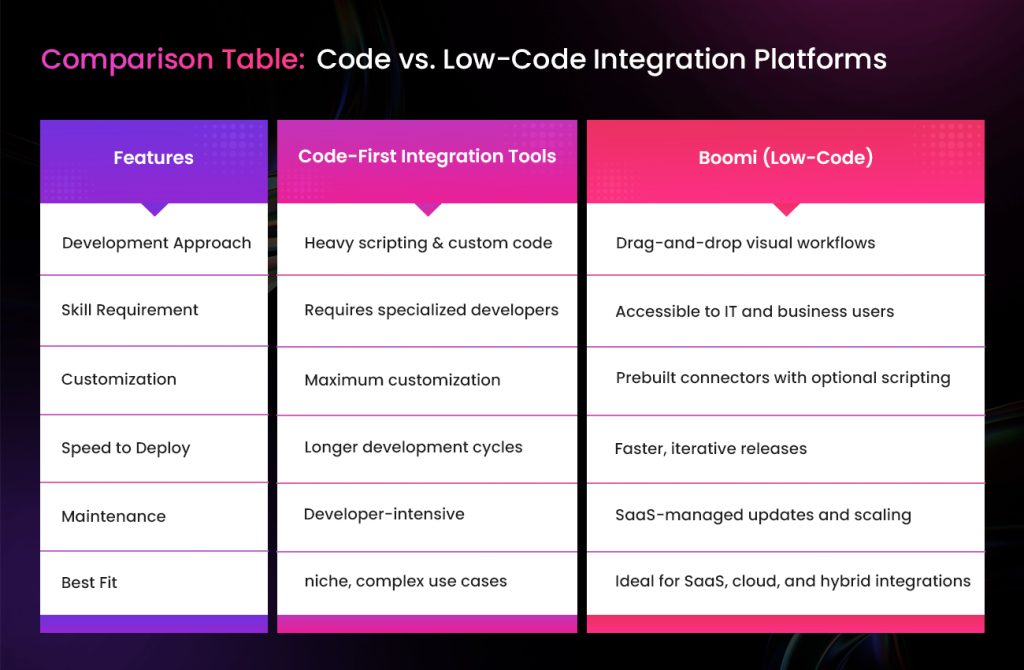
If you’ve worked with legacy ETL tools or developer centric integration environments, the experience will feel familiar. You’re often knee-deep in Java, designing workflows that can stretch across dozens, sometimes hundreds of lines of custom code.
The upside? Full control. Developers can fine-tune every step of execution and build deeply customized data transformations. These platforms reward strong technical expertise and architectural rigor.
But the trade-off is time. Projects tend to slow down as requirements evolve, and every new integration introduces additional code to test, maintain, and document. Over time, this creates technical debt that teams must continuously manage.
When sticking with a code-first approach makes sense:
- Your integrations are highly complex or require custom business logic
- You require granular control over execution and processing
- Regulatory compliance and governance require deep customization
Code-first platforms still have a place—but they are no longer the default choice for speed-driven, cloud-first enterprises.
Boomi: A Low-Code Adventure Built for Modern Enterprises
Boomi takes a fundamentally different approach. Instead of writing everything from scratch, teams visually design integrations using drag-and-drop components and prebuilt connectors.
The platform is cloud-native by design—meaning no infrastructure to manage, no manual upgrades, and no scalability headaches. While developers can still write custom scripts using Groovy or JavaScript when needed, most integrations can be built without touching code at all.
The result? Faster development cycles, easier experimentation, and the ability to respond quickly to changing business needs.
Why low-code integration changes the development model
- Broader teams can participate in building and iterating on integrations
- Faster time to market. Many integrations go live in days, not weeks
- SaaS model means updates and scaling are automatic
The Developer’s Migration: What Changes and What Doesn’t
Shifting to Boomi doesn’t mean your coding chops go to waste, it means you’ll spend more time architecting and less time debugging. You’ll likely find:
- Streamlined collaboration between IT and business users, thanks to visual tools and reusable components
- Less technical debt, since platform updates and maintenance are handled for you
- Faster onboarding, as even developers new to integration can pick up Boomi’s interface quickly
Expect a mindset shift from “how will I code this?” to “how can this visual workflow delivervalue faster?” For many teams, this means more time solving real business problems instead of keeping integrations running.
Where Aspire Systems Fits In
At Aspire Systems, we work closely with teams navigating this shift from code-heavy integration environments to modern, low-code platforms like Boomi. What we consistently see is that the challenge isn’t just adopting a new tool it’s rethinking how integrations are designed, built, and managed over time.
Our Boomi-led integration approach focuses on practical outcomes rather than platform features. We help organizations assess existing integration landscapes, identify areas where low-code adds the most value, and design integration architectures that are easier to scale and maintain.
This typically includes:
- Structuring integrations using reusable components instead of one-off custom builds
- Improving integration delivery timelines through reusable frameworks and standardized patterns
- Ensuring integrations align with enterprise standards for security, performance, and governance
- Boomi provides the platform capabilities, while Aspire brings the implementation discipline, architectural guidance, and domain experience required to make those integrations work in real-world enterprise environments.
Final Thoughts: Embracing Low-Code Without Losing Your Edge
For teams moving from traditional, code-heavy integration platforms to Boomi, the transformation is as much cultural as it is technical. Visual integration enables faster experimentation, quicker delivery, and greater collaboration across teams.
The promise of visual integration means getting new ideas to production, iterating faster, and giving developers more room to innovate. It’s not a move away from quality or complexity, but a step toward efficiency and scale for modern integration needs. With the right platform and the right partner, enterprises can scale integrations without scaling effort.
Related Blogs:
Boomi: Championing Faster Integration with the Power of Low-Code
Boomi’s AI-Powered MDM: Maximizing Data Accuracy Across Enterprises
Optimizing Integration Processes through Boomi’s AI-Enhanced API Management
From Data to Decisions: Boomi and AI Fuel the Autonomous Future of Enterprises

 Write to Us