
 TL;DR
Most SOCs detect threats quickly but still take too long to decide and act. An Agentic SOC closes that gap with a digital workforce of role-based AI agents, such as SOC analyst, threat hunter, incident responder and forensic analyst, that share context, investigate in parallel and act through your existing tools. Because security and IT operations run on one loop, a finding can move from detection to verified fix without a handoff. Every action is governed, audited and reversible. Success still depends on the foundation: integrated telemetry, documented workflows and clear approval rules. The first step is knowing whether your SOC is ready.
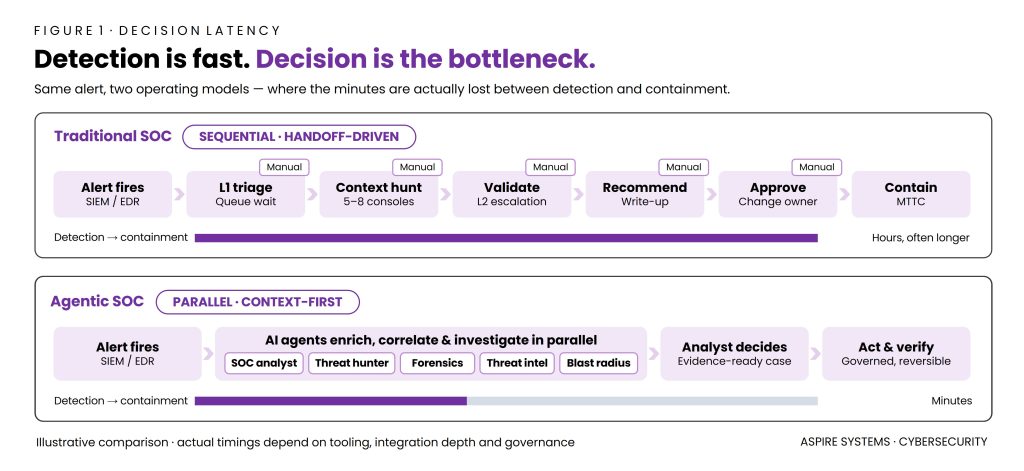
For years, security operations centers (SOCs) have run on a simple assumption: technology detects the threat, and people decide what happens next. That model is under strain. Attackers now use automation and generative AI to scale phishing, credential abuse, malware and lateral movement. Most SOCs still respond through a chain of manual steps: an alert fires, an analyst triages it, context is pulled from several consoles, the incident is validated and escalated, someone approves a response, and only then does containment begin. Even then, the fix often waits in another team’s queue.
The real question is no longer whether a SOC can detect malicious activity. It is whether the organization can understand it and act before the attacker moves further.
From Playbooks to a Digital Security Workforce
SOAR playbooks have automated repetitive tasks for years using fixed logic: if X happens, do Y. They are reliable but brittle and break when an attack does not match the script. Agentic AI works differently. Each agent, built on large language models with tool calling, works toward a goal, decides what to query, interprets results, identifies missing evidence and recommends or executes the next step within defined limits.
| Dimension | Traditional SOAR automation | Agentic security operations |
| Logic | Fixed, rule-based playbooks | Goal-driven reasoning that adapts to evidence |
| Unexpected cases | Fails or escalates to a human | Investigates further and gathers missing context |
| Scope | Security tools only | Security and IT operations on one loop |
| After acting | Stops once the step runs | Verifies the outcome and rolls back on failure |
| Analyst role | Builds and maintains playbooks | Supervises agents, approves high-risk actions, hunts |
Take a suspicious login. Instead of a queued alert, the agents check login history, device posture, impossible-travel signals, privilege level and endpoint telemetry, map the behavior to MITRE ATT&CK, and hand the analyst a complete case file. The analyst starts with context, not with an alert.
Inside an Agentic SOC
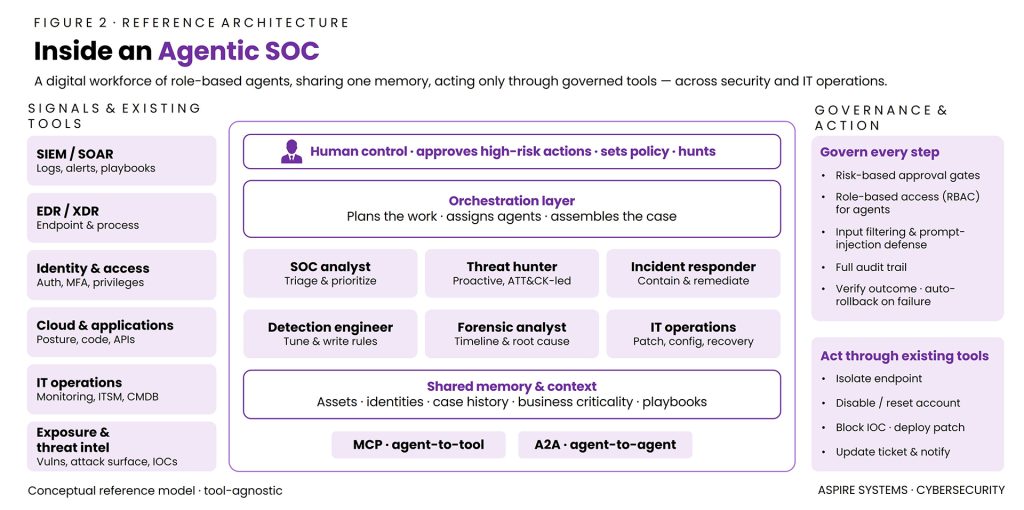
An Agentic SOC is not one large AI model. It is a team of role-based agents that mirror a real SOC: a SOC analyst agent that triages and prioritizes, a threat hunter that searches proactively, an incident responder that contains and remediates, a detection engineer that tunes rules, a forensic analyst that rebuilds timelines, and an IT operations agent that patches and restores systems. An orchestration layer assigns the work, and all agents draw on a shared memory of assets, identities, case history and business criticality, so no context is lost between steps.
Agents connect to existing tools through open standards such as the Model Context Protocol (MCP) and coordinate with each other through agent-to-agent (A2A) communication. This means the model works with your current SIEM, EDR and ITSM investments rather than replacing them.
One Loop for Security and IT Operations
In many enterprises the SOC finds the problem but IT owns the fix. A vulnerable server, a risky configuration or an unpatched endpoint becomes a ticket that waits. An Agentic SOC closes this loop by running security and IT operations (SOC and NOC) on a single cycle: detect, investigate, decide, act and verify, with governance at every step. The same model extends to continuous threat exposure management (CTEM), application security posture and automated patching, so exposures are found, prioritized by business risk and fixed in one flow. For the business, this means fewer handoffs, faster remediation and a clear record of what was fixed and when.
Progressive Autonomy: Humans Stay in Command
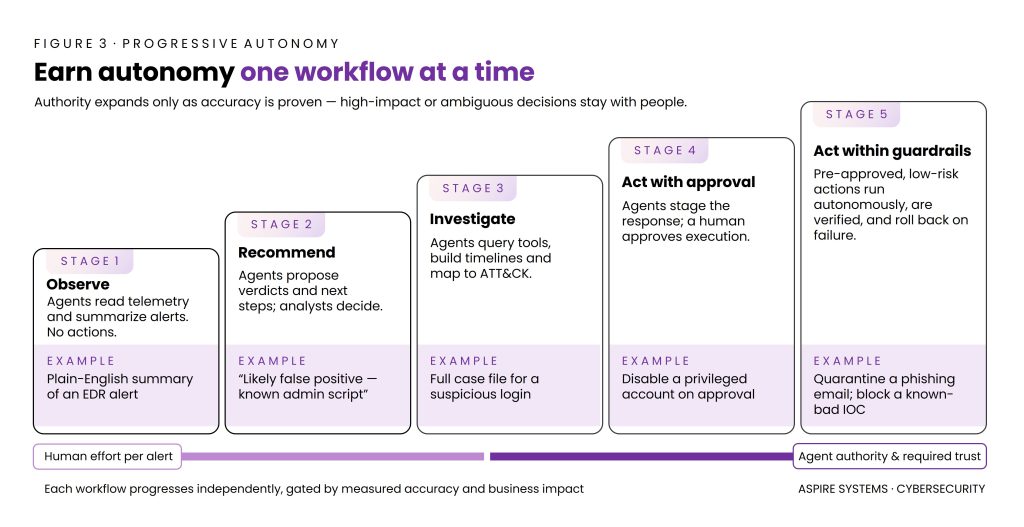
How much authority should an agent have? It depends on the action. Quarantining a phishing email is low risk and easily reversed; disabling a CFO’s account during a board meeting is not. The practical approach is progressive autonomy: each workflow advances through the stages below only when its accuracy is proven. Analysts move from collecting evidence to hunting, detection engineering and governance. The goal is not a SOC without people; it is a SOC where people no longer perform every step themselves.
Governing the Agents
AI agents are privileged systems and must be governed like one. The essential controls are:
- Risk-based approvals: low-risk actions run automatically; high-impact ones wait for a human.
- Role-based access (RBAC): each agent gets only the permissions its role needs.
- Prompt-injection defense: emails, logs and files that agents read are treated as untrusted input.
- Verify and roll back: every action is checked after execution and reversed automatically if it fails.
- Full audit trail: every query, decision and action is recorded, supporting forensics, compliance and frameworks such as the NIST AI Risk Management Framework.
The Business Case: What Leaders Should Measure
| Metric | What it tells leadership |
| MTTR / MTTC | How quickly threats are contained, which directly limits breach cost and downtime |
| Alerts auto-triaged and closed | How much routine workload has moved from analysts to agents |
| Time to remediate exposures | How fast vulnerabilities and misconfigurations are actually fixed |
| False-positive rate | Whether agent verdicts can be trusted and where tuning is needed |
| Analyst hours per incident | Capacity released for hunting and higher-value work |
| Audit readiness | How easily evidence is produced for regulators, auditors and cyber insurers |
Readiness Comes Before Agents
Agents are only as good as the data, integrations and processes around them. Before deciding where they should participate, assess five areas:
- Telemetry: are identity, endpoint, cloud, network and IT sources complete and normalized?
- Integration: can agents query and act on each tool securely through APIs?
- Workflows: are triage, response and remediation playbooks documented and current?
- Automation maturity: which tasks are already automated, and how reliably?
- Governance: which actions can run automatically, who approves the rest, and how is it audited?
The shift will be gradual, and it should be. For security leaders, the immediate question is not “How quickly can we deploy AI agents?” It is “Is our SOC ready to trust them?”
How Aspire Systems Helps
Aspire Systems helps enterprises move from analyst-led to agent-assisted and governed agentic security operations. We bring together threat detection and response, security and IT automation, exposure management and cybersecurity maturity assessment. Through a structured SOC readiness assessment, we evaluate your telemetry, integrations, workflows and governance, identify the use cases best suited to AI agents, and deliver a phased roadmap with measurable outcomes and humans firmly in control.
Is your SOC ready for the agentic era? Assess your security operations readiness with Aspire Systems.

Brings strong technical expertise across SIEM, EDR, IAM, PKI, secure SDLC, GRC, and AI-driven security capabilities, complemented by strategic leadership in service portfolio evolution, delivery governance, capability development, and operational maturity.
- Can Agentic AI Fix What Traditional SOCs Struggle With? - October 26, 2026
 Write to Us