
Software development is entering a new phase. AI actively participates across the Software Development Lifecycle (STLC) rather than stopping at code snippet generation or autocomplete suggestions. From interpreting requirements and generating code to analyzing deployments and identifying defects, AI is becoming an integral part of how modern software is built and delivered.
This evolution has given rise to the Agentic STLC, where autonomous AI agents work alongside engineering teams to automate repetitive tasks, make intelligent decisions, and continuously optimize software delivery.
For QA leaders, this shift raises an important question: How do you ensure software quality when development is becoming increasingly autonomous?
The answer isn’t simply adding more automation or generating more test scripts. It requires rethinking how testing fits into an AI-driven delivery pipeline moving from reactive automation to intelligent, autonomous quality engineering.
What is the agentic STLC and how does it transform quality engineering?
Unlike traditional automation, which executes predefined tasks, the Agentic STLC enables AI to reason, plan, and act based on goals and context. Instead of supporting isolated activities, AI becomes part of the continuous software delivery process, helping teams accelerate development while maintaining quality.
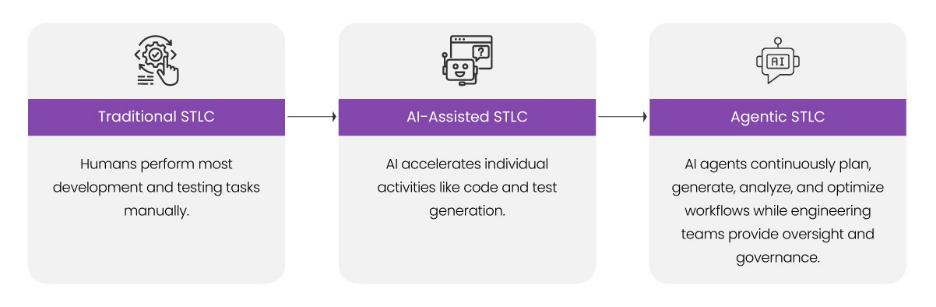
For quality engineering, it is essential that testing becomes an intelligent layer embedded throughout the software delivery lifecycle rather than remaining in a standalone validation phase.
Why QA needs a new playbook
Traditional test automation was designed for predictable release cycles and relatively stable applications. Today’s engineering environments look very different. Cloud-native architectures, microservices, feature flags, and AI-assisted development have dramatically increased both the speed and complexity of software delivery.
While CI/CD pipelines automate builds and deployments, testing often still relies on static regression suites, manually maintained scripts, and reactive failure analysis. As release frequency increases, this model becomes increasingly difficult to sustain.
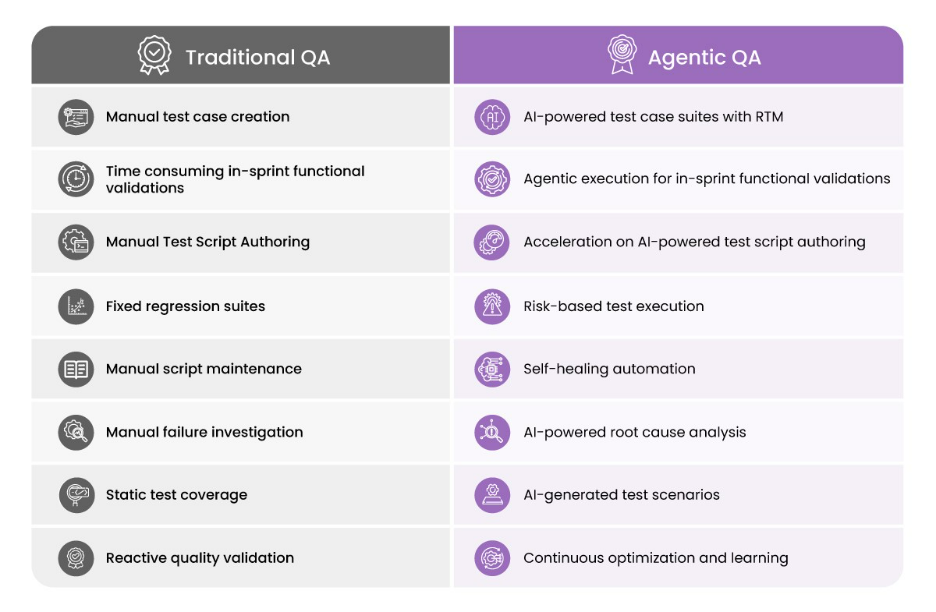
The role of QA is therefore shifting from executing tests to enabling intelligent quality decisions. Instead of validating software only after development is complete, modern testing platforms continuously evaluate application changes, prioritize risk, adapt automation, and provide actionable insights throughout the delivery pipeline.
What changes for QA leaders?
It is the adaptability of testing to change that defines quality engineering success today, moving past simple script counts or regression coverage metrics alone. As organizations adopt AI-driven software delivery, QA leaders need greater visibility into testing effectiveness.
This means focusing on questions such as:
- Are we testing the highest-risk areas first?
- How resilient is our automation against application changes?
- Can failures be classified automatically instead of manually investigated?
- How quickly can teams determine whether a release is production-ready?
Rather than replacing testers, Agentic AI augments QA teams by taking over repetitive activities such as test generation, execution planning, failure analysis, and script maintenance. This allows engineers to focus on exploratory testing, quality strategy, governance, and improving the overall customer experience.
The ultimate goal centers on smarter testing over simply reducing headcounts.
Building an agentic testing pipeline with Aspire Systems’ QE Studio
Powered by an Agentic AI engine, Aspire Systems’ QE Studio transforms testing from a scripted activity into an intelligent, adaptive quality engineering platform that supports web, API, and mobile applications.
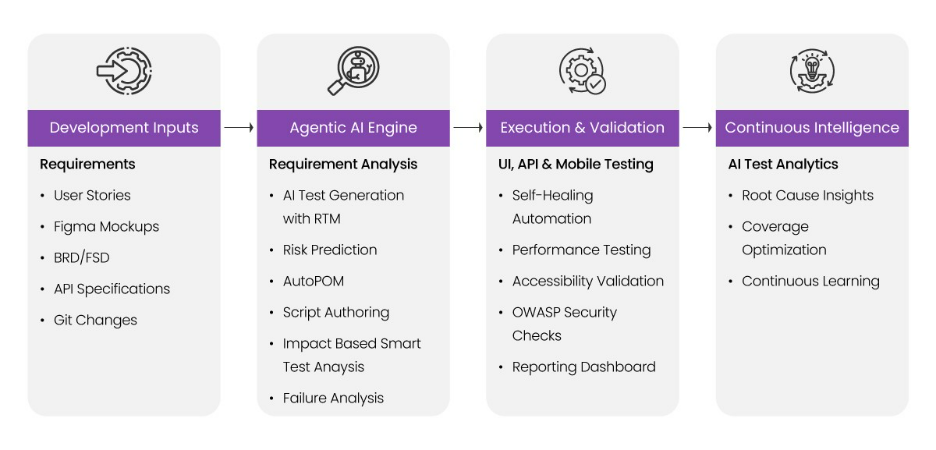
Instead of relying on manually authored scripts, QE Studio analyze user stories, design mockups, API specifications, and application changes to automatically generate functional test cases automation assets. Dynamic Page Object Models are created in multiple programming languages and integrate seamlessly with frameworks such as Selenium and Playwright, allowing organizations to build on their existing automation investments.
During execution, our Agentic framework continuously monitors application changes to detect locator modifications and heal scripts automatically, significantly reducing maintenance effort. At the same time, risk-based execution prioritizes testing based on application impact and historical patterns based development code changes, enabling faster feedback without compromising coverage.
Beyond execution, Aspire Systems’ QE Studio provide AI-powered failure analysis that categorizes defects, identifies probable root causes, and automatically captures contextual evidence for faster triage. Integrated browser-metrics performance, accessibility, and OWASP security validations further ensure that quality is assessed holistically rather than through functional testing alone.
The result is an autonomous testing pipeline that not only executes tests but also adapts, analyzes, and continuously improves with every release.
The future of quality engineering
As AI continues to reshape software engineering, testing must evolve alongside it. Static automation frameworks built around manual scripting and reactive maintenance cannot keep pace with the speed and complexity of modern software delivery.
The Agentic STLC represents a shift from automation to intelligent quality engineering, where AI helps teams make faster, better-informed testing decisions throughout the development lifecycle.
With its Agentic AI-powered capabilities, Aspire Systems’ QE Studio enable organizations to build autonomous testing pipelines that generate tests, self-heal automation, prioritize risk, analyze failures, and deliver continuous quality insights. By combining intelligent automation with human expertise, QA teams can accelerate releases, improve resilience, and confidently support the next generation of AI-driven software development.
Follow us on Aspire Systems Testing to get detailed insights and updates about Testing!

- The QA Leader’s Guide to the Agentic STLC - October 1, 2026
- Make shift-left work across the software quality lifecycle with Aspire Systems’ QE studio - June 18, 2026
 Write to Us