
For many insurers, legacy modernization has traditionally been synonymous with one thing: replacing the core. Policy administration, claims, billing, and customer servicing platforms are often seen as the natural starting point for transformation. But for insurers operating in highly regulated, cost-sensitive, and process-intensive environments, a full core migration is not always the quickest route to meaningful business value.
In today’s world, the question is not just “Should we replace the core?” It is increasingly, “How can we make our existing technology landscape work smarter, faster, and more cohesively while broader transformation initiatives continue in parallel?”
This is where overlay intelligence is emerging as a practical approach to insurance legacy modernization. Rather than immediately replacing stable transactional systems, insurers can introduce an intelligent orchestration layer that sits above existing platforms. This layer connects data, applications, workflows, business rules, automation, and AI capabilities, helping teams, systems, and processes work together more effectively.
Why Legacy Systems Are Not Always the Real Bottleneck
Many legacy insurance platforms still perform their core transactional functions reliably. They issue policies, process endorsements, manage billing, and maintain claims records. More often than not, the real challenge lies around these systems rather than within them.
Insurers frequently contend with fragmented handoffs, duplicate data entry, disconnected document repositories, manual exception handling, limited real-time visibility, and business rules spread across multiple applications. These inefficiencies can create friction across the value chain, even when the underlying systems continue to operate as intended.
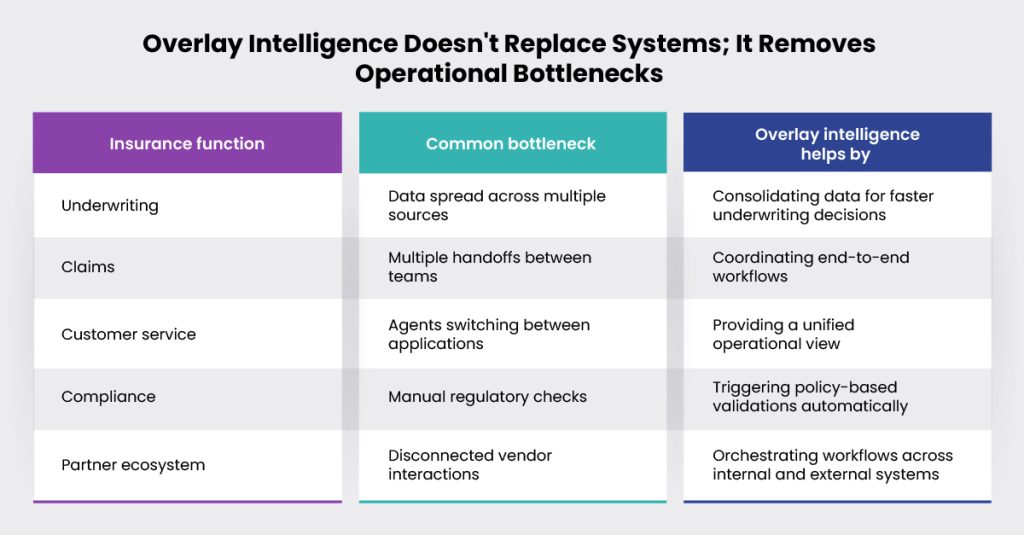
For underwriting teams, this often means moving between submissions, broker emails, third-party data, rating inputs, and internal risk guidelines before making a decision. Claims adjusters may spend time waiting on documents, fraud checks, policy validation, repair estimates, and approvals across multiple applications. Customer service agents, meanwhile, often switch between screens just to answer a simple policyholder query.
Core replacement may still be part of the long-term roadmap. But replacing the system of record without rethinking how work moves across the enterprise can result in the same complexity being transferred to newer infrastructure.
What Overlay Intelligence Changes
Overlay intelligence offers insurers a way to modernize operations without creating immediate disruption to the core. It works by establishing a layer that can access data from existing systems, apply business rules, trigger workflows, recommend next-best actions, and route exceptions to the appropriate teams.
From a business perspective, this can translate into faster turnaround times, stronger SLA adherence, improved customer and distributor experiences, and more consistent decision-making. For technology leaders, it provides an integration-led modernization strategy, reusable services, reduced migration risk, and a more practical foundation for adopting AI.
This approach becomes particularly relevant as insurers look beyond isolated automation initiatives. Traditional automation is effective at executing defined tasks. Overlay intelligence, on the other hand, helps coordinate entire business processes from end to end. When combined with AI capabilities and human-in-the-loop controls, it can help insurers evaluate context, prioritize workloads, escalate risk appropriately, and maintain auditability throughout the process.
Where Insurers Can Apply It First
The value of overlay intelligence often becomes most visible in high-friction insurance processes.
In underwriting, it can consolidate submission data, validate appetite rules, identify missing information, and support risk triage. In claims, it can orchestrate FNOL intake, coverage verification, document validation, fraud detection indicators, vendor coordination, and settlement workflows. Within policy servicing, it can improve case routing, streamline customer communications, support endorsement processing, and strengthen compliance checks.
The objective is not to bypass the core system. Instead, it is to make the core part of a more connected operating model, one where processes are connected, data is readily usable, and decisions can be executed more efficiently across the business.
Why This Matters for AI-Ready Insurance Modernization
AI in insurance requires much more than sophisticated models. To deliver meaningful outcomes, it depends on well-defined business processes, governed data access, integrated systems, decision traceability, and controlled execution. Without orchestration, AI initiatives often remain confined to pilots or isolated use cases.
Overlay intelligence helps provide that connective layer. It creates the foundation for AI-enabled underwriting, claims, servicing, and operational workflows by bringing together systems, processes, and decision points. As a result, insurers can introduce intelligence incrementally while maintaining governance, transparency, and operational continuity.
Aspire Systems’ Perspective
At Aspire Systems, modernization is not viewed as a binary choice between preserving legacy systems and replacing them. For insurers, the more immediate opportunity often lies in identifying where integration, orchestration, automation, data modernization, cloud enablement, and AI can solve operational challenges and improve outcomes today, without waiting for a multi-year core migration program to run its course.
Modernization without migration should not be seen as a compromise. When approached thoughtfully, it can be a pragmatic path to faster decisions, more resilient operations, stronger policyholder experiences, and a technology foundation that continues to evolve with business needs.
In the years ahead, competitive advantage in insurance will increasingly belong to carriers that can make every system, whether legacy or modern, work together intelligently.

- Modernization Without Migration: How Overlay Intelligence Helps Insurers Modernize Legacy Systems - August 1, 2026
- The Rise and Rise of Insurance Data Analytics: The Ultimate Game-changer for Insurers - January 27, 2026
- Insurance Automation Sweet Spot: When To Automate And When To Keep The Human Touch - August 26, 2025
 Write to Us