
TL;DR
Enterprise AI adoption is rapidly increasing, but scaling is hindered by critical AI agent governance gap that undermines trust and accountability in autonomous AI agents. This gap poses compliance and operational risks amid evolving regulations like the EU AI Act. Read more to understand how we can overcome this current scenario.
The AI Agent Governance Gap: The Invisible Force Stalling Enterprise AI at Scale
The CXO level conversations around AI agents have always been on an upscale, and the recent questions have moved from “Should we deploy them?” To “How can we efficiently scale them?”. Organizations that once saw skyrocketing wins with AI pilots have all come to a grinding halt. Why, you ask? Is it technology limitations? No. The answer is simple – the absence of trust. The analysts have coined a term for it calling it the governance gap. It is the structural failure that fails to recognize the stakeholder responsible when an autonomous AI agent makes a consequential decision.
This scenario has proved that Enterprise AI governance is no longer an option. It now plays a pivotal role in determining whether AI investments deliver lasting business value or may collapse under compliance, security, and accountability failures. The numbers do not lie and provide an undeniable clarity on the importance of governance in any AI agent infrastructure.
The Scale of the Problem
Enterprise AI agent adoption is skyrocketing, and Gartner forecasts that by the end of 2026, 40% of all enterprise applications will embed task-specific AI agents. With the CAGR projections for global AI agents market scale to 44-46% by 2030, analysts believe that investment enthusiasts are running dangerously ahead of governance maturity.
“Gartner predicts more than 40% of agentic AI projects will be canceled by end of 2027 — the primary drivers: escalating costs, unclear business value, and inadequate risk controls.”
Agent
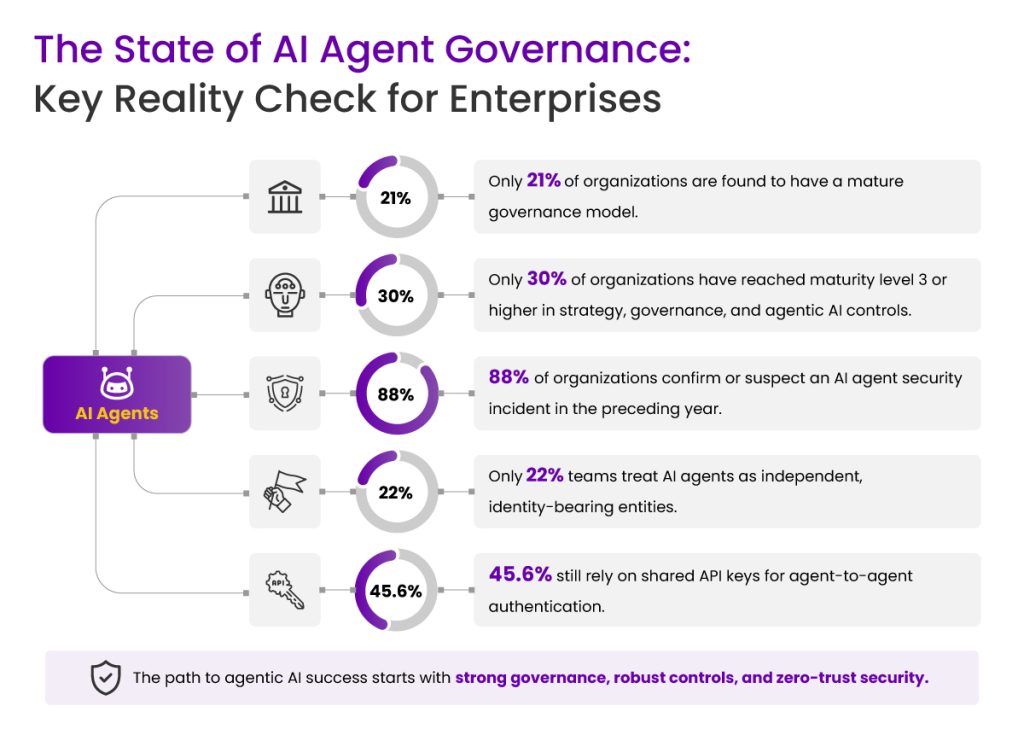
The state of AI Agent Governance
Why AI Agent Governance Is Fundamentally Different
Traditionally, AI agent governance was designed for human consumption, where humans make the final call. That assumption is now obsolete. Autonomous AI agents sift thought millions of databases daily and make independent decisions and orchestrate multi-step workflows at a scale and speeds that is impossible for humans to match.
Thus, the governance frameworks that enterprises have created over the decade have become moot and irrelevant. In the current scenario, the challenge is to design a framework that combines a scalable automated monitoring system with a human review system for judgement and accountability without creating bottlenecks.
Three core dimensions make AI agent governance in enterprises uniquely complex:
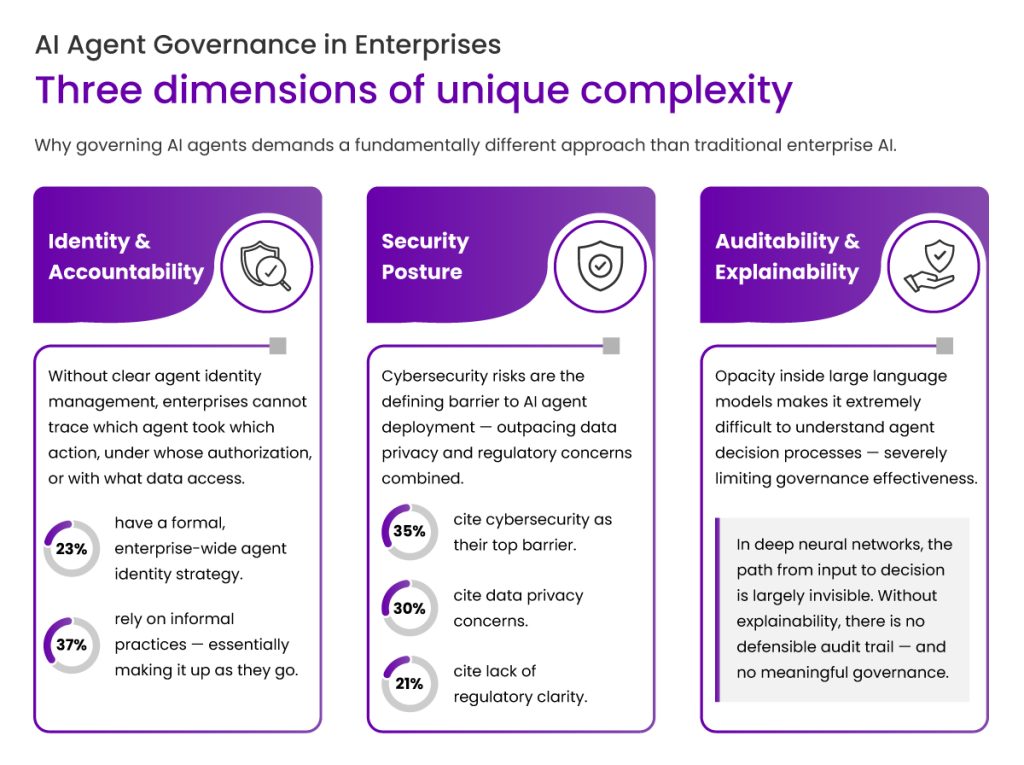
AI Agent Governance in Enterprises
The Regulatory Tide Is Coming In
With the enforcement of EU AI act in August 2024, Enterprise AI governance is no longer just a best practice add-on, but a compliance imperative. While a provisional political agreement in May 2026 extended certain high-risk deadlines, organizations that build durable AI governance capabilities now will be better positioned as regulatory requirements expand across jurisdictions.
The penalty structure for the AI act is €35 million or 7% of global turnover, which is nearly double of GDPR’s ceiling. A recent EY global survey highlights that C-suite leaders are more focused on regulatory non-compliance as the top AI risk. It is projected that by 2030, spending on AI data governance may surpass $1bn with a CAGR of about 28%. The numbers say a clear story that those who govern effectively will gain competitive advantage through industrial trust.
The AI Compliance Framework Enterprise Leaders Need
Leading organizations are moving towards a concept called “Governance by design” to embed control, audit trails and accountability mechanism directly into AI system architecture before deployment. This AI Compliance framework is composed of three structural components:
- A Live AI Inventory – It is mandatory to have a systematic, up-to-date record of every AI system in production or development, classified by risk level to ensure accurate risk classification and compliance planning.
- Runtime Governance Controls – Inspecting operational controls at the point of AI execution is also imperative. Maintaining a detailed catalog of compliance matrix mapping to EU Act, NIST, RMF and ISO/IEC 42001 clauses along with a risk register to identify owners, mitigations and evidence of risk such as data leakage or unauthorized actions will be the best course of action.
- Human-in-the-loop design for consequential decisions – Enterprises also need to introduce features for approvals and review controls to monitor high-risk environments which will help them gain trust and value over unregulated enterprises.
How Aspire Systems Helps Enterprises Close the Governance Gap
Aspire System’s Data & AI Solutions is devoted to helping enterprises not just adopt AI but scale it seamlessly. Our AI governance frameworks translate regulatory complexity into operational clarity with ease.
At the foundation layer, Aspire System implements robust data governance architectures using platforms such as Databricks Unity Catalog to ensure full data lineage tracking, access control, and audit trail generation across all AI workflows. This directly addresses the AI-ready data infrastructure that Gartner identifies as foundational to avoid project failure.
At the agent architecture layer, Aspire System designs multi-agent systems with identity-bearing agent frameworks, role-based permissions, and runtime policy enforcement. Solutions such as FinEdgAI and Lakebridge embed governance controls into agent orchestration, enabling enterprises to scale autonomous AI capabilities without sacrificing accountability. This directly addresses the 45.6% of enterprises still relying on insecure shared API keys.
At the compliance and strategy layer, Aspire offers AI governance consulting that aligns enterprise AI portfolios with the EU AI Act, NIST AI RMF, and ISO/IEC 42001, which helping clients classify AI systems, build conformity documentation, and establish cross-functional AI governance committees with clear executive ownership.
For clients in BFS and Insurance, where AI agents make credit decisions, underwriting assessments, and fraud determinations, Aspire’s AI security and governance frameworks integrate compliance checkpoints directly into agent workflows — ensuring every consequential AI decision carries a traceable audit trail that satisfies both internal audit requirements and external regulatory scrutiny.
From Governance Burden to Competitive Advantage
The enterprises with a robust AI governance will outshine their counterparts in the AI race in the next three years. They will earn customer trust more naturally, which will help them engage more deeply and safely with AI-powered products. Regulators extend greater operational latitude to organizations that demonstrate proactive compliance.
IDC projects AI investment will grow 31.9% year-over-year between 2025 and 2029, reaching $1.3 trillion by 2029. The enterprises that position governance as a strategic capability will not need to pay a compliance tax and will capture a disproportionate share of that value. Aspire Systems is helping those enterprises get there: building the governance infrastructure that makes AI agents trustworthy, scalable, and defensible in any regulatory environment.
The governance gap is real. So is the opportunity to close it.

- Agent Cost Economics: What AI Agents really Cost At Scale - August 21, 2026
- Data Poisoning: The Attack That Targets the Model, Not the Network - July 31, 2026
- Guardian Agents: Why Every AI Agent Now Needs a Watcher - July 31, 2026
 Write to Us