
For decades the digital economy has been monopolizing and thriving on a single strategy – Attention. It was a measure of success to see how long a particular brand could grab the human eye. Marketing teams build elaborate funnels, identified patterns to prevent cart abandonment and went to the extreme of hyper-drugging the UIs to trigger dopamine hits ultimately trying to remain in the spotlight with the click of a button.
However, 2026 has announced a death knell to this era. With the emergence of Agentic AI commerce, the focus has shifted from attention to intention. It is an ideal world where consumers no longer shop; they communicate their intent to autonomous AI powered commerce agents that discover, negotiate and transact on their behalf.
1. The Anatomy of a Zero-Click Transaction
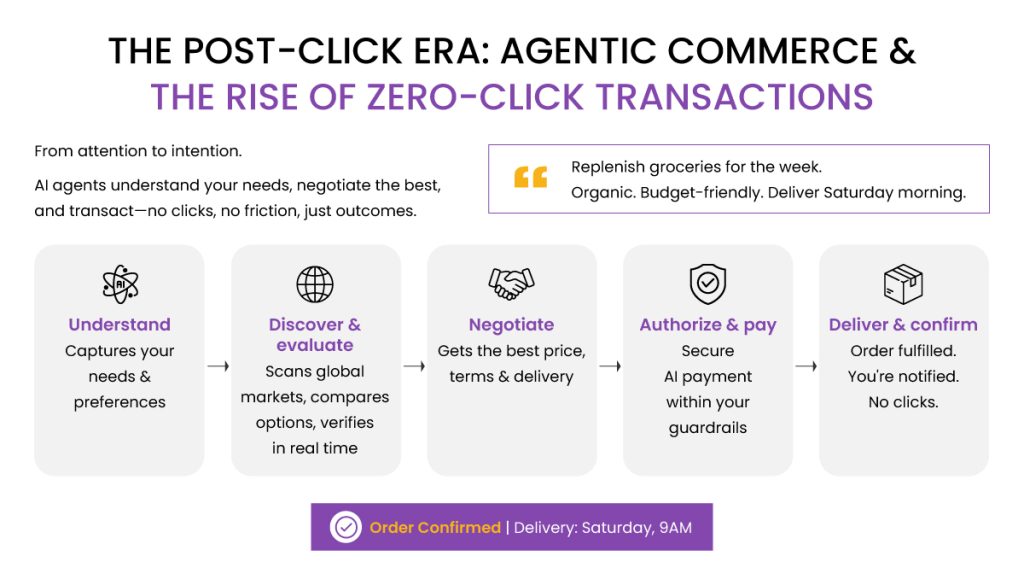
A Zero-Click Transaction is the logical conclusion to the Agentic AI commerce shift. It is a purchase made by an AI agent in e-commerce where it identifies the needs of the customer, scans the global market for the perfect match, and executes the payment via an Agentic AI Payment solution within pre-set user guardrails.
- Diminishing the cognitive overload: Research has it that an average human makes about 35,000 decisions in a day. In a world with infinite SKU proliferation, choice is often a burden. Zero-click commerce offers an easy way out, by providing you with the luxury of removing the load of grocery replenishment or utility optimization. This removes mental stress over the mundane, giving us more bandwidth for higher-level creative tasks.
- Manipulation Immunity: Agentic AI commerce solutions are immune to manipulative marketing and hence do not fall for the usual “Limited Time Offer” banners. They scan JSON-LD and Schema.org for the hard truth and verify the cost, footprints and real-time stock availability before making purchases.
- Hyper-personalization via Zero-Party Data: AI agents in e-commerce are definitive, thus do not follow the current marketing algorithms. Through Zero-party data these agents know our exact constraints and preferences (like type of material, delivery day and time and so on) unlike the common retail algorithms.
2. Collapsing the Funnel: The Strategic Solution
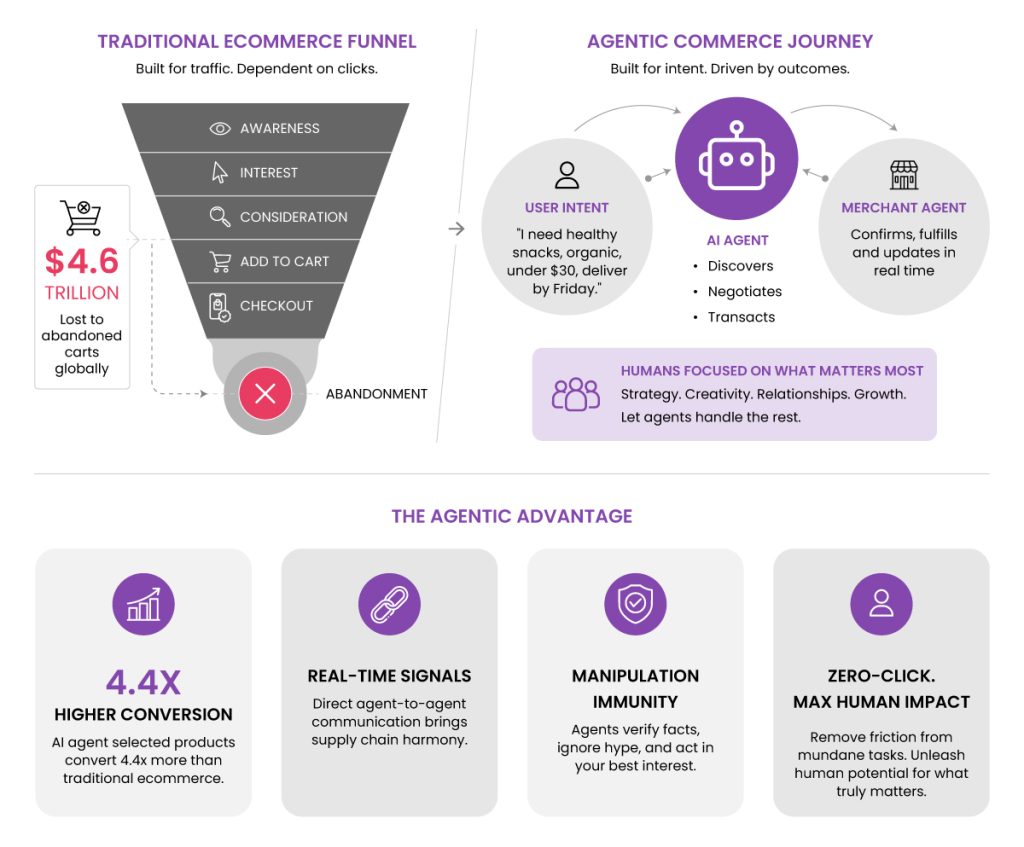
Traditional ecommerce funnels are designed to generate traffic, whereas Agentic AI commerce is designed to focus only on customers’ needs and wants.
- Solving the $4.6 Trillion Abandoned Cart Crisis: In the past, the “cart” played a pivotal role in the ecommerce business. Agentic AI commerce is all set to disrupt this trend as it is designed to narrow down on the customer intent.
- Supply Chain Harmony: The greatest amenity of Agentic AI commerce is the direct communication of merchant agents with consumer agents. This replaces the chaos of predictive analytics with the calm of actual intent. This also benefits retailers as they receive real time signals about inventory as soon as a request is raised by consumer agents.
3. The Mid-Tier Mandate: Adopting Without Big-Tech Budgets
Disintermediation by retail giants like Amazon is one of the biggest challenges small or mid-tier labels face. However, the advent of Universal Commerce Protocol (UCP) and Model Context Protocol (MCP) has leveled the playing field.
- Step #1:
Agent Legibility (AEO over SEO):
The SEO monopoly era is at an end. Today if you want to catch the attention of an agent that holds the purse strings, it is imperative that you pivot to AEO (Agent Engine Optimization). AEO makes product attributes machine-readable and thereby easier to be picked by consumer agents.
- Step #2:
Implement Agentic Adapters:
Building agentic layers on top of your existing ERP or CRM is the ideal strategy for mid-tier organizations. This translates legacy data into high-speed API endpoints that AI agents can process quicker than half a second.
- Step #3:
Small-Scale Sovereignty:
Embracing Small Language Models (SLMs) for specific workflows is faster, cheaper and provides higher ROI that general LLMs that extract higher subscription costs.
4. Realizing Value: Velocity Over Traffic
In the current era, the ritual of measuring traffic has become obsolete. In today’s era of Agentic AI Commerce, it is more prudent to measure “Win Rates”.
- A study shows that there is a 4.4x increased chances of conversion when an AI agent selects a product. This is mainly because it is intent based and cancels the noise of prediction.
- Automating mundane transactions is the ideal way to divert your human resources to emancipation. This allows them to focus on brand storytelling from an emotional angle which an agent can never replicate.
Aspire Systems: Your Partner in the Agentic Frontier
At Aspire Systems, we build Orchestration Ecosystems, anchored by our flagship innovation, Tanya.
How is Tanya different from other chatbots?
While traditional chatbots are reactive and instruction-based, Tanya is proactive and goal-oriented. It can recognize delays in shipment and find alternative shipping routes; it can negotiate a price difference with the provider and update the customer, before the customer even asks for the solution.
How can Tanya give me a better ROI?
Tanya can complete an entire month’s invoice processing and procurement adjustment in just a few minutes, increasing the decision velocity which directly co-relates to ROI and resource efficiency.
How do we ensure Tanya does not hallucinate? How can we trust an Agentic AI commerce agent not to destroy our brand reputation?
Tanya operates on RAG (Retrieval Augmented Generation) framework, which means they take information only from your organization’s specific core data, compliance rules and customer history.
How do we ensure Tanya is safe and secure?
Tanya works on the principles of Aspire System’s Agentic AppHost & TRiSM. Our TypeScript-native AppHost integrates natively with UCP and MCP standards. This is wrapped in a rigorous AI TRiSM layer, ensuring every autonomous transaction is secure and fraud-proof.
The Bottom Line:
The transition from a retail chatbot to a Zero-click economy goes beyond a technical upgrade. Yes, it helps customers reduce stress over mundane activities like grocery shopping, but it also makes room for humans to do what they do best, such as strategic planning, brand building, and storytelling. In 2026, the script is clear, there are organizations that prompt, and then there are organizations that perform. Which bucket would you like to fall in?

- Agent Cost Economics: What AI Agents really Cost At Scale - August 21, 2026
- Data Poisoning: The Attack That Targets the Model, Not the Network - July 31, 2026
- Guardian Agents: Why Every AI Agent Now Needs a Watcher - July 31, 2026
 Write to Us