
In the current enterprise landscape, integration has evolved from a “back-office necessity” to a “front-line competitive advantage.” Yet, many organizations remain tethered to legacy middleware—heavyweight, on-premises Enterprise Service Buses (ESBs) or rigid point-to-point systems that were designed for a world that no longer exists. For CIOs and integration leaders, the challenge is clear: legacy ESBs and point-to-point integrations are slowing cloud adoption, increasing costs, and limiting AI readiness.
In 2026, enterprises need integration platforms that align with cloud, SaaS, and AI-driven architectures. Here are five critical reasons why modernizing with Boomi is the most strategic move your IT organization can make this year.
AI-Driven “Agentic” Productivity
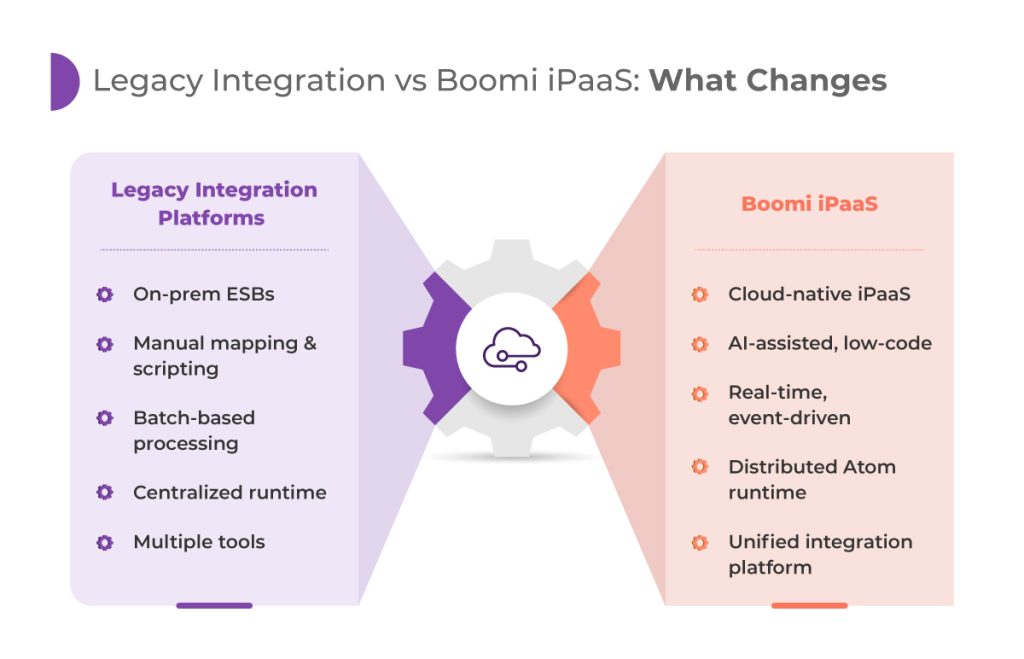
Agentic integration refers to AI systems that can design, recommend, and optimize integrations with minimal human intervention. The most significant differentiator in 2026 is the transition from manual configuration to AI-driven orchestration. Legacy platforms require developers to hand-code every logic branch.
The Boomi Advantage: With Boomi AI, your team can leverage Design Gen to build integrations using natural language. Instead of spending weeks on field-to-field mapping, Boomi AI utilizes billions of anonymized mapping patterns to suggest and automate the “heavy lifting.” This “Agentic” approach allows your developers to focus on high-level business architecture rather than the minutiae of data syntax.
Radical Reduction in Total Cost of Ownership (TCO)
Maintaining legacy integration infrastructure is a drain on both capital and human resources. Between hardware costs, licensing renewals, and the “specialist tax” (the high cost of finding experts in aging technologies), the TCO of legacy systems is often 30–50% higher than a modern iPaaS.
The Boomi Advantage: Boomi’s cloud-native, multi-tenant architecture eliminates the need for patching, server maintenance, and manual upgrades. Its consumption-based pricing and low-code interface democratize integration, allowing “citizen integrators” to handle routine tasks, thereby freeing your high-cost engineers for complex innovation projects.
Distributed Runtime Flexibility (The Boomi Atom)
Legacy platforms often force a “hub-and-spoke” model where all data must travel back to a central server, creating latency and security risks.
The Boomi Advantage: Boomi’s patented Atom technology allows you to deploy integration runtimes anywhere—in the Boomi cloud, in your private cloud (AWS, Azure, GCP), or behind your firewall. This “run anywhere” capability ensures you can keep data local for regulatory and compliance requirements such as GDPR, HIPAA, and data residency mandates.
Moving from Batch to Real-Time Event Streams
The “overnight batch job” is a relic of the past. In 2026, business happens in the now. Legacy systems often struggle to handle the high-velocity, event-driven requirements of modern e-commerce, supply chain, and IoT ecosystems.
The Boomi Advantage: Boomi is built for Event-Driven Architecture (EDA). Whether you are integrating via Webhooks, Kafka, or RabbitMQ, Boomi ensures that data flows in real-time. This allows your business to respond to a customer action or a supply chain disruption the second it happens, not eight hours later when the batch job finally runs.
A Unified Platform for the Full Data Lifecycle
One of the biggest frustrations with legacy environments is “tool sprawl” using one tool for EDI, another for API Management, and a third for Master Data Management (MDM).
The Boomi Advantage: Boomi provides a single “pane of glass” for your entire digital ecosystem:
- Integration: Connect any app, anywhere.
- API Management: Design, secure, and scale your own APIs.
- Master Data Hub: Ensure a “single version of truth” across all systems.
- Flow: Automate human-in-the-loop workflows and approvals.
- B2B/EDI: Modernize partner communications without the manual overhead.
By consolidating these capabilities, enterprises reduce integration complexity, improve governance, and accelerate digital transformation initiatives.
Conclusion: Future-Proofing Your Enterprise
Legacy integration platforms are not just “old software”—they are barriers to entry for new technologies like AI and real-time analytics. By migrating to Boomi, you aren’t just moving to the cloud; you are building a resilient, self-healing, and infinitely scalable foundation for the future.
The question is no longer if you should modernize your integration platform but how quickly you can begin your Boomi migration journey.
FAQ’s
1: What is a legacy integration platform?
Legacy integration platforms are typically on-prem ESBs or point-to-point systems that lack cloud scalability, real-time processing, and AI support.
2: Why should enterprises migrate from ESBs to Boomi?
Boomi offers a cloud-native iPaaS with lower TCO, faster development, AI-driven automation, and support for real-time, event-driven integrations.
3: How does Boomi support hybrid and multi-cloud environments?
Boomi’s Atom runtime can be deployed in the cloud, on-premises, or at the edge, ensuring flexibility, low latency, and compliance.
4: Is Boomi suitable for real-time and event-driven integrations?
Yes, Boomi natively supports webhooks, messaging platforms, and event streams to enable real-time, event-driven architectures.
5: Can Boomi replace multiple integration tools?
Yes, Boomi unifies integration, API management, master data management, workflow automation, and B2B/EDI on a single platform.
Related Blogs:
From Data to Insight: How Boomi and AI are reshaping the high-tech industries?
Boomi: Championing Faster Integration with the Power of Low-Code
Optimizing Integration Processes through Boomi’s AI-Enhanced API Management

- The hidden trade-offs of maintaining a working Legacy Integration environment - July 16, 2026
- From Legacy ESBs to Boomi iPaaS: 5 Integration Shifts Enterprises Are Making - February 19, 2026
- Code vs Low-Code: Unpacking the Differences for Developers Migrating from Traditional ETL tools to Boomi - January 6, 2026
 Write to Us